
- PRICING
- LIVE QUOTES
- LEARN
- HELP


EN
Worry-free liquidity? The Federal Reserve then pressed the “pause button”, and reserve management debt purchases stopped until mid-October
The Zhitong Finance App learned that the Federal Reserve said on Monday that it will not carry out short-term treasury bond purchases for reserve management purposes in the next phase for the second month in a row, which shows that policymakers are satisfied with the level of bank reserves in the financial system.
Although the New York Federal Reserve's open market operations department does not plan to make reserve management debt purchases during the monthly period ending October 14, according to information on its website, the operating department still plans to reinvest about 15.6 billion US dollars in debt purchases during this period.
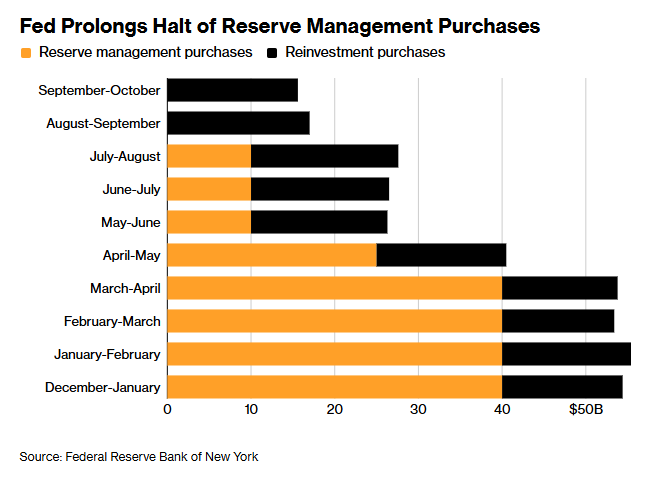
This suspension shows that the Federal Reserve has confidence in the smooth operation of the financing market. This has been confirmed: for most of the past month, the interest rate on secured overnight financing (interest rate based on the cost of borrowing on treasury bonds) remained at or below the reserve balance interest rate (IORB); at the same time, the US Treasury cut the supply of treasury notes before the quarterly tax deadline. But this change does not mean any shift in monetary policy or balance-sheet strategy.
Wall Street strategists at Wells Fargo and Bank of America previously predicted that this month's reserve management debt purchases would be suspended and resumed in mid-October because they expected that when the Treasury increases treasury note issuance efforts next month, there will be partial pressure on the financing market. Barclays strategist Samuel Earl predicts that the volume of debt purchases will rise back to 10 billion US dollars in October and 20 billion US dollars in November.
However, Citigroup strategists believe that the Federal Reserve will remain suspended for the rest of the year because bank reserve balances have been pushed back to a “mildly abundant” state.
As of September 9, the size of bank reserves was 3.04 trillion US dollars, up from 2.85 trillion US dollars at the end of last year, and higher than the average value of 3.01 trillion US dollars so far this year.
According to information, the Federal Reserve abruptly stopped the downsizing process at the end of 2025 — the so-called quantitative austerity (QT) — and switched to reinjecting reserves into the financial system by purchasing short-term treasury bonds due within one year.
The Federal Reserve's policy shift
In December of last year, the Federal Reserve began buying about 40 billion US dollars of short-term treasury bonds every month to ease the accumulated pressure on short-term interest rates. At the time, then-Chairman Jerome Powell said that the Federal Reserve was taking “pre-emptive” debt purchases to ensure that the market had sufficient reserves during the April tax season.
In April of this year, the Federal Reserve drastically lowered the reserve management debt purchase scale to 25 billion US dollars. Earlier, policy officials said that considering uncertainty and various factors, the decline in the scale of debt purchases may be “relatively flat,” but this decline has exceeded market expectations. In May, the scale of debt purchases plummeted further to 10 billion US dollars, which once again surprised the market; by August, the Federal Reserve directly suspended this operation.
In June, the Federal Open Market Committee (FOMC) revised its policy implementation statement, clearly stating that if the money market environment requires it, reserve management debt purchases can be temporarily suspended, reflecting that the Federal Reserve has flexible space to set the scale of subsequent debt purchases.
Roberto Pelley of the New York Federal Reserve reiterated in July that reserve management debt purchases are not carried out according to a predetermined path. The operating department can raise or lower the size of debt purchases in any given month according to money market conditions, and will continue to determine the amount of debt purchases with the goal of keeping reserves within an adequate range.
In the past month, the market's cash supply far surpassed collateral, and the overall financing environment was relaxed: banks continued to invest in the short-term market, and the size of money market fund assets reached a record high. This helps maintain interest rates in the money market at an anchor level even when the Ministry of Finance issues a large number of treasury notes to the market.