
- PRICING
- LIVE QUOTES
- LEARN
- HELP


EN
Is PPG Industries Stock Underperforming the Dow?
PPG Industries, Inc. (PPG), headquartered in Pittsburgh, Pennsylvania, manufactures and distributes paints, coatings, and specialty materials. Valued at $23.4 billion by market cap, the company makes protective and decorative coatings, flat glass, fabricated glass products, continuous-strand fiber glass products, and industrial and specialty chemicals.
Companies worth $10 billion or more are generally described as “large-cap stocks,” and PPG perfectly fits that description, with its market cap exceeding this mark, underscoring its size, influence, and dominance within the specialty chemicals industry. PPG’s global footprint spans 70+ countries, serving industrial, automotive, aerospace, and construction markets. This diversification cushions regional downturns and helped the company stay competitive despite foreign currency headwinds.
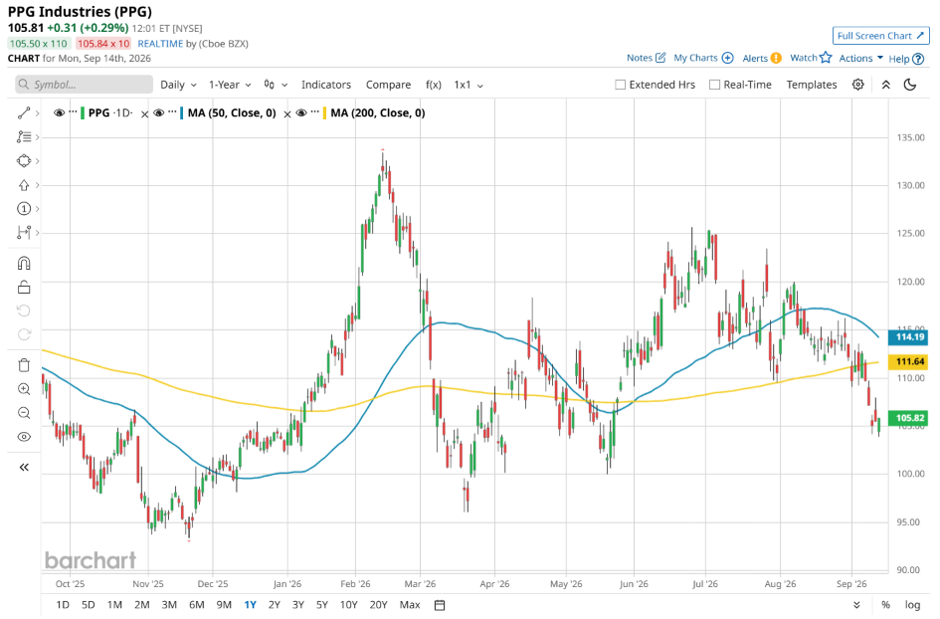
Despite its notable strength, PPG slipped 21.2% from its 52-week high of $133.43, achieved on Feb. 12. Over the past three months, PPG stock has declined 12.4%, underperforming the Dow Jones Industrials Average’s ($DOWI) 2.2% gains during the same time frame.
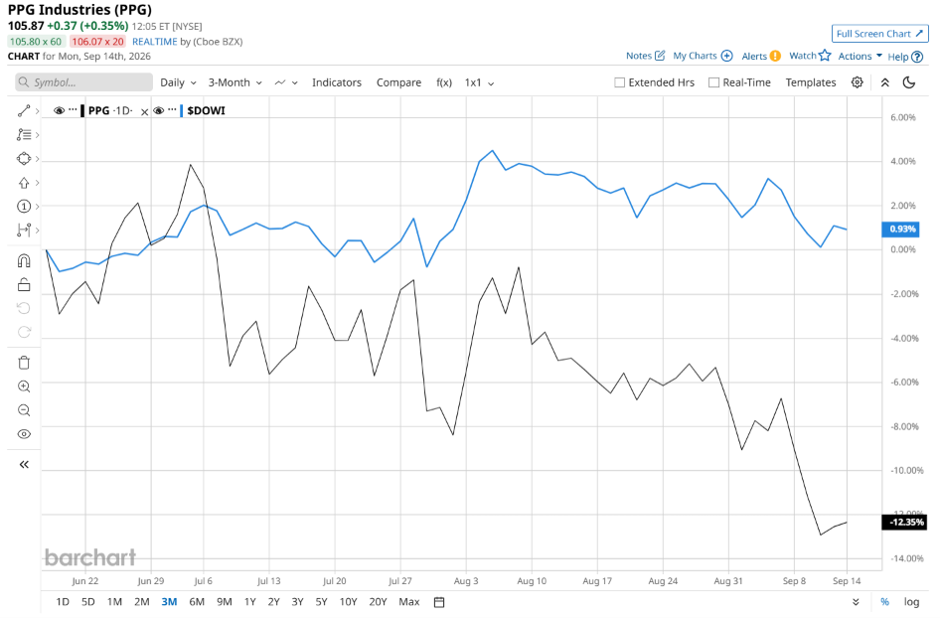
Shares of PPG have rose 2.1% on a YTD basis but dipped 5.6% over the past 52 weeks, underperforming DOWI’s YTD gains of 8.9% and 14.2% returns over the same time frame.
To confirm the bearish trend, PPG has been trading below its 50-day moving average since early August. The stock has been trading below its 200-day moving average since early September, with minor fluctuations.
PPG has underperformed due to persistent volume declines across key end-markets such as commercial construction and general manufacturing alongside specific segment drag within its automotive refinish coatings division, where lower body shop demand and shifting customer ordering patterns squeezed margins. Compounding these volume headwinds, input cost inflation across raw materials, energy, and logistics continuously challenged profitability, leading to mixed quarterly earnings execution. Additionally, sluggish economic recovery in European and Asian architectural coatings markets combined with investor caution over future margin expansion timing has weighed heavily on market sentiment, offsetting strength in high-margin segments like aerospace.
On Jul. 28, PPG reported its Q2 results, and its shares closed down more than 6% in the following trading session. Its adjusted EPS of $2.23 did not meet Wall Street expectations of $2.26. The company’s revenue was $4.5 billion, topping Wall Street forecasts of $4.4 billion. PPG expects full-year adjusted EPS in the range of $7.70 to $8.10.
In the competitive arena of specialty chemicals, The Sherwin-Williams Company (SHW) has lagged behind PPG, with a marginal downtick on a YTD basis and 10.7% losses over the past 52 weeks.
Wall Street analysts are reasonably bullish on PPG’s prospects. The stock has a consensus “Moderate Buy” rating from the 24 analysts covering it, and the mean price target of $126.28 suggests a potential upside of 20.1% from current price levels.
On the date of publication, Neha Panjwani did not have (either directly or indirectly) positions in any of the securities mentioned in this article. All information and data in this article is solely for informational purposes. For more information please view the Barchart Disclosure Policy here.