
- PRICING
- LIVE QUOTES
- LEARN
- HELP


EN
Piezo Direct Announces the World's Most Advanced Mesh-Based Piezo Atomizer for Nebulizing and Vaping Applications
Safety-driven design eliminates laser-drilling debris and holds hole diameter at 2.0 microns
BURLINGAME, Calif., Sept. 14, 2026 /PRNewswire/ -- Piezo Direct today announced the most advanced mesh-based piezo atomizer in the world, engineered specifically for nebulizing and vaping applications. The product combines laser-drilled holes as small as 2.0 microns with a proprietary process that strips away the metal debris laser drilling leaves behind — a combination that makes it best in class for particulate cleanliness in applications where a person inhales the mist.
Vibrating mesh atomizers turn liquid into an inhalable mist. They sit at the center of nebulizers, inhalers, and vaping devices, and they are the one component the mist passes through on its way to the user. Piezo Direct built its manufacturing platform around that fact.
"Safety is our number one priority when it comes to designing mesh-based piezo atomizers for human inhalation applications. Piezo Direct has made a significant investment in both the design and the manufacturing of these atomizers to make sure our products are the safest available."
— Li Hsu, CEO, Piezo Direct
Eliminating the volcano
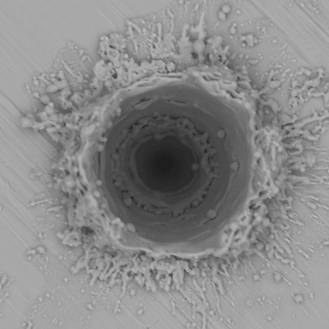
Micro-holes are drilled with a laser, and the laser makes them by melting metal. Whatever molten material is not ejected freezes at the rim as a raised lip, or lands nearby as micron and sub-micron spatter. Piezo Direct engineers call the result the volcano. Under an optical microscope it is invisible. Under an electron microscope it is unmistakable.
The problem is that it does not stay put. High-frequency vibration and hydrodynamic shear can shake particles loose, and there is no way to predict which particle will release or when. Whatever releases travels with the mist toward the user's airway. The same debris also chokes flow and erodes over time until droplet size drifts out of specification.
Conventional mesh plate manufacturing leaves the volcano in place. Industry practice treats it as an unavoidable byproduct of laser drilling and manages it downstream through inspection and cleaning steps. Piezo Direct takes it off — which is what puts its atomizers best in class among mesh plates built for human inhalation.
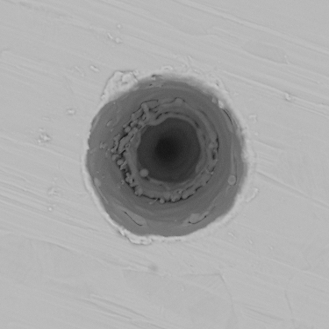
The company developed a post-process that removes the recast lip and surrounding spatter without touching hole geometry or damaging the base material. After treatment, no molten residual particles are visible under scanning electron microscopy. Addressing the debris at the point of manufacture is more effective than screening for it later, because sub-micron particulate on a finished plate is not something a device assembler can reliably catch.
"When the laser drills the hole, it leaves a volcano of resolidified metal around the rim. We cannot predict whether a piece will break loose, or when, or which piece. If one ever does and it reaches a lung, that is a disaster. We spent years and a great deal of money making that volcano go away."
— Li Hsu, CEO, Piezo Direct
Holding the hole at 2.0 microns
Hole size decides droplet size. The median droplet measures roughly 1.5 to 2.0 times the hole's exit diameter, and only droplets between 1 and 5 microns reliably reach the lower respiratory tract. Anything larger lands in the mouth and throat.
That puts the target between 2.0 and 2.5 microns — below the point where conventional laser drilling stops being repeatable. Diffraction limits the focus, thermal diffusion widens the hole, and molten material stops escaping the channel, producing blind pores and inconsistent taper angles. Piezo Direct holds 2.0 to 2.5 microns at ±0.3 microns, delivering a Mass Median Aerodynamic Diameter of 3.0 to 4.2 microns.
Titanium at production volume
The mesh is titanium. It resists aggressive drug formulations, hypertonic saline, and hydrogen peroxide vapor sterilization, and it survives continuous flexure above 100 kHz. It is also hard to drill: a 1,668 °C melting point, low thermal conductivity, and high reactivity when hot leave only a narrow processing window.
Capability at a glance
Minimum through-hole diameter |
2.0 microns |
Production hole range |
2.0 – 2.5 microns |
Diameter tolerance |
± 0.3 microns |
Resulting aerosol MMAD |
3.0 – 4.2 microns |
Substrate |
Titanium (also available in stainless steel) |
Post-process |
Recast layer and spatter removal, SEM verified |
Typical drive frequency |
100 – 180 kHz |
Availability
The atomizers are available now for nebulizers, inhalers, and vaping devices, and support portable personal care atomizers and industrial applications including semiconductor humidification, precision coating, and aroma diffusion. Device engineering teams can request samples or discuss a custom mesh specification at piezodirect.com, where a technical white paper covering the process in detail is also available.
Piezo Direct's next-generation work targets sub-1.5-micron holes, thin-film titanium alloys, and 100 percent inline optical inspection of every hole on every plate.
About Piezo Direct
Piezo Direct designs and manufactures piezoelectric components and assemblies, including vibrating mesh atomizers and piezo atomizer modules, for medical devices, consumers, and industrial customers. Learn more at piezodirect.com.
Media Contact
John Klipp
Marketing Manager, Piezo Direct
John.klipp@piezodirect.com

 View original content to download multimedia:https://www.prnewswire.com/news-releases/piezo-direct-announces-the-worlds-most-advanced-mesh-based-piezo-atomizer-for-nebulizing-and-vaping-applications-302876795.html
SOURCE Piezo Direct
