
- PRICING
- LIVE QUOTES
- LEARN
- HELP


EN
A $90 Billion Reason to Buy Oracle Stock Now
Oracle Corporation (ORCL) is riding a powerful wave of enterprise artificial intelligence (AI) spending as demand for its cloud computing services continues to accelerate. The company’s push to expand its data center footprint is also strengthening its ability to win major enterprise contracts.
That momentum was on full display last week when Oracle released its Q1 FY2027 earnings report. The results arrived at a time when shares across the AI sector had been experiencing considerable volatility. Nevertheless, the database giant delivered a quarter that surpassed expectations on both the top and bottom lines. The company also raised its full-year adjusted earnings guidance.
More importantly, Oracle expects to generate at least $90 billion in revenue in FY2027. That forecast is comfortably above the roughly $86.6 billion analysts had previously expected and represents approximately 34% growth from the company’s FY2026 revenue of $67.4 billion.
Analysts responded positively to the results, with Citigroup noting that Oracle’s Q1 performance strengthened the bullish case heading into its Investor Day. However, the more important question, of course, is whether Oracle’s latest numbers provide investors with enough reason to jump on the stock.
About Oracle Stock
Based in Austin, Texas, Oracle Corporation is a global technology company that provides cloud, software, hardware, and IT services. With a market cap of nearly $432.9 billion, the company offers a broad portfolio spanning enterprise applications, databases, cloud infrastructure, Java, AI, analytics, networking, storage, engineered systems, and consulting.
ORCL stock’s recent performance, however, has been anything but smooth. The shares have plummeted 51% over the last 52 weeks and are down 26% in 2026. The weakness has continued more recently, with ORCL stock falling 22% over the last three months.
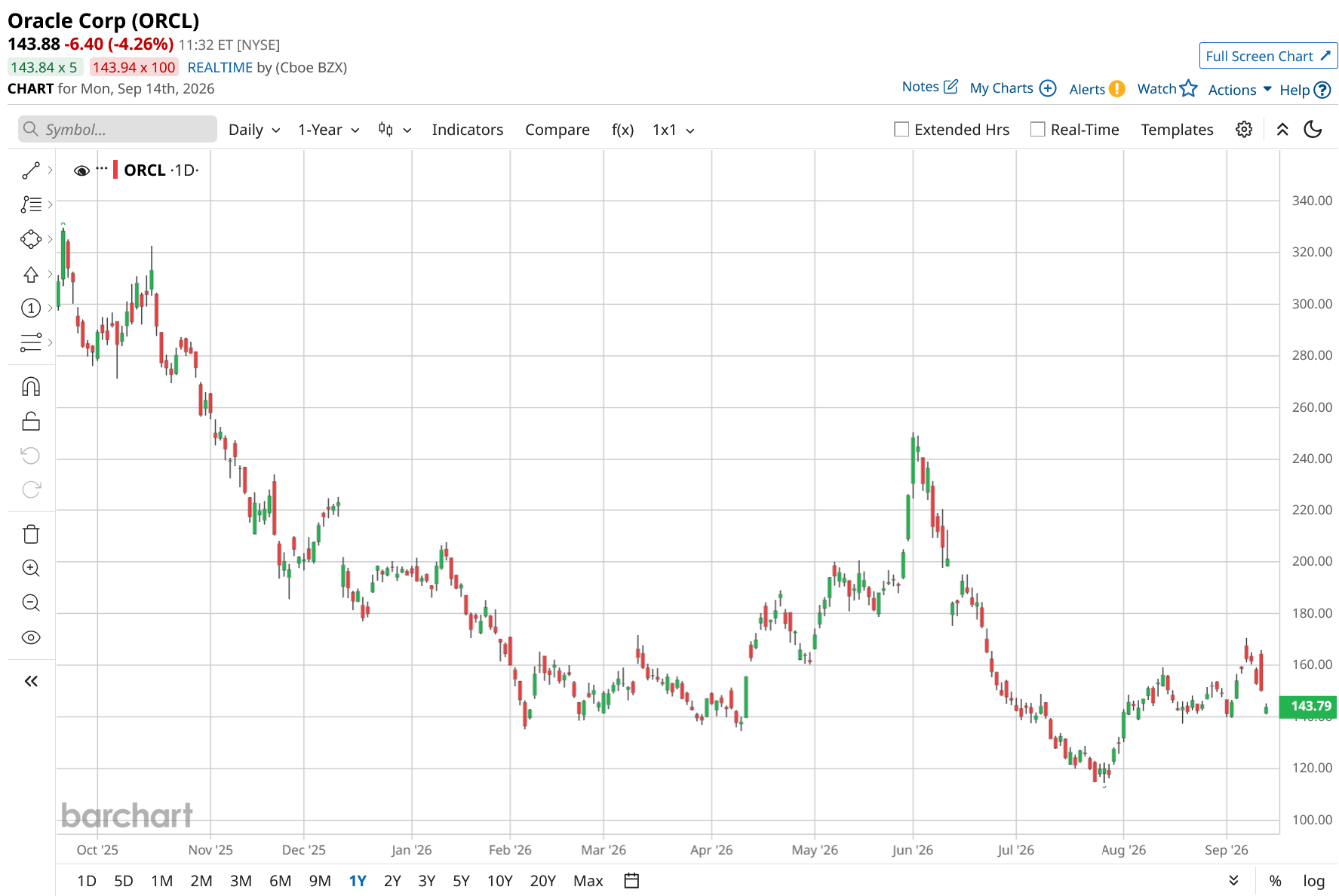
From a valuation perspective, Oracle's stock is trading at 18.46 times forward adjusted earnings. That multiple sits well below both the industry average and its own five-year historical multiple, pointing to a valuation discount that could offer an attractive entry point for long-term investors.
The company also has a respectable dividend track record. Oracle has increased its dividend for 11 consecutive years and currently maintains an annual payout of $2 per share, equivalent to a 1.33% dividend yield. The company is scheduled to pay its most recent dividend of $0.50 per share on Oct. 23 to shareholders of record as of Oct. 9.
Oracle Surpasses Q1 Earnings
On Sept. 10, Oracle reported its Q1 FY2027 earnings results, beating Wall Street expectations. Total revenue increased 29.6% year-over-year (YoY) to $19.35 billion, exceeding Street expectations of $19.14 billion. Adjusted EPS grew 30.6% from the year-ago value to $1.92, comfortably ahead of analyst estimates of $1.74.
A closer look at the cloud business reveals where much of Oracle’s momentum is coming from. Oracle Cloud Infrastructure (OCI) generated $7.4 billion in revenue during the quarter, an increase of 121% YoY. That marked the ninth consecutive quarter of accelerating cloud infrastructure growth.
Total cloud revenue climbed 61.5% to $11.6 billion, including both OCI and software-as-a-service (SaaS) applications. Another figure that stood out in Oracle’s quarterly results was remaining performance obligations (RPO), which surged to $664 billion.
Oracle also signed more than $30 billion in additional AI cloud contracts during the quarter. Following the end of its previous quarter, the company delivered more than 300,000 GPUs to AI cloud customers, nearly tripling the capacity delivered in Q4 FY26.
The company’s infrastructure expansion was equally substantial. Oracle brought an additional 850 megawatts of data-center capacity online during the quarter. Capital spending surged to roughly $28.5 billion as the company invested heavily in expanding its infrastructure to keep pace with demand for AI computing.
Looking ahead, Oracle expects Q2 revenue to increase between 30% and 34%, while cloud revenue is projected to grow between 65% and 71%. Moreover, non-GAAP EPS is expected to come in between $1.85 and $1.93, representing growth of 21% to 25%. For the full fiscal year, Oracle now expects revenue of at least $90 billion, accompanied by a non-GAAP EPS of $8.10.
On the other hand, analysts expect Q2 FY2027 EPS to decline 21% YoY to $1.54. For full FY2027, they forecast bottom-line growth of 4.6% from the previous year to $6.60, while their FY2028 estimates call for 39.1% growth from last year to $9.18.
What Do Analysts Expect for ORCL Stock?
Oracle’s latest earnings report has prompted several analysts to revisit their views on the stock. Oppenheimer analyst Brian Schwartz has reiterated a “Buy” rating on ORCL stock while maintaining a $275 price target. Cantor Fitzgerald analyst Thomas Blakey also reiterated a “Buy” rating, with a $284 price target.
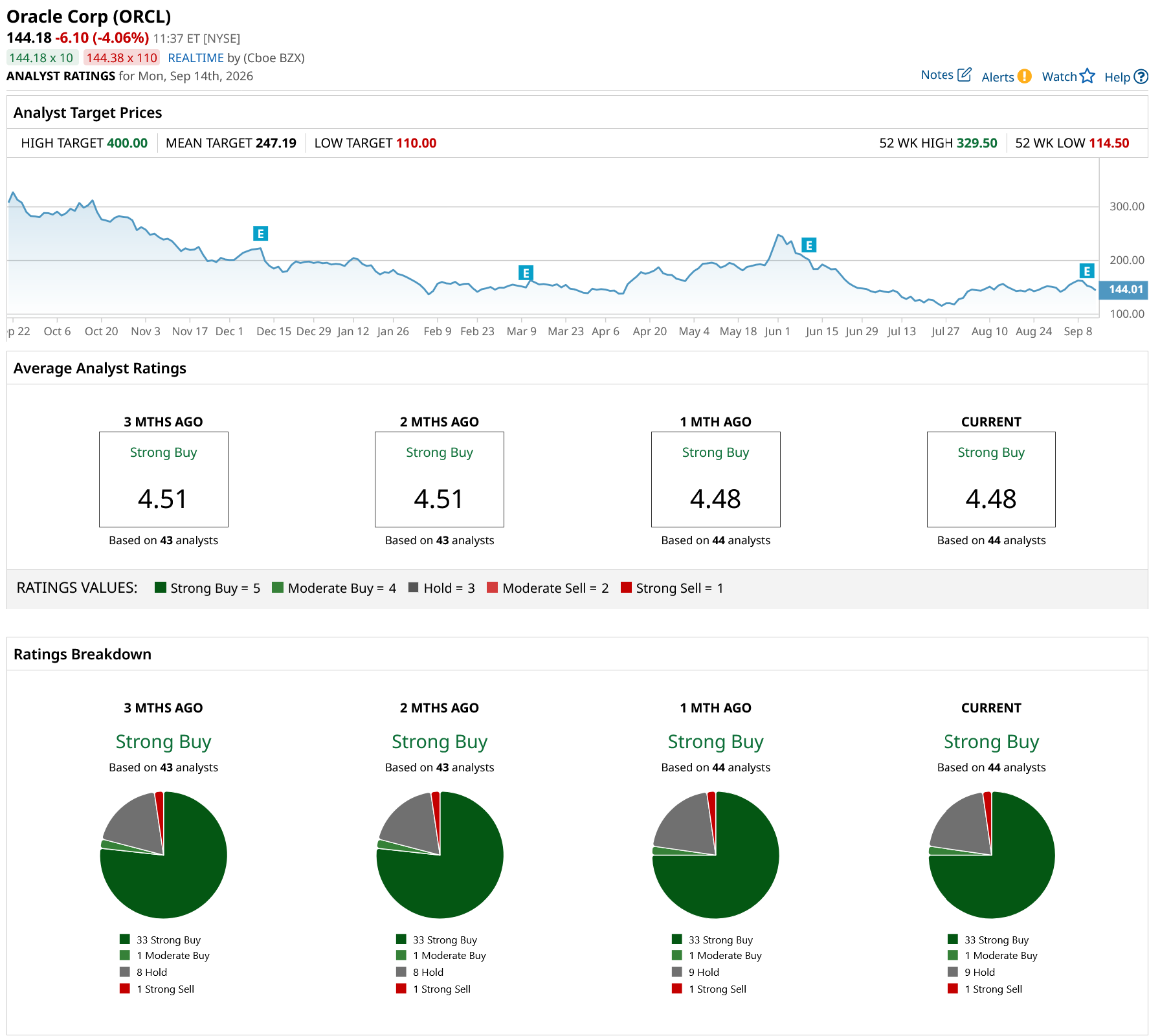
Wall Street’s overall assessment remains firmly bullish, with Oracle's stock receiving a “Strong Buy” rating. Of the 44 analysts covering its stock, 33 recommend “Strong Buy,” one recommends “Moderate Buy,” nine suggest “Hold,” and one flags a “Strong Sell.”
To that end, ORCL's average price target of $247.19 represents a potential upside of 72%. Meanwhile, the Street-High target of $400 suggests a gain of 178% from current levels.
On the date of publication, Aanchal Sugandh did not have (either directly or indirectly) positions in any of the securities mentioned in this article. All information and data in this article is solely for informational purposes. For more information please view the Barchart Disclosure Policy here.