
- PRICING
- LIVE QUOTES
- LEARN
- HELP


EN
Hain Celestial (NASDAQ:HAIN) Misses Q2 CY2026 Revenue Estimates, But Stock Soars 9%

Natural food company Hain Celestial (NASDAQ:HAIN) missed Wall Street’s revenue expectations in Q2 CY2026, with sales falling 27.6% year on year to $263.1 million. Its non-GAAP loss of $0.05 per share was $0.02 below analysts’ consensus estimates.
Is now the time to buy Hain Celestial? Find out by accessing our full research report, it’s free.
Hain Celestial (HAIN) Q2 CY2026 Highlights:
- Revenue: $263.1 million vs analyst estimates of $269 million (27.6% year-on-year decline, 2.2% miss)
- Adjusted EPS: -$0.05 vs analyst estimates of -$0.03 ($0.02 miss)
- Adjusted EBITDA: $18.74 million vs analyst estimates of $18.69 million (7.1% margin, in line)
- Operating Margin: -21.2%, down from 1.5% in the same quarter last year
- Free Cash Flow was $6.83 million, up from -$8.87 million in the same quarter last year
- Organic Revenue fell 2% year on year
- Market Capitalization: $55.9 million
“Fiscal 2026 was a pivotal year for Hain. We simplified our portfolio, reduced debt, significantly improved free cash flow and exited the year with improving momentum across the business. Our fourth quarter results reflected encouraging sequential improvement, including organic net sales growth in North America, gross margin and adjusted EBITDA margin expansion, and continued progress on productivity and cost discipline initiatives,” stated Alison Lewis, President and CEO.
Company Overview
Sold in over 75 countries around the world, Hain Celestial (NASDAQ:HAIN) is a natural and organic food company whose products range from snacks to teas to baby food.
Revenue Growth
A company’s long-term sales performance can indicate its overall quality. Any business can experience short-term success, but top-performing ones enjoy sustained growth for years.
With $1.35 billion in revenue over the past 12 months, Hain Celestial is a small consumer staples company, which sometimes brings disadvantages compared to larger competitors benefiting from economies of scale and negotiating leverage with retailers.
As you can see below, Hain Celestial struggled to generate demand over the last three years. Its sales dropped by 9% annually, a rough starting point for our analysis.
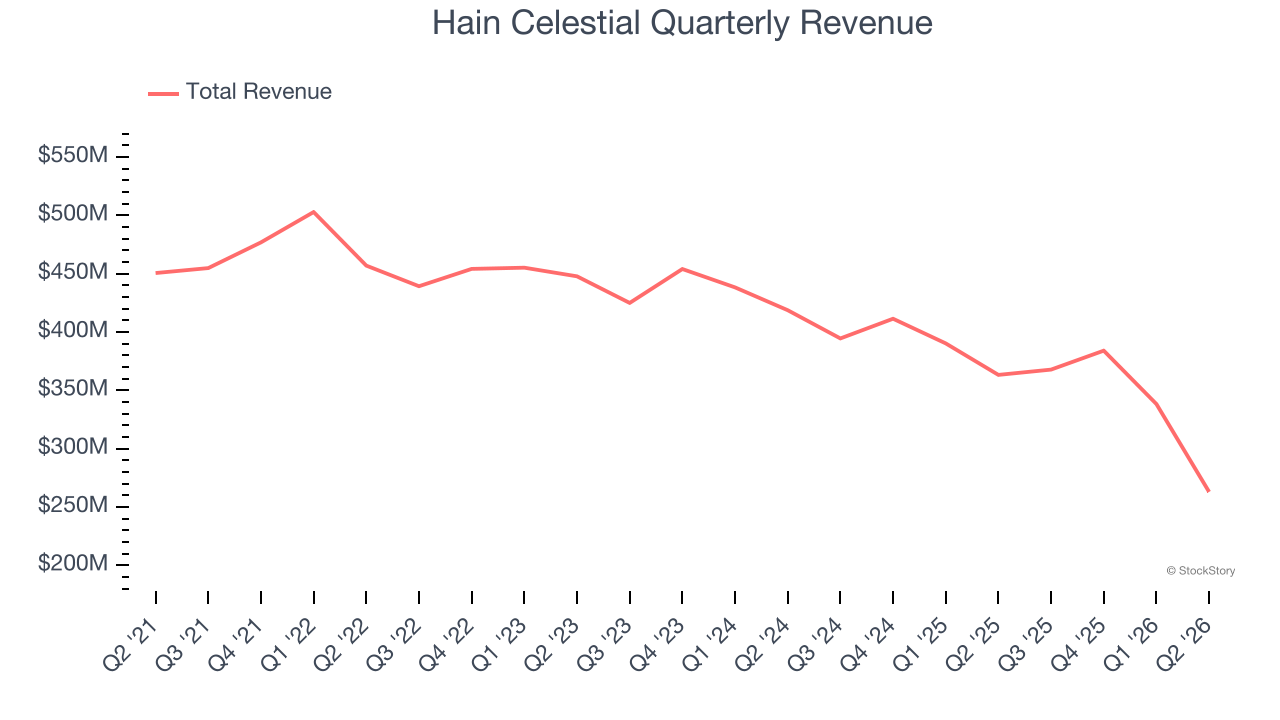
This quarter, Hain Celestial missed Wall Street’s estimates and reported a rather uninspiring 27.6% year-on-year revenue decline, generating $263.1 million of revenue.
Looking ahead, sell-side analysts expect revenue to decline by 15.7% over the next 12 months, a deceleration versus the last three years. This projection is underwhelming and indicates its products will see some demand headwinds.
ONE MORE THING: 3 Hidden Platforms Growing 3X Faster than Amazon, Google, and PayPal. Amazon, Google, and Meta all followed the same playbook: Dominate an ignored market. Build an unbeatable moat. Scale until you’re unstoppable.
These three platforms are running that exact playbook right now. The early investors in Amazon made fortunes. The early investors in these could do the same. Get All 3 Stocks Here for FREE.
Organic Revenue Growth
When analyzing revenue growth, we care most about organic revenue growth. This metric captures a business’s performance excluding one-time events such as mergers, acquisitions, and divestitures as well as foreign currency fluctuations.
Hain Celestial’s demand has been falling over the last eight quarters, and on average, its organic sales have declined by 6.2% year on year. 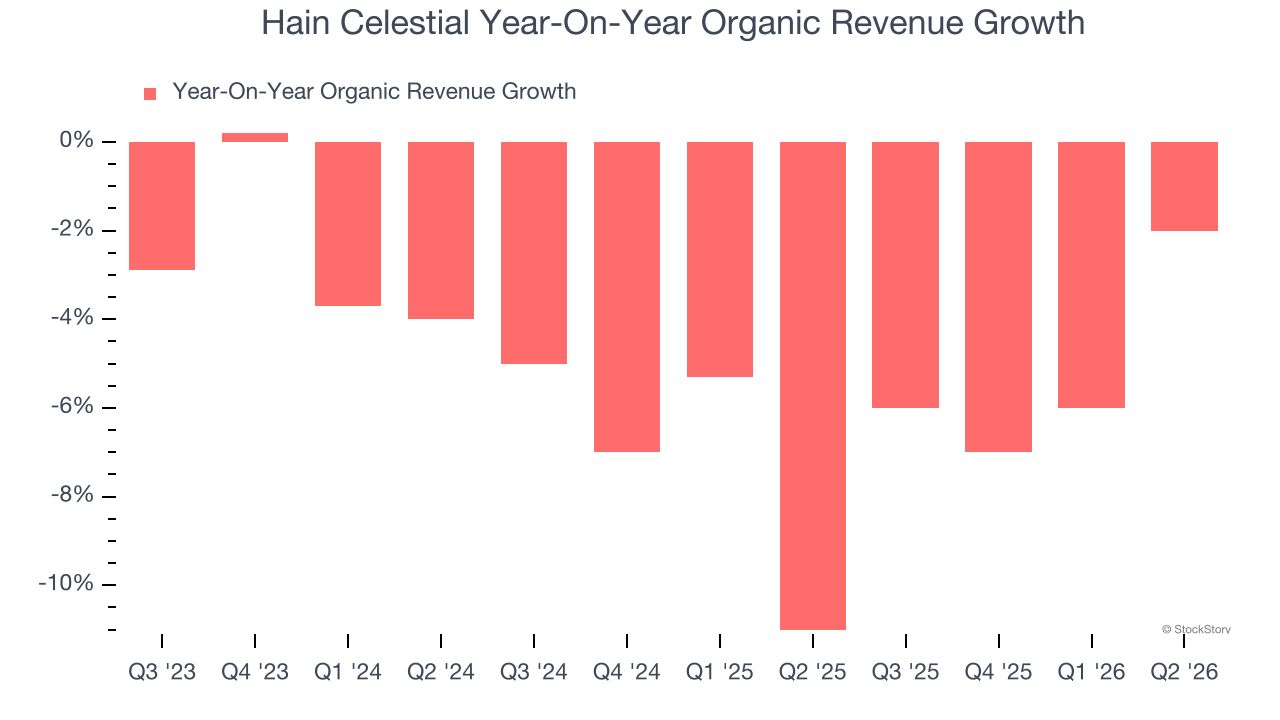
In the latest quarter, Hain Celestial’s organic sales fell by 2% year on year. This decrease was an improvement from its historical levels. It’s always great to see a business’s demand trends improve.
Key Takeaways from Hain Celestial’s Q2 Results
We struggled to find many positives in these results. Its EPS was in line and its revenue fell short of Wall Street’s estimates. Overall, this was a weaker quarter. The stock traded up 9% to $0.68 immediately after reporting.
Should you buy the stock or not? What happened in the latest quarter matters, but not as much as longer-term business quality and valuation, when deciding whether to invest in this stock. We cover that in our actionable full research report which you can read here (it’s free).