
- PRICING
- LIVE QUOTES
- LEARN
- HELP


EN
3 Financial Stocks Tied To Inflation And Short Duration Bonds
Bond markets are on edge as central banks from the US Federal Reserve to the Bank of Japan weigh fresh rate decisions, while global inflation readings loom in the background. That mix can punish slow movers and reward investors who position around inflation-linked and short-duration themes. This article explains how those macro shocks connect to your portfolio and highlights 3 stocks that screen positively against this backdrop.
The three stocks covered below are only a sample, and the full screen surfaced another 15 companies with equally compelling inflation-linked and short-duration stories that are not covered here.
Head straight into the Global Inflation-Linked and Short-Duration Bond Proxies screener to identify, analyze, and focus on the inflation and short-duration bond proxies that best match your portfolio goals.
Jefferies Financial Group (JEF)
Overview: Jefferies Financial Group is a global investment banking and capital markets firm that advises, underwrites, trades, and manages assets across fixed income and equities.
Operations: Jefferies generates about US$7.5b from Investment Banking and Capital Markets and US$772m from Asset Management, primarily across the Americas, Europe, and Asia Pacific.
Market Cap: US$12.0b
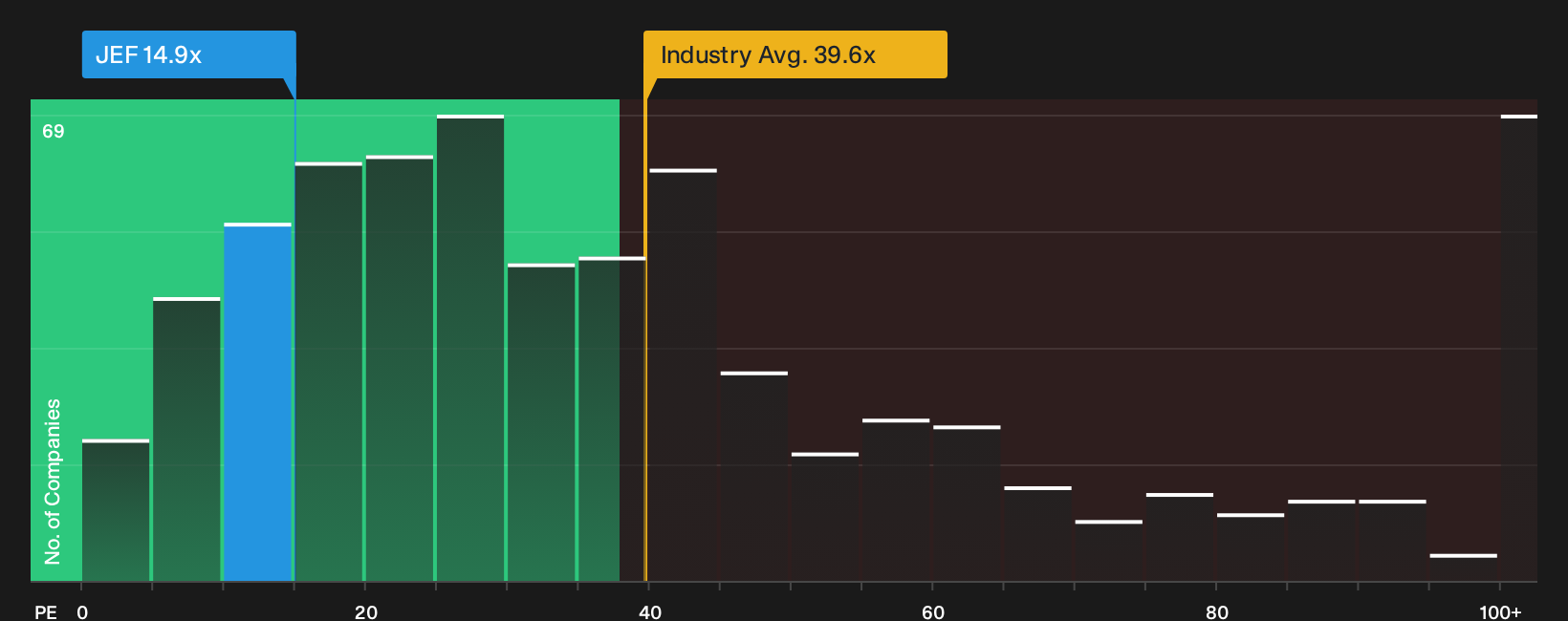
Jefferies Financial Group operates in a segment of the capital markets that focuses on arranging and trading short-duration and inflation-linked fixed income products, during a period when interest rates remain elevated in many regions. The stock trades on a 14.9x P/E, which is below both the US market and capital markets peers. Investor interest may depend on how a period of quieter funding conditions influences future deal activity and margins.
If you want to see how that 14.9x P/E compares with the rest of Jefferies Financial Group, go straight to the DCF valuation analysis for Jefferies Financial Group for the full valuation story.
Robinhood Markets (HOOD)
Overview: Robinhood Markets runs a US trading and investing app where retail customers can buy stocks, ETFs, options, crypto, and hold cash-like balances.
Operations: Robinhood generates US$4.9b of brokerage revenue, entirely from customers in the United States, tying its fortunes closely to US retail activity.
Market Cap: US$101.2b
Robinhood Markets plugs directly into the screener’s inflation and short-duration theme because its customers often shift between cash-like products, short-term fixed income ETFs, and higher risk trades as rate expectations change, which can influence both activity levels and how the platform earns interest on idle balances.
"The ongoing diversification of Robinhood's product offerings, including the expansion into banking, retirement accounts, credit cards, crypto staking, option products, and tokenized assets, positions the company to tap into a broader addressable market and multiple recurring revenue streams, which may drive resilient top-line growth and higher revenue per user."
What matters most for investors is how one unseen pressure on those new revenue streams eventually filters through to net interest and fee margins.
Those shifting pressures on interest and fees are exactly what the full narrative for Robinhood Markets unpacks, revealing where Robinhood Markets might be accelerating, stalling, or quietly being underestimated.

TP ICAP Group (LSE:TCAP)
Overview: TP ICAP Group is an interdealer broker and data provider that connects large financial institutions trading rates, FX, inflation products, and commodities.
Operations: TP ICAP Group earns most of its £2.4b revenue from Global Broking at £1,447 million, alongside Energy & Commodities at £444 million, Liquidnet at £364 million, and Parameta Solutions at £204 million.
Market Cap: £2.4b
TP ICAP Group plugs into the inflation-linked and short-duration theme because its broking desks and data feeds sit where rate volatility, inflation hedging, and money market flows intersect. This positioning provides the business with a direct read on how large institutions adjust portfolios when central banks move.
"TP ICAP is accelerating its shift into new alternative asset classes, including energy transition-linked products, digital assets, and expanded capabilities in dry bulk commodities and biofuels, evidenced by 39% revenue growth in energy transition products and a surge in institutional activity on their digital exchange. This is intended to create new high-margin revenue streams and diversify earnings."
What happens to TP ICAP Group’s earnings power if a single key assumption about how that new business mix affects margins breaks?
If that core assumption proves wrong, the full narrative for TP ICAP Group shows where TP ICAP Group’s mix shift could accelerate earnings power or expose underappreciated fragility.

Seeking Fresh Alternatives For Your Curiosity
Fresh ideas do not stay under the radar for long. Once momentum builds, entry windows close fast and prices can start flying before the crowd reacts. Get in early.
- Spot potential breakout compounders early by scanning a curated 15 high quality undiscovered gems before momentum traders catch on and entry points start dropping out of reach.
- Target durable income streams by reviewing a hand-picked 6 dividend fortresses while yields remain attractive and dividend reliability still flies below most investors’ radar.
- Explore the infrastructure backbone of AI by checking a focused 89 AI infrastructure stocks before capital focuses on the same bottleneck suppliers and valuations move away from you.
This article by Simply Wall St is general in nature. We provide commentary based on historical data and analyst forecasts only using an unbiased methodology and our articles are not intended to be financial advice. It does not constitute a recommendation to buy or sell any stock, and does not take account of your objectives, or your financial situation. We aim to bring you long-term focused analysis driven by fundamental data. Note that our analysis may not factor in the latest price-sensitive company announcements or qualitative material. Simply Wall St has no position in any stocks mentioned.
Have feedback on this article? Concerned about the content? Get in touch with us directly. Alternatively, email editorial-team@simplywallst.com