
- PRICING
- LIVE QUOTES
- LEARN
- HELP


EN
Cui Dongshu: Renewable energy competition shifts from “speed” to “durability”
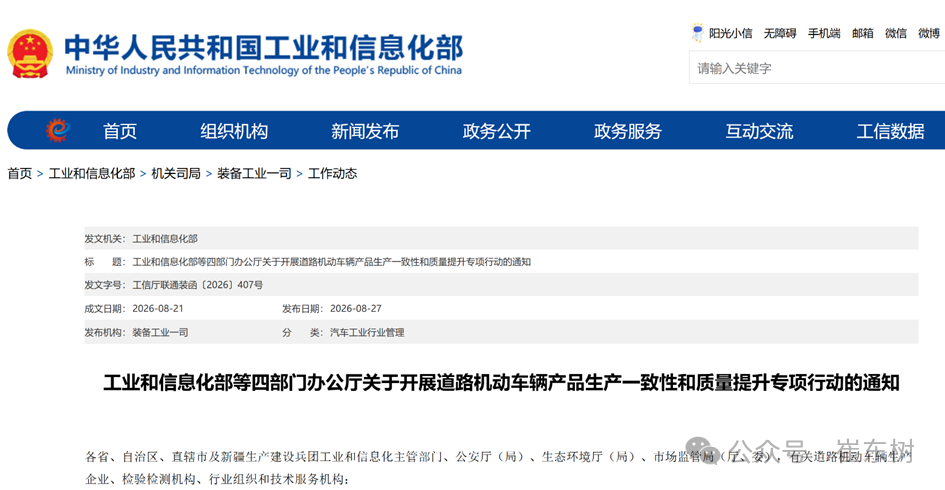
The Zhitong Finance App learned that Cui Dongshu, Secretary General of the Passenger Transport Association, issued an article stating that in August 2026, the National Automobile Standardization Technical Committee solicited public comments on the three electric vehicle qualification test procedures. The core adjustment was to unify the total reliability mileage of new energy vehicles from 15,000 kilometers to no less than 30,000 kilometers, comprehensively leveling fuel vehicle standards. On August 27, the Ministry of Industry and Information Technology, the Ministry of Public Security, the Ministry of Ecology and Environment, and the General Administration of Market Supervision (hereinafter referred to as the “four departments”) decided to launch a one-year nationwide campaign to improve the consistency and quality of road motor vehicle product production from now on. Inspection targets include road motor vehicle manufacturers and products, and relevant road motor vehicle inspection and inspection agencies.
1. From “halving” to “leveling out”: a 15-year transition from a one-paper rule
Back in 2005, GB/T 18388 stipulated that the reliability test mileage for electric vehicles was 50% of that of fuel vehicles — fuel vehicles run 30,000, and trains only need 15,000. This is a special support to lower the entry threshold and encourage “trial and error” during the industry development period. In January 2026, the Ministry of Industry and Information Technology upgraded it to a mandatory standard; in August, the revised draft regulations not only doubled the mileage to 30,000, but also added detailed requirements: pure electric vehicles must account for no less than 90% of the total DC charging mileage, plug-in hybrid models need to complete an additional 10,000 kilometers of pure electric driving, and fuel cell vehicles must complete tests in hybrid mode throughout the process.
From “halving” to “leveling out,” the policy logic has changed from “cultivating soil and nurturing seedlings” to “survival of the fittest.” This means that the window period for gaining market share by relying on policy subsidies and parameter gimmicks is closing, and all players must face the test of durability under real road conditions.
2. The cost of “rapid delivery”: the compression of the new product cycle reveals hidden reliability concerns
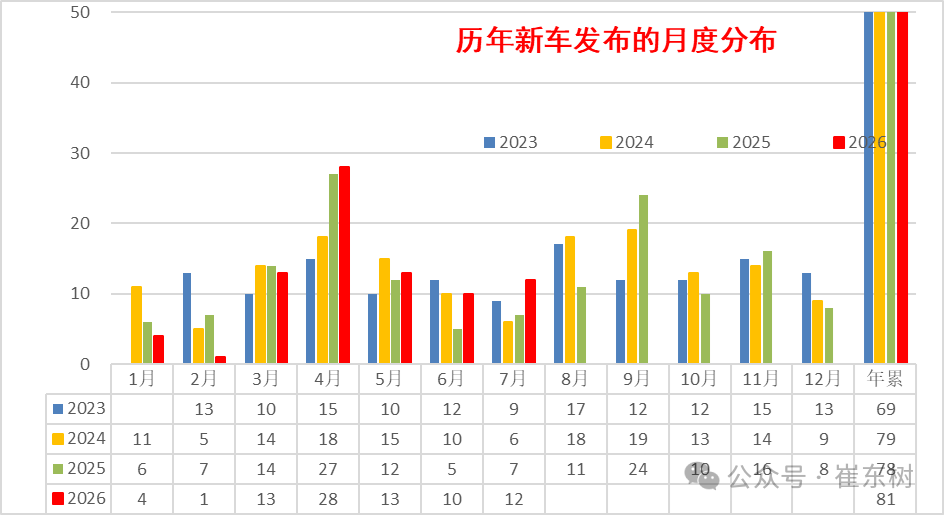
Modular platforms and software-defined vehicles have drastically reduced the R&D cycle, and new forces have generally been reduced from project establishment to mass production to 20 to 24 months. From January to July 2026, a total of 81 new models were released in China, a slight increase from 78 models in the same period last year, and the volume was concentrated in April-July. Although the overall number is not over 500 models (different calibers) that have been distributed online, the speed at which new products are being added remains high.
The other side of the “acceleration” of R&D is a compromise in the verification process. In the first half of 2026, problems such as car crashes, battery failure, and shortage of parts supply broke out. Recalls were announced less than 100 days after the launch of many new cars. Consumers jokingly called them “lottery cars.” On August 26, Vice Minister of Industry and Information Technology Xin Guobin clearly stated at the press conference of the State Information Office: “Radical innovative design is loaded and applied without full experimental verification” is a problem that must be addressed in the 15th Five-Year Plan. This new 30,000 kilometer regulation is a precise institutional correction to this issue.
3. Differentiation of “slow” strategies: traditional verification systems ushered in compliance dividends
In the context of the industry's belief in “only fast and unbreakable,” the 36-48 month development cycle that some traditional car companies insist on was once interpreted as conservative. However, when the new regulations were implemented, this conservatism showed a cost advantage.
Take Toyota's Lexus as an example. The internal durability certification threshold at its Kyushu plant was originally higher than the previous national standard requirements. As a result, when the entire industry is forced to raise the mileage to 30,000 kilometers, the marginal costs of production line adjustment and compliance faced by such companies are far lower than those new forces that have relied on OTA for a long time to repair semi-finished products.
However, it is necessary to clearly see that “slow” does not equal omnipotence. Data for the first half of 2026 shows that the complaint rate of traditional architectures for intelligent interactive experiences is on the rise. Especially in the fields of vehicle interconnection and voice control, there is a clear gap between the speed of iteration and new forces in mainland China. Slow workers may be able to do detailed work, but they may not necessarily be able to do “new work.” On electrified and intelligent scales, the side that favors physical reliability too much is facing pressure from users to “vote with data” other than “voting with their feet.”
4. Structural changes in imported cars: the “safe-haven effect” and one-legged risk in the luxury market
Structural differentiation is intensifying against the backdrop of a contraction in the total number of imported cars. Non-luxury imported cars have shrunk sharply, while the share of imported luxury cars has passively increased. Among these, Lexus's performance is worth paying attention to — but it needs to be examined in the context of objective data.
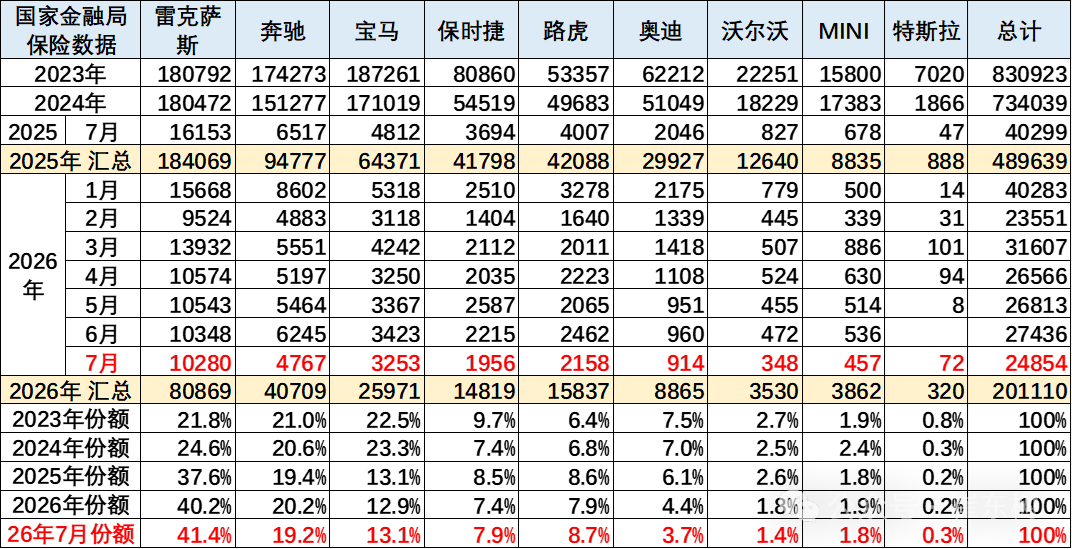
Currently, imported cars are mainly supported by demand for luxury cars, and non-luxury imported cars are shrinking sharply. Among imported cars, the share of the main imported luxury cars has increased dramatically. Imported cars from joint venture brands are shrinking rapidly, and imported cars from some brands, such as European imported cars, are shrinking drastically.
Lexus's retail sales data for imported insurance in 2025 was 184,000 units, up 2% year on year. The share reached 40.2% of imported luxury cars, and Lexus' sales volume in 2025 was higher than 2022 sales, and remained at the level of 180,000 units for three consecutive years from 2022 to 2024. The estimated volume of ES series single models reached 118,700 units, contributing over 60% of sales. The code for contrarian growth is simple: consumers ultimately vote with their feet for quality that can stand up to scrutiny over time, rather than aggressive parameters. From January to July 2026, Lexus's market share of imported luxury cars was 41.4%, which is about 1.2 percentage points higher than 40.2% in 25 years. The overall performance of BMW, Porsche, and Land Rover was relatively good.
The causes of this phenomenon are twofold:
On the one hand, there is a need for safe haven. Under economic cycle fluctuations, consumers are more likely to choose models with high value preservation rates and low maintenance costs. Lexus' “low failure rate” reputation fits this risk aversion mentality, rather than simply winning with brand appeal.
The other side is structural fragility. It is extremely dependent on ES bicycle models, and the new energy product line is seriously lacking, making its market foundation not strong. The average price of bicycle transactions has dropped significantly compared to 2023, and concerns about “exchanging price for volume” have surfaced. If the shortcomings of electrification cannot be made up, once competitors catch up in terms of reliability, their share moat can easily be overtaken.
5. Localization in 2027: not only production line migration, but also a major brand test
In February 2025, Toyota announced the wholly-owned establishment of the Lexus Pure Electric R&D and Production Company in Jinshan, Shanghai, with a total investment of about 14.6 billion yuan and a planned annual production capacity of 100,000 vehicles. It is expected to be put into operation in 2027. Construction began in June of the same year, and in August, it was further revealed that the next generation of pure electric SUVs will be produced here, using integrated die-casting technology.
Judging from the industrial layout, this breaks Toyota's “Japan First” practice and shows the importance attached to the efficiency of China's supply chain. But from a brand perspective, localization is a double-edged sword:
1. Price system restructuring risk. Once it abandons its status as an “imported car,” the “imported aura” and high premium logic that it has depended on for a long time will be challenged. Referring to the localization process of Infiniti and Acura, the shadow that “Japanese high-end domestic products get cold” did not come out of nowhere.
2. Quality control consistency risk. Whether the craftsman cultivation system and static inspection standards that have been established in the Kyushu factory for decades can be completely transplanted in a short period of time in Jinshan, Shanghai, tests not only hardware investment, but also cultural run-in. The quality of the first batch of products after domestic production will directly determine the new positioning of its brand tone in the Chinese market.
6. Conclusion: After the quinceanera ceremony, the knockout tournament had just been shot
30,000 kilometers is a “coming-of-age ceremony” for new energy vehicles. It marks China's NEV industry's official bid farewell to the policy “swaddle,” moving from adolescence to maturity, and from “nurturing priority” to “standardization priority.”
After the implementation of the new regulations, there will be multiple chain effects: increasing the hard cost of R&D, speeding up the clearance of low-end production capacity, forcing the upgrading of BMS (battery management system) and thermal management technology, alleviating consumers' long-standing “durability anxiety under mileage anxiety,” while also adding internationally compliant passes to vehicle exports.
Brands that truly stand the test of time never need to rely on policy thresholds to prove themselves — because they have long been accustomed to demanding themselves with higher internal control standards than national standards. When the “speed race” bubble is pierced by a 30,000 kilometer odometer, China's new energy market will usher in a serious “quality knockout race”. After the quinceanera ceremony, it's not the end; it's the beginning of a longer and more grueling journey.