
- PRICING
- LIVE QUOTES
- LEARN
- HELP


EN
From trillions of computing power to a “next-generation drug king”: value differentiation and production capacity realization in Nvidia's AI4S circle of friends
Hwang In-hoon once asserted that life science is the most far-reaching implementation scenario for AI. As Nvidia and Eli Lilly reach a joint AI lab partnership of up to $1 billion, a top-level capital consensus has been established.
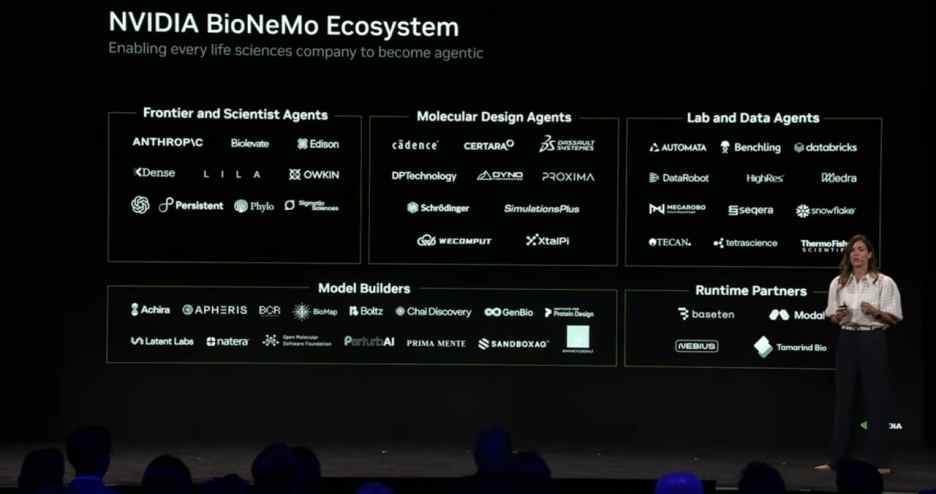
Nvidia BIO26 Biomedical Special Report
Looking at the life science ecosystem companies officially announced by Nvidia this year, it is clearly visible that the market's valuation perception of this racetrack is also constantly being upgraded: Anthropic's valuation approached trillion US dollars after completing financing, and ended up deploying the Claude Science R&D platform; Chai Discovery completed $400 million in financing with biomolecular models and novel antibody design capabilities, and collaborated successively with pharmaceutical companies such as Eli Lilai, Novartis, and Bristol-Myers Squibb; Lila Sciences uses “AI hypothesis+robots to execute The scientific factory concept pushed the valuation to 8.5 billion US dollars; Jingtai Holdings (02228) opened up a closed loop of digital reasoning and physical verification, and Agentic AI directly dispatched robot clusters to complete the “design-synthesis-testing-feedback” of new molecules and materials in the real world.
This ecological map is evolving into an AI4S industry map with strong barriers: Anthropic provides general reasoning, Chai enhances biomolecular models, and Lila and Jingtai explore independent laboratories, Dassault and other companies connecting instruments and industrial scenarios. AI4S is leaving the simple “model ranking” and entering a “productivity competition” in the real world. In drug development, the cost of a chemical illusion is months and millions of dollars. The model parameters are only admission tickets. The results of closed-loop experiments in wet and dry laboratories are the core test stones that determine the market value of industrialization.
Beyond project cooperation: exporting “core R&D infrastructure” to global MNC
Among the ecological partners presented by Nvidia, Jingtai Technology is one of the few companies from China. What is special about it is not that it has trained another drug model, but that it has already made models, scientific agents, and robotic laboratories work together. Today, Jingtai's “AI+ robot” system has passed the proof of concept stage and has received continuous verification and “repurchase” from Eli Lilai, the world's highest market capitalization pharmaceutical company.
The cooperation path between the two sides has shown strong strategic penetration: from the initial discovery of small molecule drugs with a total potential total of 250 million US dollars to double antibody cooperation of 345 million US dollars; recently, the delivery of a 10-million-grade compound management system at Eli Lilly's Shanghai R&D Center and the acceptance of the HTE (High Throughput Test) platform was completed. Lilly's continued expansion of repurchases — first buying small molecule discovery capabilities, then leveraging AI antibody platforms, and finally purchasing automation infrastructure directly — marks Jingtai's move from single-project cooperation to MNC Infrastructure supplier for the core R&D process of repurchase endorsements.
This logic has been confirmed at the financial level. In the first half of 2026, after excluding the impact of the previous year's high base down payment, Jingtai's revenue increased 73.8% year over year. Among them, AI4S smart solution revenue reached 193.5 million yuan (surged 136.4% year on year), accounting for half of the country.
Quantification of efficiency is Jingtai's core moat: Agentic HTE reduces the traditional 3-4 week experimental cycle limit to about 6 days; the SureRoute reverse synthesis system reduces the chemical illusion rate to 4.6%, and the accuracy rate of the Top-1 recommendation reaches 74.3% (several times that of existing general models). At the same time, Jingtai has systematically disclosed asset cards: nearly 40 autonomous and joint incubation pipelines, including more than 10 pipelines entering the IND or IND preparation stage, covering small molecules, antibodies, peptides, small nucleic acids, and molecular adhesives.
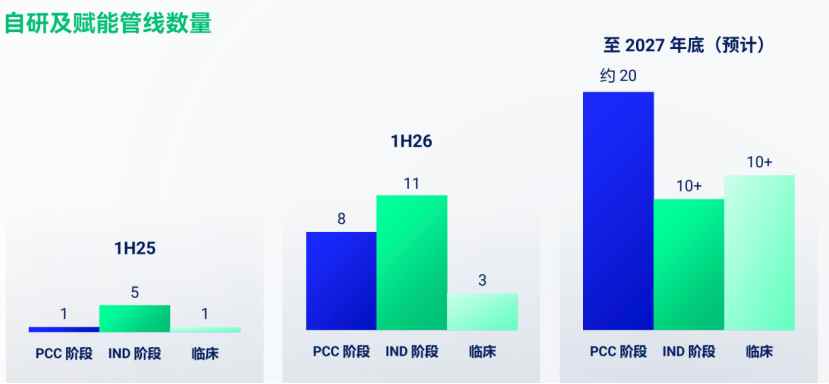
At this point, Jingtai's commercial twin engine has completely taken shape: exporting “equipment + platform” to the outside world to accumulate stable infrastructure revenue; generating pipeline assets in batches internally, gaining huge upward space for milestone sharing and asset explosions.
Implications of the “New Drug King”: The valuation of pioneering non-drug targets has jumped
In August of this year, Revolution Medicines' new molecular gum drug Rasonque (targeted RAS) was approved by the FDA. The phase III clinical survival period almost doubled, and the risk of death was drastically reduced by 60%, making it a veritable “next-generation drug king”. The core implication is that the value of the new model is not to seize share in the traditional Red Sea, but to reshape the boundaries of “what can become medicine.” Once the historical “untreatable” target is overcome, the upper limit of its assets will far exceed traditional R&D outsourcing service fees.
Greg Verdine, the early founder of the Rasonque route, later founded DoveTree and reached a sky-high cooperation with Jingtai with a potential total value of up to 5.99 billion US dollars. Currently, Jingtai has secured a total of 70 million US dollars in advance payments, and the first oncology project has entered the IND-enabling phase. This not only confirms the extremely high drug conversion rate of the underlying technology, but also gives the market a clear glimpse of the exponential explosive potential of the Jingtai platform at the level of future commercial development (BD).
This is not only an endorsement by top experts of Jingtai's ability to discover molecules, but also a verification of their underlying mechanisms. In some projects, the Jingtai xGlue platform optimized target protein degradation activity to pmole level (pM) in only a single quarter. In the context of innovative drugs, being able to locate molecules at extremely low concentrations that are still efficient in a very short period of time means that the clinical success rate in the later stages has been greatly improved.
Three Frontier Modalities and Valuation Anchors: From Single Point Breakthrough to “Underlying Capacity Takeover”
In the race of the three new modes of antibodies, peptides, and small nucleic acids, breakthroughs in a single technology platform have all obtained extremely high pricing in the capital market. This is the best frame of reference for re-examining Jingtai's values:
Antibody network: AI design is crossing the technical narrative and entering the clinical implementation period. Jingtai relies on the dual-core drive of “dry and wet closed+top veterans” to accelerate the realization of the high commercial premium of its own pipeline.
Chai, valued at $3.8 billion, and Generate Biomedicines, which has five clinical pipelines, proved the broad future of AI antibodies. Jingtai's Ailux platform not only opens up computational design and wet test development evaluation, but has also been verified in more than 100 projects. Relying on Eli Lilly's dual-antibody collaboration of up to US$345 million, its 3 self-exempt pipelines directly point to Phase I clinical trials in 2027. At this critical point, Ailux also recruited Dr. Maria G. Belvisi, former core management of AstraZeneca (AZ) and CEO-3, as its Chief Scientific Officer. As one of the most important examples of a major international pharmaceutical company joining a Chinese startup, its top industrial management vision will strongly promote pipeline circulation, and Jingtai is truly making a value leap from “platform empowerment” to “own rights and interests.”
Peptide engine: The 100 billion metabolic market has sparked a frenzy of mergers and acquisitions of peptide assets. Jingtai directly hit R&D pain points with automated synthesis and launched a dimensional reduction attack on the broad consumer product efficacy molecule market.
Eli Lilly's Peptide Magic Matrix (generating revenue of approximately $36.5 billion in 2025) and Roche's $5.3 billion bet on New Zealand Pharma confirmed the strong ability of peptide assets to absorb money. The core pain point of peptide development has always been the extremely high synthesis and screening threshold. Jingtai's Pepix platform is directly connected to AI and automatically synthesized. Some oral cyclic peptide projects can target emerging compounds in just two months, directly peak the upstream production efficiency of peptide assets, and simultaneously lay out consumer products. Currently, Jingtai has an anti-release polypeptide and a food-grade polypeptide that inhibits carbohydrate absorption through INCI and FDA filings and has been approved for the market, respectively. It is reshaping the consumer product efficacy molecule market with AI pharmaceuticals' underlying capabilities.
Small nucleic acid (siRNA): Verification of precise targeting technology has spawned a wave of MNC's 10 billion mergers and acquisitions. With a generalized model with an extremely high hit rate, Jingtai has confirmed the ability of its underlying infrastructure to scale across modes.
Novartis's $12 billion acquisition of Avidity and Alnylam, with a market capitalization of over $33 billion, established an extremely high valuation anchor in the field of small nucleic acids. Benchmarking global giants, Jingtai has efficiently deployed 6 siRNA pipelines, of which more than half have completed the evaluation of efficacy in vivo. The SiDiff model's hit rate in untargeted genetic tests jumped by more than 30%, and the IgA nephropathy program obtained superior non-human primate (NHP) efficacy data verification in just 9 months. Traditionally, this process takes 12 to 18 months. This is not only a breakthrough in a single pipeline and a huge improvement in efficiency, but also proved to the market that its “AI+ experiment” system can still output overwhelming R&D efficiency in the face of a new mode.
AI cannot completely eliminate clinical risks, but it can preempt pharmacogenicity evaluations, so that molecules with obvious errors can be eliminated as soon as possible. When mature companies have verified the new model's commercial ceiling, what Jingtai competes for is the underlying general-purpose mass production capacity of these full-modal assets.
Jingtai's real scarcity is that antibodies, peptides, small nucleic acids, and molecular gels are sharing the underlying basic capabilities and infrastructure of the same underlying “big AI model+robot”. When mature companies have verified the new model's commercial ceiling, what Jingtai competes for is the underlying general-purpose mass production capacity of these full-modal assets.
Reshaping the valuation model: from “project band” to “full modal asset factory”
It is already difficult for Jingtai to use a single comparable company for valuation. For such a complex infrastructure enterprise, the market needs a new “SOTP (classification summation)” valuation vision: its AI4S automated infrastructure targets Lila Sciences, which is valued at 8.5 billion US dollars; antibody platforms can refer to Chai or Generate premiums; molecular gels, peptides, and small nucleic acid pipelines can be risk-adjusted separately according to the R&D stage, cooperative rights, and market space. Combined with equipment sales, R&D services, high-milestone payments, and a secure cash cushion of nearly 8.7 billion yuan, it has built a moat with a very high margin of safety and cyclical resistance.
Revaluation does not price all early pipelines based on successful final values, but rather confirms the underlying transformation of their value creation engine: in the past, it looked at project statements, and now it looked at the combined growth of experimental equipment, data assets, and multi-modal pipelines.
The logic behind the evolution of the AI4S industry is extremely clear: the first stage is about model parameters, the second stage is about closed-loop experiments, and the final winner or loser is who can solidify the experimental capability into an industrial-grade system that “continuously mass-produces high-value assets”.
There is no shortage of stars in Nvidia's computing power ecosystem, but there are few companies that can simultaneously handle “continuous repurchase of top-level MNC,” “large-scale automation laboratories,” and “full-modal pipeline reservoirs.”
The success of a single pipeline can only define the price of a single transaction, and the AI industrial base for continuous mass production pipelines will define the platform value of an era.