
- PRICING
- LIVE QUOTES
- LEARN
- HELP


EN
From “chasing the light” to “going upstream of the light”! Damo asserts: Under the tsunami of computing power, glass fiber cloth and copper foil set off a material supercycle
The Zhitong Finance App learned that Damo released the latest research report indicating that the fanatical expansion of global AI infrastructure is spreading across the board from downstream GPUs and foundry to upstream key basic materials fields. This trend has not only reshaped the printed circuit board (PCB) and multilayer ceramic capacitor (MLCC) supply chain system, but has also spawned a “supercycle” of upstream materials with a long cycle and high certainty.
AI contributed almost to the entire net growth of the industry
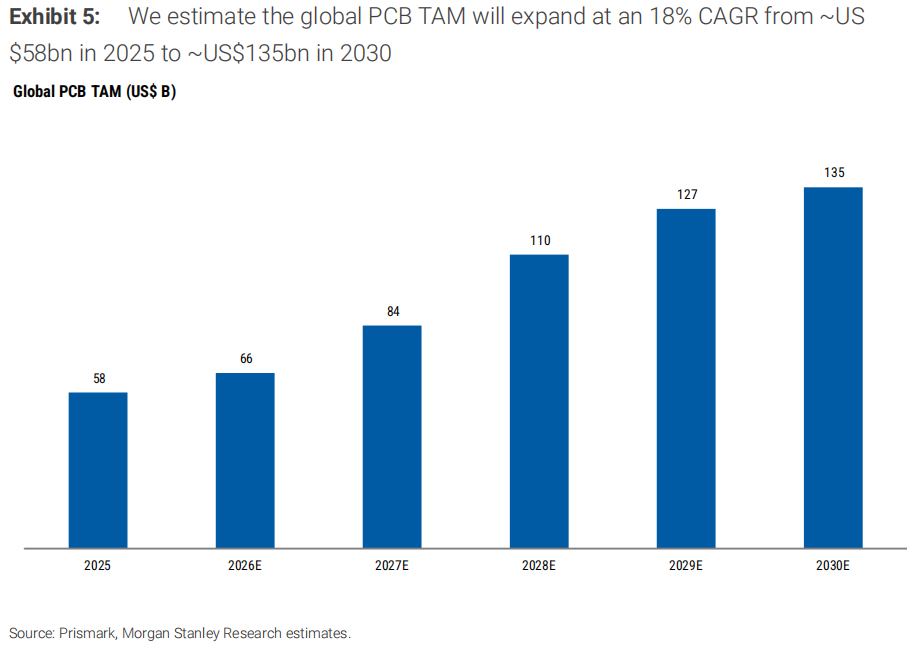
According to Damo's estimates, the global PCB market will expand at a compound annual growth rate of 18%, from about $58 billion in 2025 to about $135 billion in 2030; of these, AI/data center-related demand will increase more than sixfold, from about $13 billion to $86 billion, and its share of industry revenue will jump from 20% to 25% to 64%. In other words, by 2030, AI and data centers will contribute almost all of the industry's net growth, and demand for other terminals will be roughly equal.
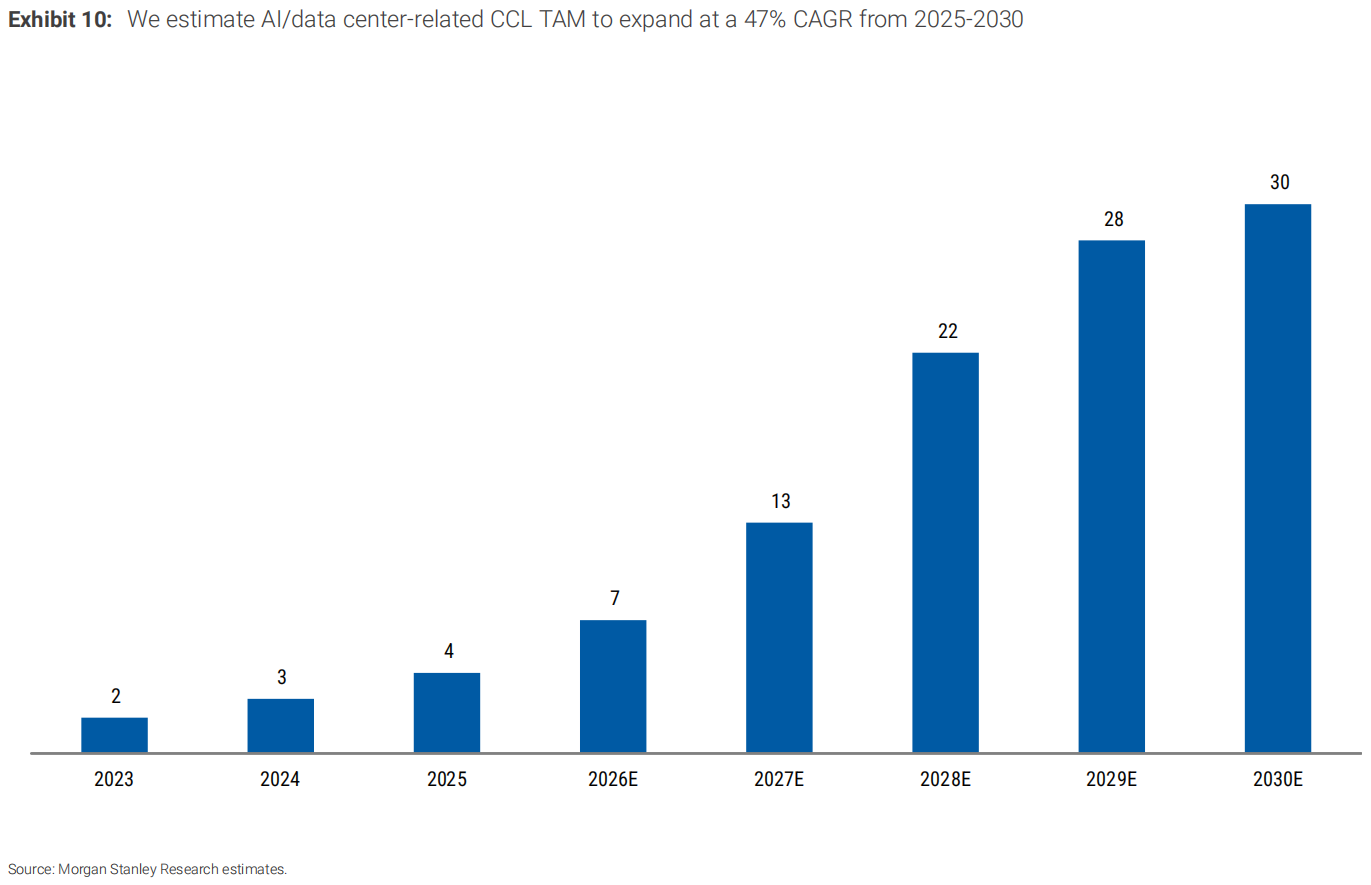
Copper clad plate (CCL) has a steeper slope: the global market size will grow from about $19 billion to $47 billion (CAGR about 20%), while AI/data center CCL demand will soar more than sevenfold from about $4 billion to about $30 billion (CAGR about 47%), contributing about 90% of the industry's net growth. The Nvidia platform's migration from Blackwell's M8 rating to Rubin's M8.5 and Feynman's anticipated M9/M10 continues to drive up the material usage and value of stand-alone machines.
Manufacturing complexity is also changing qualitatively: the end-to-end delivery time for an advanced AI PCB is about 100 days, 2.2 times that of an ordinary multi-layer board (46 days); an Nvidia-grade computing board requires 22 layers and five presses, while a conventional 12-16 layer board only needs to be pressed once.
The three most scarce materials
No. 1: High-end fiberglass cloth. Due to the limited supply of Toyota looms (only 300 units shipped at the end of 2027), tight high-end glass fiber yarn, and technical barriers, the price of glass fiber cloth in China has doubled during the year, and inventory is at an extremely low level. Damo anticipates a supply gap of around 40% in 2026, worsening further in 2027, and easing to around 30% in 2028. The average price of glass fiber cloth in Japan has risen from 3274 yen/kg in 2023 to 4,589 yen/kg in 2025, an increase of 40%. Nittobo (Nittobo) has drastically raised its cumulative capital expenditure for the 2025-2028 fiscal year from 80 billion yen to about 120 billion yen.
Second place: HVLP4+ ultra-low profile copper foil. According to CBC Metals, demand for HVLP copper foil for AI servers will increase 260% to 24,000 tons year-on-year in 2026, and an additional 108% to about 50,000 tons in 2027; the operating rate of China's copper foil industry has exceeded 93%. The Damo model shows that the gap between supply and demand was about 31% in 2027 (monthly demand of 3270 tons, production capacity of only 2,495 tons), and still about 20% in 2028. Supply is highly concentrated, and Mitsui Metals alone accounts for 41% of global production capacity in 2026, and is the main beneficiary of volume and price.
Third place: optical fiber, the price of which reached a seven-year high. Large-scale AI data centers use 5-10 times more fiber than traditional data centers, and some estimates show 5-36 times higher usage per rack; AI-driven data center fiber demand CAGR is expected to exceed 20% from 2025 to 2030, and data center-related fiber demand will increase 69% year over year in 2026. Corning has promised to increase US fiber production capacity by 50% and expand optical connectivity production capacity by 10 times, and Lumen alone locked in 10% of its global production capacity from 2025 to 2026.
Valuation: The pullback gave a second chance
The AI materials sector has risen 91% over the past 12 months, but it still outperforms the PCB/CCL sector by 147% over the same period; and has retreated an average of about 36% from the 52-week high in May-June 2026. The current sector's expected price-earnings ratio in 2026 is about 26 times, compared to about 35 times PCB/CCL, and there is room for the valuation gap to narrow. Damo emphasized that “the next stage is content, not quantity”: its forecast for the CCL market size of about 47 billion US dollars in 2030 is significantly higher than the market consensus of 30 to 35 billion US dollars, reflecting that the increase in the value of stand-alone materials is still underestimated. The capital expenditure background remains strong — Damo expects cash cloud capital expenditure of around $1.2 trillion in 2026 (+104% YoY) and around $1.6 trillion (+38%) in 2027.
Combinations and long tails
Daima's preferred targets are: Nitto Textile, Grace Fabric (Grace Fabric), Mitsui Metals, Co-Tech, Corning, Furukawa Electric, Mitsubishi Gas Chemical, and Denka.
Resins (PPE/OPE, BMI, cyanate) are structural beneficiaries but are less scarce; in terms of MLCC, Murata's order shipment ratio from April to June reached 1.47, the highest since 2004, with an operating rate of about 95%.
Longer-term options include synthetic diamonds (Rubin power consumption reaches 2300W, traditional copper heat dissipation is insufficient, diamond-copper composites can reach 600-1000 W/m·k, high-purity CVD diamonds can reach 2000-2400), tungsten and molybdenum material replacement (3D NAND from tungsten to molybdenum), and rare earth and scandium oxide (SOFC data center power supply scheme).
Risk Alerts
The aggressive expansion of optical fiber production capacity in the medium term may normalize supply and demand and suppress prices; Toyota loom bottlenecks are unresolved in the short term, limiting the expansion of glass fiber cloth production; MLCC media powder price increases still require difficult negotiations with downstream, which may squeeze component profits.
epilogue
Damo's core judgment is that the valuation of downstream AI hardware has taken into account most of the story, and the shortage of upstream materials — particularly high-end glass fiber cloth, HVLP copper foil, and optical fiber — will continue until at least 2028. This is where expectations in this super cycle are most different.