
- PRICING
- LIVE QUOTES
- LEARN
- HELP


EN
Trump's crypto policy paved the way, and the Singapore Exchange took advantage of the momentum to break into the US perpetual contract market
The Zhitong Finance App learned that the Singapore Exchange (SGX) is preparing to launch cryptocurrency perpetual futures to US institutional investors, making it the first large-scale traditional exchange to introduce popular trading types in the cryptocurrency market into the mainstream financial system.
The exchange submitted an application to the US Commodity Futures Trading Commission (CFTC) last month to open these contracts to US investors. As a registered foreign exchange, it can provide these products to US institutions if no regulatory objections are received within 10 days. The move enabled SGX to reach out to a larger community of hedge funds, asset management companies, and proprietary trading companies after launching Bitcoin and Ethereum perpetual futures in November last year.
Perpetual futures (“Perps” for short) have become the core variety of the cryptocurrency market, allowing traders to place leveraged bets without the expiration date limits of traditional futures. As regulators become more open, major traditional exchanges have launched similar products one after another, opening up a new competitive front in a derivatives market that generates hundreds of billions of dollars in monthly transactions.
However, there is a problem: introducing perpetual contracts into traditional finance means changing some of the characteristics that make them unique cryptocurrency products. SGX contracts are traded 5 days a week for 22.5 hours a day. Members must pay a 35% deposit and use fiat currency as collateral. The exchange also doesn't use the automatic depreciation mechanism on some cryptocurrency platforms.
Although the underlying crypto token supports 7×24 hour trading, the SGX doesn't see this as a problem and indicates the type of customer it is chasing.
“We are targeting institutions, accredited investors, professional investors — the type of customers who don't trade on weekends,” said KC Lam, head of crypto derivatives at the SGX in an interview.
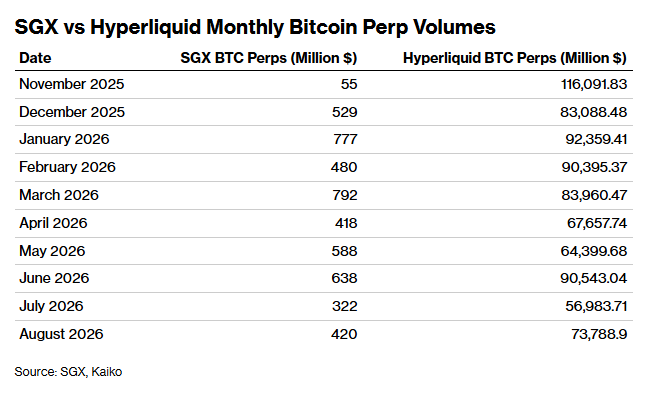
Until now, native cryptocurrency trading platforms have firmly grasped the vast majority of liquidity. The decentralized platform Hyperliquid processes about $80 billion to $100 billion in Bitcoin and Ethereum perpetual contract transactions every month, while the cumulative trading volume of the SGX since the launch of perpetual futures is about $6 billion. Opening these contracts to US institutions will test whether a larger institutional customer base can begin to close this gap.
“The US has one of the largest institutional engagements in the cryptocurrency sector — whether it's futures or ETFs,” Lam said. “I think moving to the US market is a logical choice for us.”
Timing is critical
US investors have historically obtained cryptocurrency perpetual contracts mainly through offshore platforms. However, in May of this year, the CFTC opened the door to providing these products in the US and approved the first compliant Bitcoin perpetual contract on Kalshi. Kalshi is a CFTC-registered exchange and prediction market operator.
CFTC Chairman Michael Selig described the move as a step to bring one of the most liquid segments of the cryptocurrency market into the US regulatory framework.
The rapid growth of platforms such as Hyperliquid has further strengthened the appeal of perpetual contracts, where users can trade contracts linked to a range of assets, from stocks such as SpaceX (SPCX.US) to commodities such as petroleum and gold.
This increase drew the attention of US President Trump, who said in August that Seliger was working to introduce Hyperliquid “in a fully compliant and legal manner” to the US. Trump has made no promises or given a timeline.
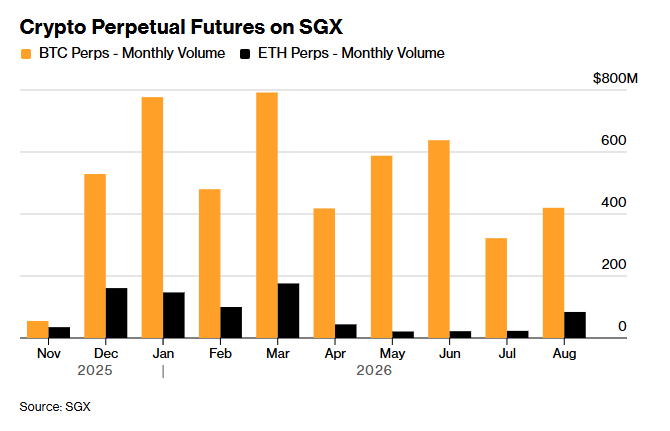
In this context, the SGX believes the time is ripe to introduce cryptocurrency perpetual contracts to the US. Lam said he expects the move will help boost trading volume. “Liquidity will generate more liquidity,” he said, “so more people will trade.”
According to exchange data, a total of 29,655 Bitcoin perpetual contracts and 6,758 Ethereum perpetual contracts were traded on the SGX in August, bringing the total trading volume for the first eight months of this year to 353,825.
The competitive landscape of the industry
In addition to Kalshi, cryptocurrency's native rivals are also seizing the market by improving the regulatory environment.
Coinbase (COIN.US), the largest cryptocurrency exchange in the US, has actively entered this market. In May of this year, the company said its US-regulated futures commissioners can offer global cryptocurrency perpetual contracts and options to institutional clients. Earlier this month, the company said it had filed an application with the US Securities and Exchange Commission to offer a share-based perpetual contract.
The exchange said 80% of global cryptocurrency trading volume comes from derivatives.
The SGX is betting that it can break new ground in this market and become a multi-asset exchange for professional investors. Through the SGX, institutions can trade cryptocurrencies along with other derivatives such as stocks, interest rates, foreign exchange, and commodities.
Lam also said that getting these products through Asian exchanges would be an advantage for US investors currently limited by local liquidity pools and trading hours.
“Once the US trading session is over, we can actually be a great addition to their existing deals,” he said.