
- PRICING
- LIVE QUOTES
- LEARN
- HELP


EN
The more amazing AI is, the faster the data needs to run! Goldman Sachs Optics Industry Research Released: CPO Testing and Coupling Equipment Takes the Lead in Realizing Revenue
The Zhitong Finance App learned that Wall Street financial giant Goldman Sachs recently released the “Optical Industry Research: Ten Key Points of Technology, Demand, Supply and Competition” research report showing that the scale of unprecedented investment in the trillion-dollar scale of AI computing power infrastructure is simultaneously greatly expanding the number, rate, and application range of high-speed optical connection units in data centers. Growth opportunities are further accelerated from strong demand for high-speed optical module systems to lasers, fiber arrays, optical industry-related testing and high-performance automated coupling equipment.
Goldman Sachs has previously raised demand forecasts for 800G and above by 39% and 36%, respectively, to 144 million and 171 million units in 2027 and 2028. Goldman Sachs analysts believe there is still room for improvement; at the same time, the supply of DSP, lasers, and PCBs may continue to limit shipments in 2027.
Looking at the underlying engineering, the growth in optical interconnection demand comes from more frequent and stricter data exchanges between more computing nodes: experts in hybrid expert models (MoE) require parallel data distribution and aggregation across GPUs; prefill—decode disaggregation (Prefill—Decode Disaggregation) requires transmission of key-value caches (KV Cache); and complex agent workflows increase the amount of concurrent model calls, tool execution, and data access. As clusters expand, network congestion causes expensive GPUs to wait for data, directly reducing the amount of effective tasks that can be delivered per dollar or watt. The distance, loss, and power consumption constraints of high-speed electrical connections therefore drive a wider range of optical connections. NPO/CPO shortens electrical signal paths, EML, CW, and ELS provide the light sources required for optical communication, and OCS supports reorganization of connections according to workload.
Therefore, as demand related to cutting-edge AI applications accelerates, AI cluster collaboration requires more and more transmission bandwidth and efficiency. Goldman Sachs believes that the investment value surrounding the data center optical interconnection/optical communication field depends on whether enterprises can obtain key materials, complete high-speed product certification, and transform demand into deliverable production capacity. In particular, the report emphasizes that commercialization of CPO takes time, but testing and coupling equipment has already begun to redeem revenue, and profit clocks in different parts of the industry chain are not fully synchronized.
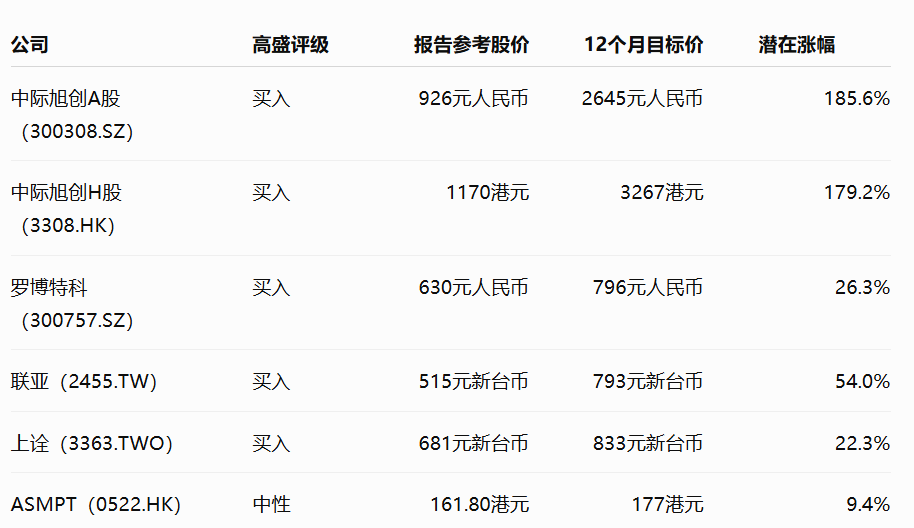
In terms of the ratings covered by Goldman Sachs, Goldman Sachs gave “buy” ratings for Zhongji Xuchuang A/H shares, Roboco, United Asia, and Shanghai. The target price for Zhongji Xuchuang A shares is based on a price-earnings ratio of 35.6 times in 2027, and the target price for H shares uses a 13% H/A premium assumption; LianAsia, Robotec, Shangquan, and ASMPT use longer term profits and discounts respectively.
For the target price of Zhongji Xuchuang A shares, Goldman Sachs gave a target price of 2,645 yuan, which means a potential increase of up to 185.6% over the next 12 months. For the target price of Zhongji Innochuang's Hong Kong stock, Goldman Sachs gave a target price of HK$3,267, which means a potential increase of 179.2% over the next 12 months; for LianAsia (2455.TW) in Taiwan, Goldman Sachs's latest target price means a potential increase of 54% over the next 12 months.
Goldman Sachs expects demand for high-speed optical modules to reach 144 million in 2027! Optical interconnection opportunities extend from modules to manufacturing bottlenecks
Demand expansion and price resilience are the basis for Goldman Sachs's optimism about high-speed optical modules. Goldman Sachs said that the global demand range for 800G and 1.6T modules given by the surveyed Chinese companies is 130 million to 200 million. The overall demand in the Chinese market is expected to exceed 50 million units, mainly 400G and 800G, and 1.6T will enter the market; however, there are differences in the product range of these calibers, and they cannot be directly added together.
In terms of price, the companies surveyed expect the 800G module price reduction to be controlled in single digits in 2027, and the 1.6T price will remain above $700 each, which means that the increase in shipments is still expected to translate into revenue growth. The iteration cycle for data communication products has been shortened to about 1 to 2 years, which is significantly faster than the telecom market cycle of about 5 years. R&D, supply chain management, mass production, and cross-regional delivery capabilities have become competitive thresholds.
Goldman Sachs said that Zhongji Xuchuang guarantees supply through joint research and development, investment in suppliers, advance payments and long-term agreements, reflecting the path of leaders turning procurement capabilities into competitive advantages. The surveyed companies also believe that demand is strong for the next two to five years, and that some customers have already planned until 2030; what they claim is a payback period of about one to two years is a business judgment of the surveyed industry and cannot be promoted to a definitive return for all AI projects.
Goldman Sachs said that the upgrade of lasers and fiber arrays has caused supply constraints to occur simultaneously with an increase in domestic supply capacity. Higashiyama Seimitsu said that 200G electrically absorption-modulated lasers (EML) have been mass-produced, but current production is still limited by tight supply of digital signal processors (DSP); the company has locked in the supply of 10 million DSPs in 2027 to support subsequent growth in laser and optical module shipments. Changguang Huaxin expects EML production capacity to be slightly higher than continuous wave lasers (CW) in 2027. Among them, EML will still be mainly 100G, supplemented by 200G. The United Asia (VPEC) sees an improvement in the supply of indium phosphide (InP) substrates, plans to increase the number of metal-organic chemical vapor deposition equipment (MOCVD) from 62 to 69 in the second quarter of 2027, and plans a new production base; its epitaxial film products are also being upgraded from servicing 70-100 milliwatt CW lasers to over 100 milliwatts required for NPO and 300-400 milliwatts required for CPO, while expanding 100G and 200G EML.
In addition, FOCI's fiber array unit (FAU) was upgraded from 40 channels for 3.2T to 80 channels for 6.4T, and 100 channels are still being developed; revenue in August increased 20% month-on-month, up from 9% in July. These changes support an increase in the share of high-end products, but it cannot be assumed that the heat dissipation, yield, and certification issues of high-power lasers have been solved based on this.
The early benefits of CPO are showing up in the testing and automation equipment process. Goldman Sachs expects to ship 10,000, 92,000, and 131,000 CPO switches from 2026 to 2028, respectively. At the same time, it has observed strong demand from Chinese and overseas customers for 3.2T near-package optical (NPO) engines. Robotec's revenue for the second quarter of 2026 increased 172% month-on-month, 141% higher than Goldman Sachs's forecast; it and its FiConTec expect equipment shipments in the next year to exceed half of the cumulative shipments over the past 25 years, and aim to reduce wafer-level testing time by 50% to 60% and quadruple chip-level testing speed next year.
Goldman Sachs analysts also write that high-value photonic integrated circuits (PICs) must identify defects as early as possible, so double-sided wafer testing, known good die (KGD) screening, and precise coupling are key to reducing scrap costs. Guangyan Technology's NightJar system is used to identify optical losses and defects in advance; Junhao's dual-fiber array active alignment equipment can simultaneously process the transmitter and receiver, reducing coupling time by 50%; Wheatt's assembly system covers applications such as optical modules, external light sources, OCS, NPO, and CPO; ASMPT's MEGA platform integrates high-precision mounting, dispensing, UV fixing, and 3D inspection. Goldman Sachs analysts agree that this is an upgrade in a complete set of photonic manufacturing capabilities.
The more capable AI agents are, the more unblocking the data center network and high-speed data transmission!
Strong AI computing power demand support linked to the AI computing power industry chain level has been clearly reflected in the strong performance and long-term capacity agreement arrangements of industry chain leaders. Nvidia's revenue for the second quarter of fiscal year 2027 was US$96.2 billion, up 106% year on year, of which data center revenue was US$89 billion, up 117% year over year; Anthropic revealed capacity arrangements including a maximum of 5 gigawatts with Amazon, 5 gigawatts of collaboration with Google and Broadcom, and the computing power of more than 300 megawatts and more than 220,000 Nvidia GPUs through SpaceX. These agreements are in various stages of delivery. They support the visibility of continuous construction and expansion, and cannot be fully counted as the capacity already online.
The market rebound also highlights the strengthening of the bullish logic of strong AI computing power demand for the entire computing power industry chain. South Korea's KOSPI rebounded about 22% from the July 30 low on August 13, and the Philadelphia Semiconductor Index closed at 12,621 points on August 17, rebounding more than 20% from the July 29 low, and entered a technical bull market one after another. The restoration of weighted storage stocks such as Samsung and SK Hynix mutually strengthened AI profit expectations, but Korea's KOSPI benchmark index still showed a downward trend in September, which also shows that there are still obvious fluctuations in expectations during the rebound in AI computing power.
Looking at the underlying technology, the strong increase in optical interconnection in the AI inference era comes from “more concurrent workloads+broader cross-node collaboration.” Astra, the most advanced AI model recently launched by OpenAI, can improve the ability to complete computer operations, software engineering, and complex workflows, so that more tasks that are not economical can be performed by smart agents. The statement by the OpenAI product manager that demand is unprecedented and that the company may suspend new Pro subscriptions is an important sign that AI computing power service capacity is under pressure, so the continued large-scale expansion of computing power demand brought about by the most cutting-edge model will also become a catalyst for a new round of strong growth in the data center optical interconnection product line.
In a system using hybrid expert model (MoE) experts in parallel, data needs to be distributed and aggregated across accelerators; prefill—decode disaggregation (Prefill—Decode Disaggregation) requires transmission of a key-value cache (KV Cache); agents call tools, access databases, and shared storage, which increases system-level data traffic. When the network slows down data exchange, even if the GPU has high peak computing power, it cannot deliver the corresponding amount of effective tasks. The bandwidth, distance, and energy efficiency advantages of optical connections, as well as the ability of NPO/CPO to shorten high-speed electrical signal paths, have strong and obvious economic value.
Increased demand does not require each task to consume more tokens: even if the efficiency of individual tasks increases, as long as new tasks and the scale of concurrency expands faster, the total AI computing power infrastructure resource scale and demand for high-performance network equipment can still grow; however, the number of ports, rate per port, and optical adoption ratio are the most direct variables for measuring optical module demand.
The Navier-Stokes study provides a more specific scale reference: According to OpenAI, its stronger internal model organizes about 10,000 concurrent agents, forms a solution in about 88 hours, and then takes about 17 hours for Astra to complete lean formalization and verification; the entire study attempted to generate about 300 billion output tokens, including about 130 billion Navier-Stokes parts, which shows the scale that research-level reasoning can achieve. Furthermore, recursive self-improvement (recursive self-improvement, or so-called RSI) further opens up the demand space for scientific research computation: AI participates in code writing, experimental design, data generation, evaluation, and training tool optimization, which may increase ongoing experimental and inference workloads, and OpenAI has clearly advanced the research direction towards RSI.
The GPT-6 Astra model launched by OpenAI and the RSI technology path focused on by AI leaders are expected to become the two core driving forces driving the exponential expansion of AI computing power demand, namely the AI big model with better performance, the use of a wider range of AI application tools, and a next-generation AI training path with stronger computing power requirements, which are an important basis for the continued growth in AI computing power infrastructure demand. Combined with Goldman Sachs's latest research, the new growth curve has a technical and commercial basis. Investments should also track actual delivery of high-speed modules, laser yield, test equipment acceptance, and cash flow per share: only companies that can transform complexity and supply constraints into customer value can have an opportunity to continue to realize the profit premium of AI optical interconnection.