
- PRICING
- LIVE QUOTES
- LEARN
- HELP


EN
10-year US bonds are approaching 5%, and US stocks are retreating: Goldman Sachs bucked the trend and bullish. Is it an “insured rate hike” or a restart of the austerity cycle?
The Zhitong Finance App learned that the biggest suspense at the Federal Reserve's interest rate meeting this week is probably not about raising interest rates anymore.
According to CME FedWatch data, after the August CPI report was released, the market's pricing for the September interest rate hike of 25 basis points jumped from about 70% to close to 90%, and was still above 86% as of press time.
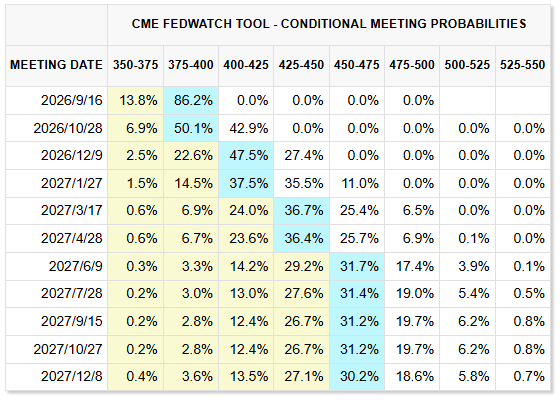
David Merrick, chief US economist at Goldman Sachs, directly changed his statement in the research report last Friday. From the previous “stand still” forecast to an interest rate hike of 25 basis points in September, the wording is also very straightforward — “In a situation where the probability of interest rate hikes is close to 90%, if the Fed chooses to stay on hold, it is likely to cause severe market fluctuations.” Even earlier, TD Bank and J.P. Morgan Chase, which had been hesitating, have also taken turns. KPMG's chief economist Diane Swonk summed up the current market consensus in one sentence: “The question now is no longer whether they will raise interest rates, but how much they need to raise interest rates to contain inflation.”
So what is the remaining 10% chance betting on? The bet is whether Federal Reserve Chairman Walsh can find a path of self-agreement between “hawkish statements” and “actual action.”
The “surface” and “inside” of inflation data
The August CPI data made it difficult for the market to continue telling the story of “inflation continues to decline.”
On the surface, the numbers don't look too bad — CPI rose 3.4% year over year, in line with expectations, and core CPI even fell to 2.4% year over year, the lowest since March 2021. But the devil lurks in Zubi. Core CPI rose 0.3% month-on-month, higher than expected 0.2%, the strongest monthly increase since April.
It's even more unsettling when taken apart. Housing prices rose 0.3% month-on-month, communication service prices soared 2.3%, and air ticket prices soared 2.7%. The price of wireless phone services jumped 5.94% in a single month, setting a record — Omair Sharif of Inflation Insights estimates that this alone contributed 10 basis points to the core CPI. This is no longer the “dominant force” in energy prices; price increases are spreading to a wider range of fields.
According to estimates by Stephen Brown, North America's chief economist at KITU Macro, based on CPI and PPI data, the Federal Reserve's most valued core PCE deflator will rise 0.28% month-on-month in August, which is enough to push core PCE from 3.3% to 3.4% year over year, far higher than the 2% target. Brown's judgment was straightforward — “The policy option to raise interest rates is likely to receive general support within the FOMC.”
Coupled with the 5.4% year-on-year increase in PPI for August, which was announced earlier this week, and the fact that Brent crude oil soared above $109 per barrel due to the situation in the Middle East, the upward pressure on inflation can no longer fool the past.
The “big test” of Walsh's credibility
For Walsh, this meeting was not of average weight.
The new chairman of the US Federal Reserve, who just took office in May of this year, was quite hawkish when he made his debut in Jackson Hole at the end of August. He said at the time that although summer inflation data was better than expected, “this doesn't tell me that the underlying trend has improved meaningfully” and that if policymakers fail to get confirmation that inflation is falling back towards the 2% target, they “still have work to do.” However, at the same time, Walsh declined to give a specific “response function,” and did not specify whether interest rate hikes were needed in September. “I stand here today and promise a discipline, not a decision.”
This line of rhetoric has sparked a delicate reaction in the market. In his report to clients, Sharif of Inflation Insights wrote: “For the Federal Reserve, now is the time to speak with action or shut up (put up or shut up).” What Sharif meant was straightforward — Walsh couldn't give a speech similar to Jackson Hole and not support a rate hike at the next meeting. Economists Anna Wong and Andrew Sacher also said bluntly that if the Federal Reserve does not raise interest rates, Walsh's credibility in the eyes of market participants will completely disappear.
This pressure doesn't come from nothing. Walsh's press conference after the July interest rate meeting failed to satisfy investors. JP Coviello, head of portfolio strategy at Citigroup Wealth, said: “The market is still a bit concerned about the independence of the Federal Reserve.”
In other words, the conference was not only an interest rate decision, but also a market pricing of Walsh's personal credit.
Long and short tug saw in US stocks
Expectations of interest rate hikes are heating up, and US stocks are clearly feeling the pressure.
The S&P 500 is still up nearly 12% this year, but recently it has continuously retracted, and is currently about 2% lower than its all-time high in mid-August. Investors are most wary of developments in the bond market — the 10-year US bond yield once hit 4.99%, approaching the “psychological line of defense” of 5%. Institutions such as J.P. Morgan Chase and Barclays have warned before that the 10-year US Treasury yield reaching 5% will cause investors to be very cautious about stock prospects.
Cayla Seder, a macro-multi-asset strategist at State Street, said: “We are in a period of uncertainty. Yields are rising, expectations of interest rate hikes are rising... the market needs to set a price for overall nervousness.”
But not everyone is bearish either. Goldman Sachs's latest research report on September 11 gave a reverse judgment: rising interest rates do not equal falling US stocks; profit growth is the key to a bull market. Goldman Sachs's argument is that the “yield difference” between the S&P 500 profit yield (5.2%) and the actual 10-year US Treasury yield (2.6%) is currently 270 basis points. It has remained quite stable over the past two years, and the allocation value of stocks compared to bonds has not deteriorated systematically.
Goldman Sachs also sorted out data from 7 interest rate hikes over the past few decades: within 3 months after the start of the rate hike, the average return for the S&P 500 was -2%, and there was only a 29% chance of achieving a positive return; however, within 12 months after the start of the rate hike, the average return for the S&P 500 was +9%, achieving positive returns every time except 2022. The 1997 case is particularly instructive — the Federal Reserve raised interest rates by only 25 basis points, and the S&P 500 immediately fell 10%, but when the market stopped tightening prices further, the stock market bottomed out and hit a new high within three months.
The logical chain behind this historical law is actually uncomplicated: the medium-term impact of interest rate hikes on the stock market ultimately depends on how monetary tightening affects profit growth. As long as corporate profits continue to grow, the lethality of valuation compression is limited. However, Goldman Sachs also warned that about 75% to 80% of the current value of the S&P 500 comes from forward cash flow of 10 years or more, which means that stock valuations are far more sensitive to long-term interest rates than short-term interest rates, and interest rate volatility itself is an additional source of risk.
Will a single rate hike start a new cycle of interest rate hikes?
If interest rates are actually raised, what the market is most concerned about is actually another question: is this a one-time “insurance rate hike”, or is it the beginning of a longer cycle of austerity?
“If it signals a cycle — say we have work to do — I don't think that's a good thing for the market,” BNY Wealth Chief Investment Officer Alicia Levine expressed this concern.
This difference is directly reflected in bond market pricing. After the CPI data was released in August, the 2-year US Treasury yield rose by about 4 basis points, and the 10-year term basically remained flat, while the 30-year term declined by 2 basis points, and the yield curve flattened out. This “short- and long-term” approach shows that the bond market is more inclined to interpret this rate hike as “the Federal Reserve is taking inflation targets seriously” rather than “the beginning of a new cycle of austerity.”
The next FOMC statement and Walsh's press conference will be critical moments to test this judgment. If the statement's wording is hawkish and suggests further action, the first reaction of the market may be a further flattening of the yield curve and pressure on the stock market. But if Walsh can send a signal that “this rate hike is a disciplinary response to inflation data, rather than a complete shift to austerity,” market tension may be eased.
Either way, the global market is going through a delicate moment. “If the Federal Reserve does not raise interest rates and the market rebounds as a result, I think this may be an opportunity to reduce holdings. Because there's another possibility — they won't move in September, but they might do it sometime later.”
This unresolved feeling is probably more unsettling for investors than the interest rate hike itself.