
- PRICING
- LIVE QUOTES
- LEARN
- HELP


EN
On the eve of the 5% mark, the US debt sell-off storm posed a problem for the market and the Federal Reserve
The Zhitong Finance App learned that a wave of sell-offs in the bond market has pushed the yield on a key US Treasury bond to a level close to 5%, increasing concerns from Wall Street to Washington about rising borrowing costs impacting the US economy.
Benchmark 10-year Treasury yields jumped to 4.97% at the end of last week after soaring oil prices were likely to bring a new wave of inflationary shocks and the Trump administration's efforts to ease pressure on the government debt market failed. This is just one step away from the high in October 2023 — when the yield briefly topped 5% in a single trading session, then declined due to an influx of buying orders.
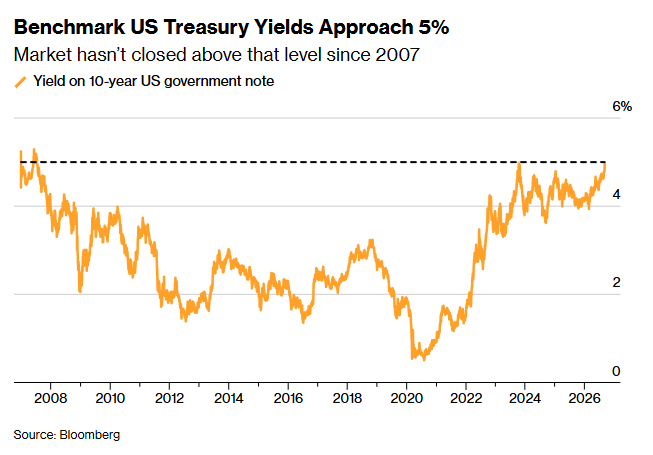
The recent sell-off has heightened the risks faced by Federal Reserve Chairman Walsh before the interest rate meeting on Wednesday local time. On Friday, the market stabilized only after data showed that consumer price increases in the previous month exceeded expectations, strengthening speculation that policymakers will start raising interest rates to curb inflation that has surpassed the target for five consecutive years.
“The Federal Reserve is clearly lagging behind the situation,” said Tracy Chen, portfolio manager at Brandywine Global Asset Management. “Yields will continue to rise in the medium term.”
She said this is because some of the factors driving long-term higher yields — such as the impact of inflation caused by the war in Iran — are not within the control of policymakers. “I'm not sure exactly how high it will rise, but I think it will definitely surpass 5%.”
Three forces “draw blood” at the same time
Global bond yields have been rising since US President Trump launched war against Iran in late February, disrupting Middle Eastern oil and gas supplies. In the US, the artificial intelligence (AI) boom — injecting large amounts of debt into the market and boosting the economy — and concerns about the federal government's growing deficit have also played a role in fueling it.
The rise in yields made Trump very difficult, as it affected the entire market, driving up the cost of mortgages and other loans ahead of November's midterm elections.
Earlier this month, he threatened to cut off all trade between the US and some countries if the Federal Reserve did not cut interest rates — a move that would almost certainly worsen bond sell-off by increasing concerns about inflation. Treasury Secretary Bezent tried to curb the rise in bond yields by increasing Treasury debt buybacks, but investors reacted lukewarm after his first such operation, and yields soared last week.
As the prospects for the Middle East conflict to end are slim, investors are preparing for the risk of continuing sell-off in the bond market. Ian Lyngen, head of US interest rate strategy at BMO Capital Markets, said he expects 10-year Treasury yields to break through 5% “in a very short period of time.”
What does 5% really mean?
Breaking through this level is not inherently significant — the yield has never closed above 5% since 2007. However, this type of integer threshold is often viewed as a critical turning point, and may catalyze the decision-making of investors and policymakers.
US Treasury yields are particularly important because they are the benchmark for other loans. In the stock market, they are also used as discount rates to measure the present value of expected profits over the next few years. The higher the rate of return, the smaller the present value after conversion of forward profits.
Some investors say this may begin to weigh on stocks — the stock market is still hovering near historic highs due to strong profits and economic resilience brought about by the AI boom. Furthermore, high bond yields may trigger capital outflows from the stock market, as higher returns will attract investors to bonds.
“If you see bond yields rise to 5% or 5.25%, I think there will be some digestive adjustments in the stock market at that time,” said Grace Peters, head of global investment strategy at J.P. Morgan Chase Private Bank. “The 5% mark has a strong psychological effect.”
According to a previous survey of 122 market participants, about 30% thought that a 10-year yield of 5% to 5.25% would be enough to trigger a 10% drop in US stocks from their peak — that is, a technical correction; another 22% set the trigger threshold between 5.25% and 5.5%. Notably, however, more than two-thirds of respondents believe that the real danger sign is not the absolute level of yield, but the rate at which it is rising. A disorderly and rapid sell-off is the biggest risk.
Macro strategist Brendan Fagan said, “Inflation is still significantly above target levels, and the federal government needs to finance huge deficits in an already heavy supply environment. If nominal economic activity remains near current levels, and the Federal Reserve has acquiesced to accept 3% inflation as 2%, long-term interest rates will inevitably rise.”
Last week's turbulence — two-year US Treasury yields saw the biggest one-day increase since Trump's tariffs disrupted the market in April 2025 — increased pressure on the Federal Reserve.
This is because part of the sell-off in recent months stemmed from doubts about Walsh. At the press conference after the first meeting in June, he stressed his focus on bringing inflation back to the central bank's 2% target. However, after the July meeting, the Federal Reserve once again kept interest rates unchanged, and traders sold longer-term bonds because they doubted whether he would deliver on his promises.
On Friday, after the US Department of Labor reported that one of the core inflation indicators had risen more than expected, traders were betting that this would probably force the Federal Reserve to take action. The futures market is starting to price the probability that the Federal Reserve will raise interest rates by 25 basis points after the upcoming meeting is about 90%.
“The more the Federal Reserve can demonstrate its credibility in fighting inflation, the more likely it is to reduce the risk premium on the long end of the treasury bond yield curve in the medium term,” said Daleep Singh, chief global economist at PGIM Credit.
Even so, some other factors that have boosted yields continue. The federal deficit reached $2 trillion in the first 11 months of this fiscal year. Last week, Trump proposed that if the Republican Party continues to control Congress after the upcoming election, he could issue a check of $5,000 to every American adult, with a total expenditure of more than $1 trillion — a “serious proposal” according to the White House economic adviser. The Middle East conflict also continues to escalate, pushing oil prices to a four-month high.
J.P. Morgan's team of strategists led by Jay Barry said they expect interest rate hikes this week, but they are “biased” on long-term US debt due to traders likely reacting to the Fed's statement and the Wash press conference. Others have also expressed caution, believing that if the Federal Reserve surprises investors, the sell-off could be rekindled.
“If the Federal Reserve doesn't raise interest rates, the long-term sell-off is likely to become more disorderly,” said Ed Al-Hussainy, portfolio manager at Columbia Threadneedle.