
- PRICING
- LIVE QUOTES
- LEARN
- HELP


EN
Oil Is $100, The 10-Year Is Near 5%. Why Doesn’t The Stock Market Care?
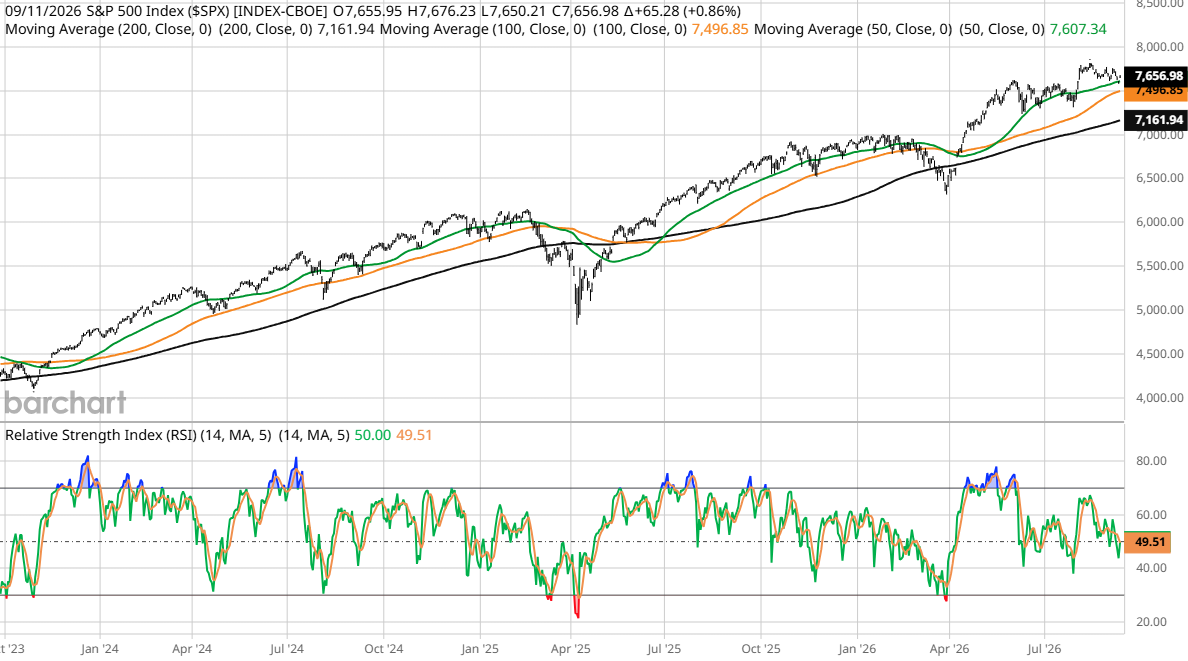
I tweeted something on X Friday night that received a lot more attention than I anticipated. It was just a list of things investors were looking at: oil around $100, the 10-year Treasury near 5%, inflation at 3.4%, and another Fed rate hike increasingly imminent. Below that, the S&P 500 was up 0.86 percent. That’s a weird combination.
I have been in this business a longtime, and normally, when you put those ingredients together, investors at least get nervous. This time they didn’t. The VIX fell. Most sectors finished higher. There was no sense of panic, and most investors seemed willing to stay ahead of the Fed.
My initial reaction was that the market simply doesn’t care. I don’t quite believe that, though. Markets care about everything eventually. What they are really doing now is looking through a set of risks that would normally get much more attention because, so far, they haven’t done much damage to earnings.
People can spend too much time looking at the level of the 10-year or trying to guess what Jerome Powell will say at the next meeting. Those things matter, but they only really become a problem for stocks when they start showing up in the numbers companies report. A 5% Treasury yield on its own doesn’t cut anybody’s earnings. The pain comes when a company must refinance debt that used to cost 3% at 6% or 7%, or when a project that made sense with cheap money suddenly doesn’t make sense anymore. That takes time. We may be somewhere in that gap now.
Rates have been high for a while, but a lot of corporate America is still living on financing put in place when money was much cheaper. That debt doesn’t all reset on the same day. It rolls over gradually. And so, it is for customers. Eventually, higher borrowing prices hit the mortgages, auto loans, credit cards, and spending, but it’s not a switch somebody turns the moment the 10-year crosses 5%.
Oil is similar. $100 looks ugly on a screen, but if it lasts for a few weeks and comes back down, most companies get through it. If it stays there for six months, that is a different situation. Delivery costs go up, airlines pay more, manufacturers pay more, and consumers spend more at the pump and less somewhere else. Companies then must decide whether to swallow the higher cost or pass it on. Neither option is particularly attractive. The market seems to be betting that neither high oil nor high rates will stay painful for long enough to do real damage. It is probably right.
That is probably why I would not look at this setup and immediately get bearish. I have seen enough markets to know that a scary macro backdrop does not automatically mean stocks fall. Sometimes the economy is simply stronger than people think. Sometimes companies earn their way through it. Occasionally the thing everybody is worried about turns out not to be the thing that matters.
Corporate earnings have certainly held up better than many expected. AI spending is also throwing an extraordinary amount of money into the economy. Data centers, chips, networking, power, cooling, and construction—there is a huge capital cycle underway, and plenty of companies are benefiting from it. That helps explain why the market has been able to shrug off things that would normally worry investors.
But there is a slightly uncomfortable side to that as well. Many of the companies driving this spending are committing large amounts of capital, and at some point, the return on that capital will have to show up. Investors have been pleased to reward the spending. The next question is whether they are equally happy when they start asking what all of it earns.
The risk is probably not that one bad inflation report suddenly knocks 10% off the S&P 500. It is that several pressures sit around for longer than expected and slowly work their way into profits. Oil stays high. Rates stay high. Refinancing gets more expensive. Consumers become a little more cautious. Margins are getting a little tighter. None of those things look dramatic by itself, but eventually analysts start trimming numbers.
That is why I am less interested in whether the Fed hikes 25 basis points this week than most people seem to be. We will know that soon enough. I care much more about where rates are three or six months from now and whether companies start talking differently about earnings calls. Are financing costs becoming a problem? Are customers delaying orders? Are projects being pushed out? Are margins starting to be squeezed? Those are the things I would watch.
It also makes individual stock selection more important. At The Edge, we spend most of our time looking for situations where something inside a company is changing and the market has not fully caught up with it. That feels a lot more useful to me right now than trying to decide whether the S&P should be 3% higher or 3% lower next month. With Treasuries yielding close to 5%, investors have a real alternative to equities again. A stock must earn its place in a portfolio.
I make a similar point in Price Catalysts. A cheap stock can stay cheap for years if nothing changes. The same goes for a good company trading at too high a price. There needs to be something that moves expectations. In the broader market today, earnings are still doing that job. They are giving investors enough confidence to look past oil, rates, and the Fed.
What surprised me on Friday was not really that the S&P went up. Stocks go up on bad news all the time. What surprised me was how little fear surrounded any of it.
Maybe investors have their predictions exactly right, and corporate earnings continue to hold up. But if oil stays around $100 and the 10-year stays near 5%, I will be watching earnings expectations closely. The market can ignore a number on a screen for a long time. It is much harder to ignore it when it turns up in the income statement.
On the date of publication, Jim Osman did not have (either directly or indirectly) positions in any of the securities mentioned in this article. All information and data in this article is solely for informational purposes. For more information please view the Barchart Disclosure Policy here.