
- PRICING
- LIVE QUOTES
- LEARN
- HELP


EN
Sonera Acquisition Bodes Well for Apple Stock in the Long Term, But Negative Catalysts Appear to Be Weighing on the Firm’s Performance
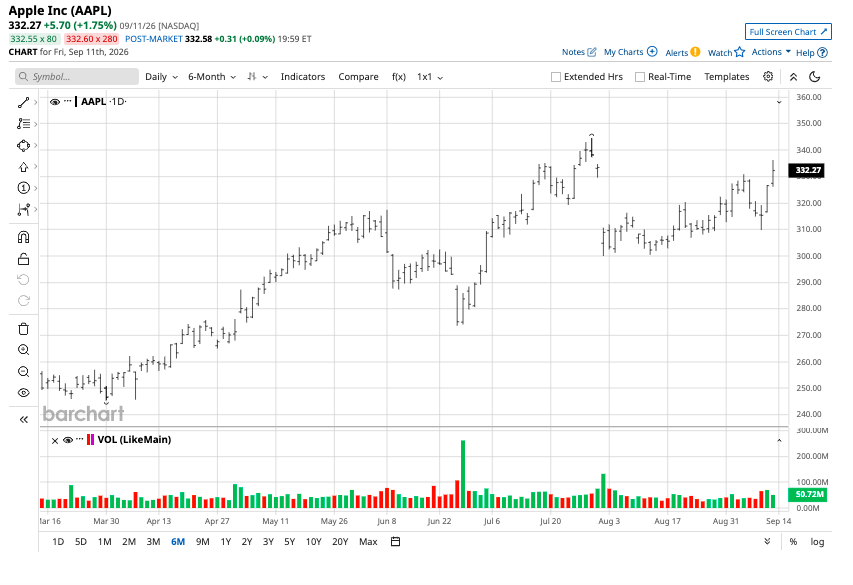
Apple (AAPL) recently decided to buy startup Sonera, which has reportedly developed a neural-data technology tool. The move could boost Apple stock within the next few years and bodes well for the company's long-term outlook. In the medium term, however, AAPL stock is unlikely to surpass the returns of the Nasdaq-100 by a significant margin, as the company continues to face multiple, negative catalysts. Weaker-than-expected revenue-growth guidance for the current quarter also suggests that these factors are beginning to weigh on Apple's performance. Let's take a closer look.
The Sonera Acquisition Bodes Well for Apple's Long-Term Outlook
Earlier this year, Apple agreed to buy California-based startup called Sonera, which the European Commission disclosed on Sept. 8. The startup reportedly utilizes "breakthrough sensing technology" which allows it to analyze human brains without making direct contact with individuals' bodies.
In a 2023 press release, Sonera stated that its systems can allow "brain activity [to be] as easy to measure as heart rate, temperature, and other physiological signals." The company has reportedly developed "advanced prosthetics control, continuous monitoring of neuromuscular conditions, discovery of disease biomarkers, and sport performance tracking," among other capabilities.
With that said, Sonera's technology sounds like it could eventually allow Apple devices to measure human activity in ways that competing products cannot. Consequently, the technology may meaningfully boost the demand for many of Apple's product offerings in the future.
Perhaps more importantly, under new CEO John Ternus, this acquisition may signal that Apple is becoming more interested in developing and obtaining new, ground-breaking technologies. With that potential in mind, I believe such systems could enable AAPL stock's gains to meaningfully accelerate in the long term.
Negative Catalysts Still Weigh on Growth and Margins
Still, Apple faces several negative catalysts that could weigh on AAPL stock in the near and medium term.
Earlier this year, higher memory costs caused Apple to raise prices on its Macs and iPads by about 16% to 20%. Moreover, Apple recently decided to hike prices for both its current and upcoming iPhones by $100 in the United States — and by even more in some international markets, at least on a percentage basis.
There are signs that these price increases could be negatively impacting the company's performance. In July, Apple provided year-over-year (YOY) revenue growth guidance for the current fiscal quarter of 9% to 11%, coming in below analysts' average estimate of about 12% growth. Excluding tariff refunds, Apple also predicted that its gross margin for the current quarter will come in at 46% to 47%, down significantly from the gross margin of 50.1% the company reported in fiscal Q3.
Additionally, due to memory shortages, Apple reportedly slashed its China production output for the standard iPhone 17 by about one-third in July 2026. Former CEO Tim Cook recently suggested that supply constraints could negatively affect Apple's results during the current quarter while demand remains high, although Apple's huge cash reserves and status as a gigantic consumer should enable it to overcome some supply issues.
Overall, AAPL stock has a consensus “Moderate Buy” rating on Wall Street. Out of 41 analysts with coverage, 21 have a “Strong Buy” rating, three have a “Moderate Buy,” 13 have a “Hold” rating, two have a “Moderate Sell,” and two analysts have a “Strong Sell” rating.
On the date of publication, Larry Ramer did not have (either directly or indirectly) positions in any of the securities mentioned in this article. All information and data in this article is solely for informational purposes. For more information please view the Barchart Disclosure Policy here.