
- PRICING
- LIVE QUOTES
- LEARN
- HELP


EN
Yum China (YUMC) Stock Could Be Cheap On Cash Flow And Earnings
Yum China Holdings has seen its share price fall over the past few years, yet both an intrinsic value estimate and traditional market multiples currently point to the stock trading at a discount. That disconnect between a weak share price record and signals of potential undervaluation is what investors now have to weigh.
- The share price has declined 22.6% over the past 3 years, which means recent buyers have faced a difficult run despite the underlying business continuing to trade.
- Future cash generation from Yum China Holdings can support the current equity value if management keeps converting revenue into steady free cash flow, but any sustained hit to restaurant traffic or margins would quickly challenge that case.
- The broader checks lean cheap, with the company screening as undervalued in 6 out of 6 valuation tests based on both intrinsic value estimates and earnings multiples.
For investors, the debate is whether Yum China Holdings deserves that discounted sticker or whether the current price already underestimates the firm’s long term cash flow potential.
Scan beyond Yum China Holdings and compare its setup with 32 high quality undervalued stocks that also screen as cheap on both intrinsic value estimates and traditional market multiples.
Does Yum China Holdings Look Undervalued on Cash Flow?
The Discounted Cash Flow model values Yum China Holdings by projecting the cash it can return to shareholders and discounting that stream back to today. On the latest numbers, the group generated about $873 million of free cash flow over the last twelve months, and the model assumes that this cash generation grows from here rather than shrinking.
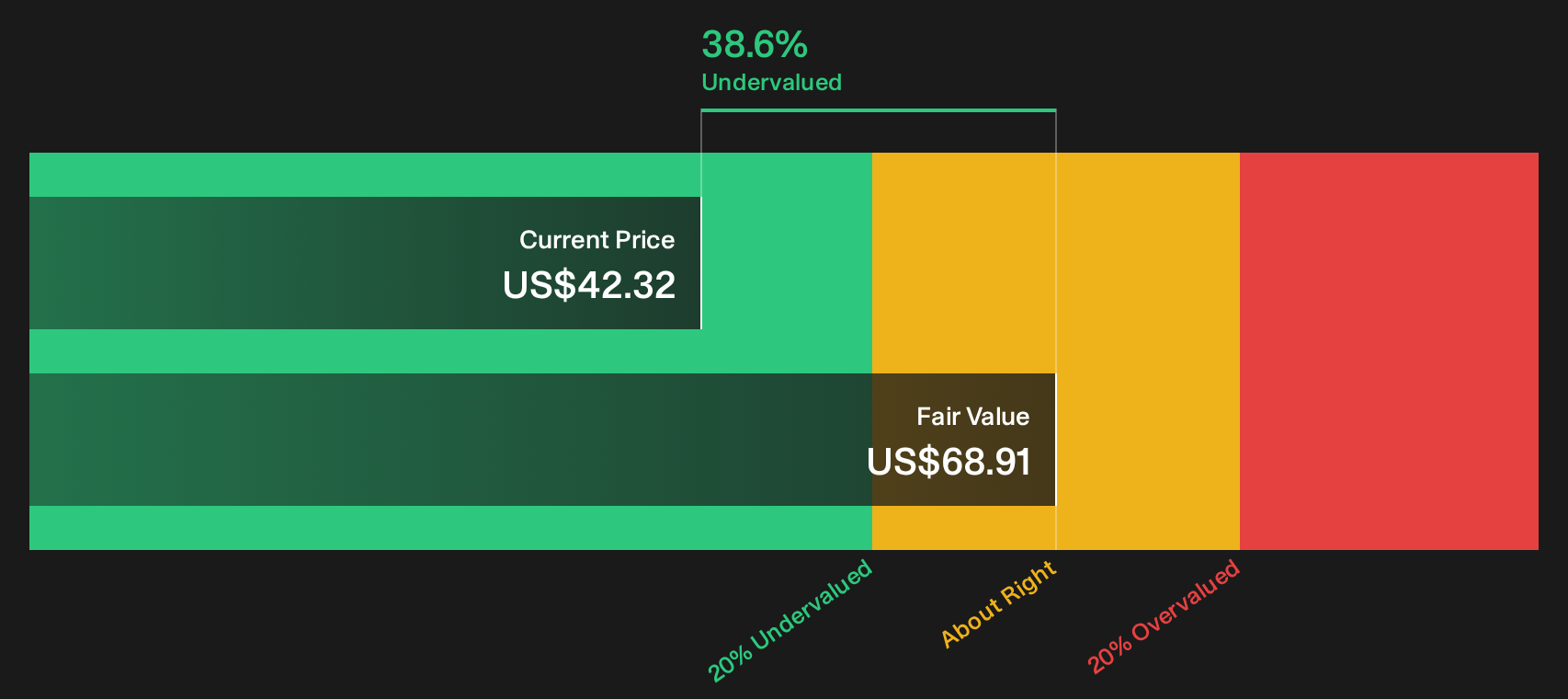
On those inputs, the Discounted Cash Flow output lands at an intrinsic value of about $69 per share, which sits well above the current market price and implies the stock screens roughly 38.6% undervalued. The free cash flow profile behind that result is not explosive, yet it is steady enough in the model to support a valuation that the market is currently not paying for.
Put together, the DCF work suggests Yum China Holdings currently appears undervalued relative to the cash flows analysts expect it to produce.
Our Discounted Cash Flow (DCF) analysis suggests Yum China Holdings is undervalued by 38.6%. Track this in your watchlist or portfolio, or discover 32 more high quality undervalued stocks.
Is Yum China Holdings a Bargain on Earnings?
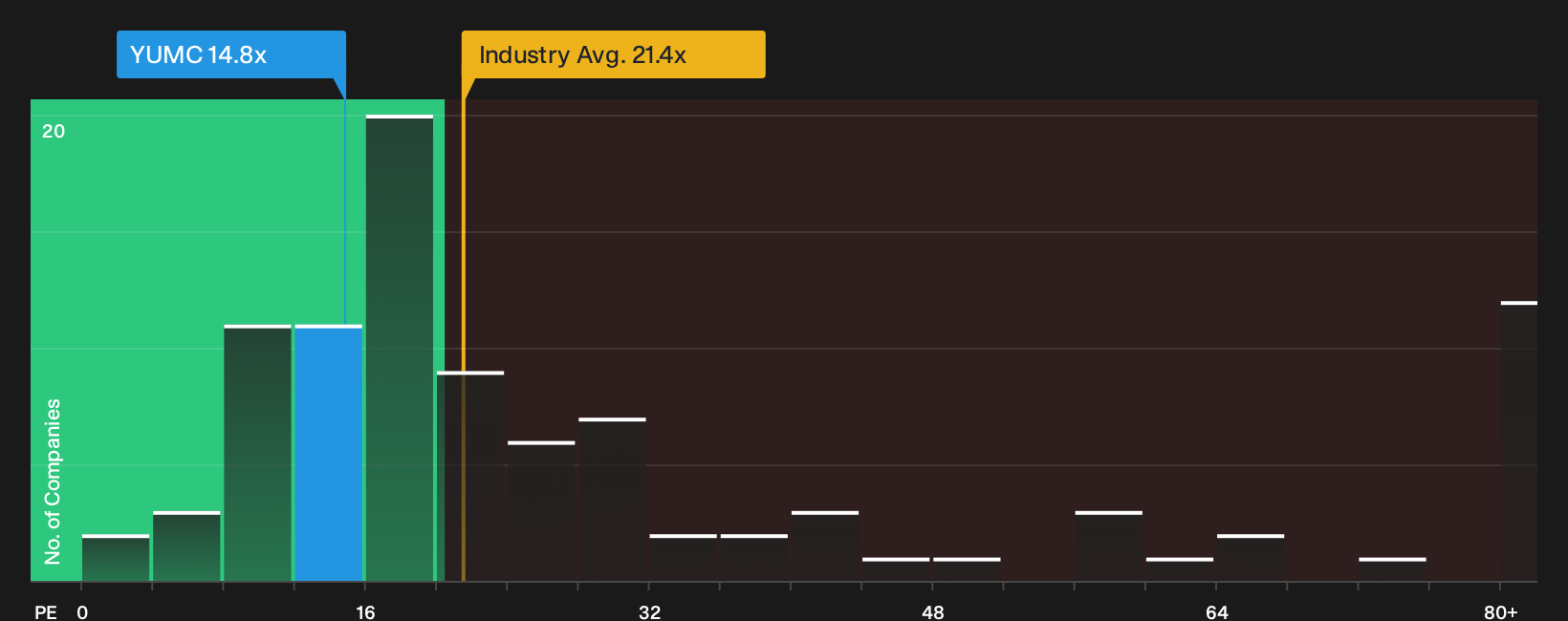
P/E suits Yum China Holdings because earnings remain a key anchor for how investors judge consumer brands with steady cash generation potential. On this score, the stock trades on about 14.8x earnings, which sits well below the Hospitality sector average of roughly 21.4x and a peer group closer to 26.5x. That is a wide gap for a large, established restaurant operator.
The fair P/E multiple derived for Yum China Holdings is about 21.4x, which reflects what investors might reasonably pay given its size, industry, and risk profile. Set against that yardstick, the current 14.8x implies a sizeable discount, since the share price would need to rise meaningfully to close the space between the present earnings multiple and this fair ratio. For anyone comparing options across restaurant chains, this kind of spread suggests the market is applying a relatively cautious earnings label to Yum China Holdings.
On the P/E lens alone, Yum China Holdings stock appears undervalued relative to both its tailored fair multiple and the broader Hospitality sector.
See what the numbers say about this price — find out in our valuation breakdown.
The Yum China Holdings Narrative: What Would Justify Today's Price?
Simply Wall St Narratives pick up where the Yum China Holdings valuation puzzle leaves off by spelling out which assumptions about future growth, margins and earnings would need to hold for the shares to be worth materially more or materially less than today. Each narrative links a fair value estimate to a particular storyline about Yum China Holdings' potential catalysts and key risks, so you can watch over time which version of events lines up with reality on the Community page.
Share a narrative on Yum China Holdings' valuation to present a clear, number-driven view of where its growth, margins, and execution go from here. Add your voice to the Simply Wall St community and track how your thesis holds up as new results arrive.
Do you think there's more to the story for Yum China Holdings? Head over to our Community to see what others are saying!
The Bottom Line
Yum China Holdings screens as undervalued on both the Discounted Cash Flow (DCF) intrinsic value estimate and its current earnings multiple, so the core question is whether that gap reflects caution or mispricing. The DCF work points to meaningful upside to intrinsic value, while the P/E comparison suggests the market is assigning a relatively low earnings label to the group. What matters from here is whether Yum China Holdings can keep turning its restaurant footprint into reliable free cash flow without a lasting hit to traffic or margins, since that will decide whether today’s discount proves to be an opportunity or a warning.
This article by Simply Wall St is general in nature. We provide commentary based on historical data and analyst forecasts only using an unbiased methodology and our articles are not intended to be financial advice. It does not constitute a recommendation to buy or sell any stock, and does not take account of your objectives, or your financial situation. We aim to bring you long-term focused analysis driven by fundamental data. Note that our analysis may not factor in the latest price-sensitive company announcements or qualitative material. Simply Wall St has no position in any stocks mentioned.
Have feedback on this article? Concerned about the content? Get in touch with us directly. Alternatively, email editorial-team@simplywallst.com