
- PRICING
- LIVE QUOTES
- LEARN
- HELP


EN
Teradyne (TER) Launches New AI Test Tools On A Fair Value Debate
Teradyne (TER) has just expanded its UltraFLEXplus test platform with three new instruments aimed at AI and data center chips, a move that could reshape how investors view the stock’s role in advanced semiconductor testing.
Teradyne’s new UltraFLEXplus instruments arrive after a powerful run, with the share price up 82.94% year to date and a 1-year total shareholder return of 238.97%, even though the 30-day and 90-day share price returns declined 9.33% and 12.19% respectively. Recent days have seen momentum pick up again, with a 2.57% 1-day and 6.36% 7-day share price return, as the market weighs these AI focused product launches in relation to the sharper share price pullback in recent months and reassesses both growth potential and risk around the current US$379.72 level.
Spot opportunities across the wider AI hardware chain by scanning the hand picked 89 AI infrastructure stocks alongside Teradyne’s push into advanced data center testing.Teradyne now trades near its highs again after a sharp pullback and a powerful rebound. Do the current fundamentals and AI test exposure still justify paying this price, or has the balance swung toward risk?
Most Popular Narrative: 14.1% Undervalued
Teradyne’s most followed valuation story pegs fair value at $442.20, above the recent $379.72 close, which puts a spotlight on the growth assumptions baked into that gap.
Teradyne expects significant future growth potential from AI accelerators, robotics, and semiconductor automation, which are being driven by long-term industry themes such as AI, verticalization, and electrification. These areas are likely to boost future revenue.
Read the complete narrative. Read the complete narrative.
Want to see what kind of revenue ramp, margin profile, and future earnings scale that narrative is leaning on? The full breakdown shows exactly which long term assumptions have to line up to support that $442.20 fair value and why the discount rate applied matters so much to where Teradyne trades today.
Result: Fair Value of $442.20 (UNDERVALUED)
Have a read of the narrative in full and understand what's behind the forecasts.
Still, Teradyne’s AI test story leans heavily on analyst forecasts that could crack if tariffs, trade policy shifts or weaker robotics demand hit customer spending.
Find out about the key risks to this Teradyne narrative.
Another View: Teradyne Through The P/E Lens
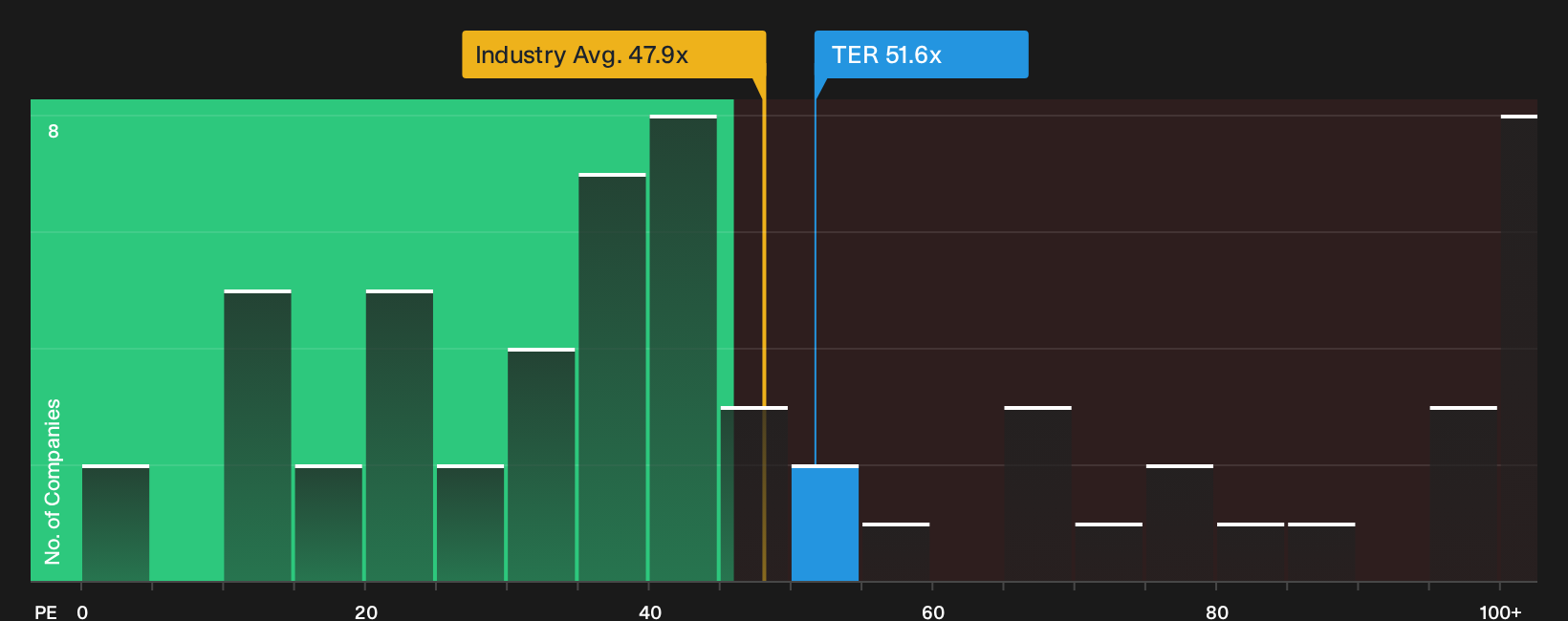
There is a very different message when you look at Teradyne through its P/E ratio. The shares trade on 51.6x earnings, compared with 47.9x for the US Semiconductor group and 51.3x for close peers, while the fair ratio sits lower at 41x. That points to a valuation where expectations already do a lot of the work, so the question becomes whether you are comfortable paying a higher price for this AI test story.
See what the numbers indicate about this price in the valuation breakdown, then weigh it against your own view on Teradyne’s growth and risk profile. See what the numbers say about this price — find out in our valuation breakdown.
Next Steps
If this Teradyne story feels finely balanced between excitement and concern, act quickly on your own research and pressure test the assumptions yourself with the 2 key rewards and 2 important warning signs.
Looking for more Teradyne sized ideas?
If the Teradyne setup has your attention, do not stop here. Use the wider market to pressure test your thinking and uncover fresh possibilities.
- Target resilience by scanning companies with strong finances and cleaner balance sheets through the list of solid balance sheet and fundamentals (23 results).
- Hunt for mispriced quality and see which businesses screen as 32 high quality undervalued stocks before enthusiasm catches up.
- Spot early stage potential by reviewing a curated group of 21 elite penny stocks with strong financials that already show stronger fundamentals than typical micro caps.
This article by Simply Wall St is general in nature. We provide commentary based on historical data and analyst forecasts only using an unbiased methodology and our articles are not intended to be financial advice. It does not constitute a recommendation to buy or sell any stock, and does not take account of your objectives, or your financial situation. We aim to bring you long-term focused analysis driven by fundamental data. Note that our analysis may not factor in the latest price-sensitive company announcements or qualitative material. Simply Wall St has no position in any stocks mentioned.
Have feedback on this article? Concerned about the content? Get in touch with us directly. Alternatively, email editorial-team@simplywallst.com