
- PRICING
- LIVE QUOTES
- LEARN
- HELP


EN
GF Securities Says NAND Prices May Stabilize Later This Year. What This Means for Sandisk Stock.
Chinese financial services firm GF Securities has cautioned that NAND prices will stabilize by the end of the year. For NAND king SanDisk (SNDK), this is particularly relevant as analyst Jeff Pu said, "We maintain our high‑teen QoQ NAND price expectation for 3Q26 but expect softening in 4Q26 to low single‑digit QoQ, pressured by weaker mobile demand and elevated mobile/PC inventories. Hyperscaler NAND inventory remains healthy at ~14 weeks (vs. ~15‑week normal), but the softer pricing outlook could slow pull‑ins."
This follows almost one-and-a-half years of strong NAND price growth, as AI drove a significant rise in enterprise SSD demand for training datasets, inference workloads, and model updates, among other use cases.
About SanDisk
Founded in 1988 with the current Micron (MU) CEO Sanjay Mehrotra on its founding team, SanDisk is one of the world's leading flash memory companies and a pioneer in NAND storage technology. The company designs and manufactures NAND flash memory, solid-state drives (SSDs), embedded storage, removable memory cards, USB flash drives, and enterprise storage solutions for consumer electronics, personal computers, smartphones, automotive systems, and AI data centers.
Valued at a market cap of $254.5 billion, SNDK stock has rallied by 643.2% on a YTD basis.
So, can this potential rationalization in NAND prices affect the broader thesis around SanDisk? Not really, and here's why.
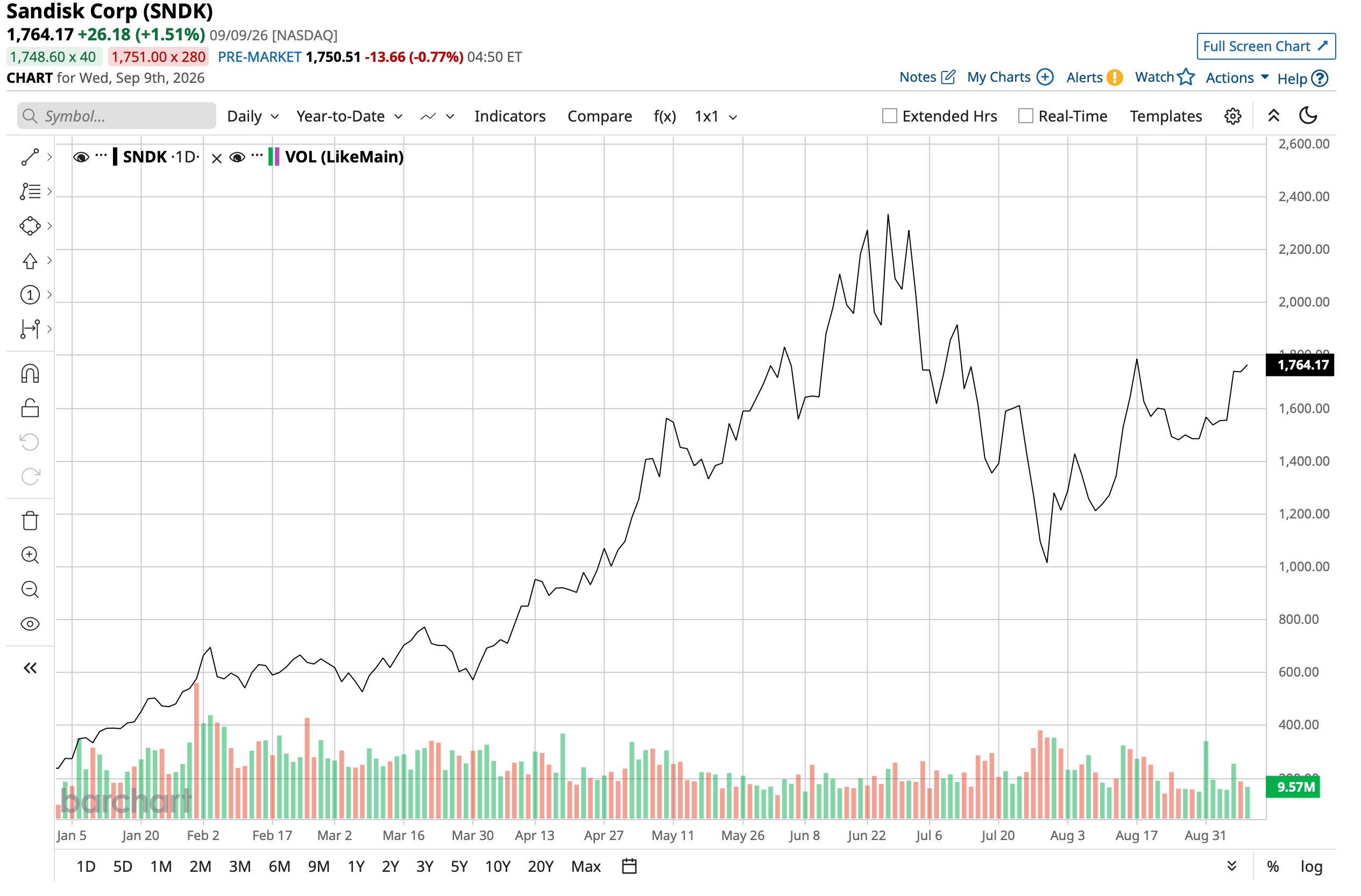
Still The King In a Growing Kingdom
In an earlier analysis, I had made the case as to why SanDisk — being the only pure-play NAND player in the market — has a competitive advantage in the space. With a market share of 11%, it may be behind the memory giants of Samsung, SK Hynix (SKHY), and Micron (MU) in terms of market share now. Yet, SanDisk remains well-positioned to capture a market that is projected to reach about $96.1 billion by 2030.
How? Well, the company's Investor Day provided a glimpse into its strategic vision. The New Business Model, or NBM, will play a crucial part here. NBM replaces the old habit of renegotiating NAND pricing every quarter with multi-year supply contracts. SanDisk has signed NBMs with eight customers — three of them US hyperscalers — covering roughly half of fiscal 2027 bit output and about two-thirds of fiscal 2028 output. The average contract length runs past four years, and the longest stretches to five. Total contract value across those eight customers stands at $93.9 billion, with $91.1 billion still to be delivered, and SanDisk has backstopped the arrangement with $16.5 billion in financial guarantees from third-party institutions.
Management paired this with a fiscal 2028 through 2030 framework targeting mid-to-high teens revenue growth, about 80% non-GAAP gross margin, roughly 75% operating margin, and a policy of returning 100% of excess cash to shareholders, on top of an existing $6 billion buyback authorization.
On the product side, the growth lever is QLC, not just TLC or HBF. SanDisk's UltraQLC platform, built on BiCS8 QLC dies paired with a Direct Write architecture that skips pseudo-SLC caching, already ships a 256TB enterprise SSD, with 512TB targeted for 2027 and a petabyte-class drive teased beyond that. This is a direct assault on the hard drive tier of the data center, since QLC SSDs now undercut HDD arrays on power and rack density even if not yet on raw cost per gigabyte.
Underneath that sits a genuinely new manufacturing trick, CMOS directly bonded to array, or CBA, which SanDisk and Kioxia used in August 2026 to unveil a 10th-generation QLC die reaching 37 gigabits per square millimeter, a 60% density jump over the eighth generation, while hitting a 4.8 gigabit per second interface. Because CBA lets the logic wafer and the memory array wafer be built and optimized separately before bonding, SanDisk can add density and speed without a proportional jump in capital spending, which is how management justifies its claim of roughly 27% annual growth in bits per wafer.
A Fruitful Q4
SanDisk ended its fiscal year with quite a solid showing. Both revenue and earnings exceeded Street expectations. Notably, revenues grew by almost five times from the previous year to $8.97 billion as gross margins made an unbelievable leap to 84.6% from 26.4% in the year-ago period. Its largest segment, Edge, which is the storage that goes inside devices outside the centralized data centers, saw a YoY jump in revenues of 392%, coming in at $5.43 billion. Datacenter revenues were about $3 billion, up from $213 million in the last year.
Earnings also saw a massive rise to $39.25 per share from a mere $0.29 per share a year ago. This also came in higher than the consensus EPS estimate of $34.51. Since it started trading as a separate stock last year, SanDisk's earnings have never missed Street estimates.
The strength is also reflected in the company's cash flows. Q4 saw SanDisk generating net cash flow from operating activities of $7.13 billion compared to just $94 million in the previous year. Overall, SanDisk closed the quarter with a cash balance of $4.76 billion, with no short-term debt on its books.
And despite the searing rally, SNDK stock trades at undervalued levels. Its forward P/E and P/CF of 8.12 and 9.23, respectively, are lower than the sector medians of 22.86 and 19.77, respectively. Moreover, the forward P/S of 5.20 is just above the sector median of 3.42.
Analyst Opinion on SNDK Stock
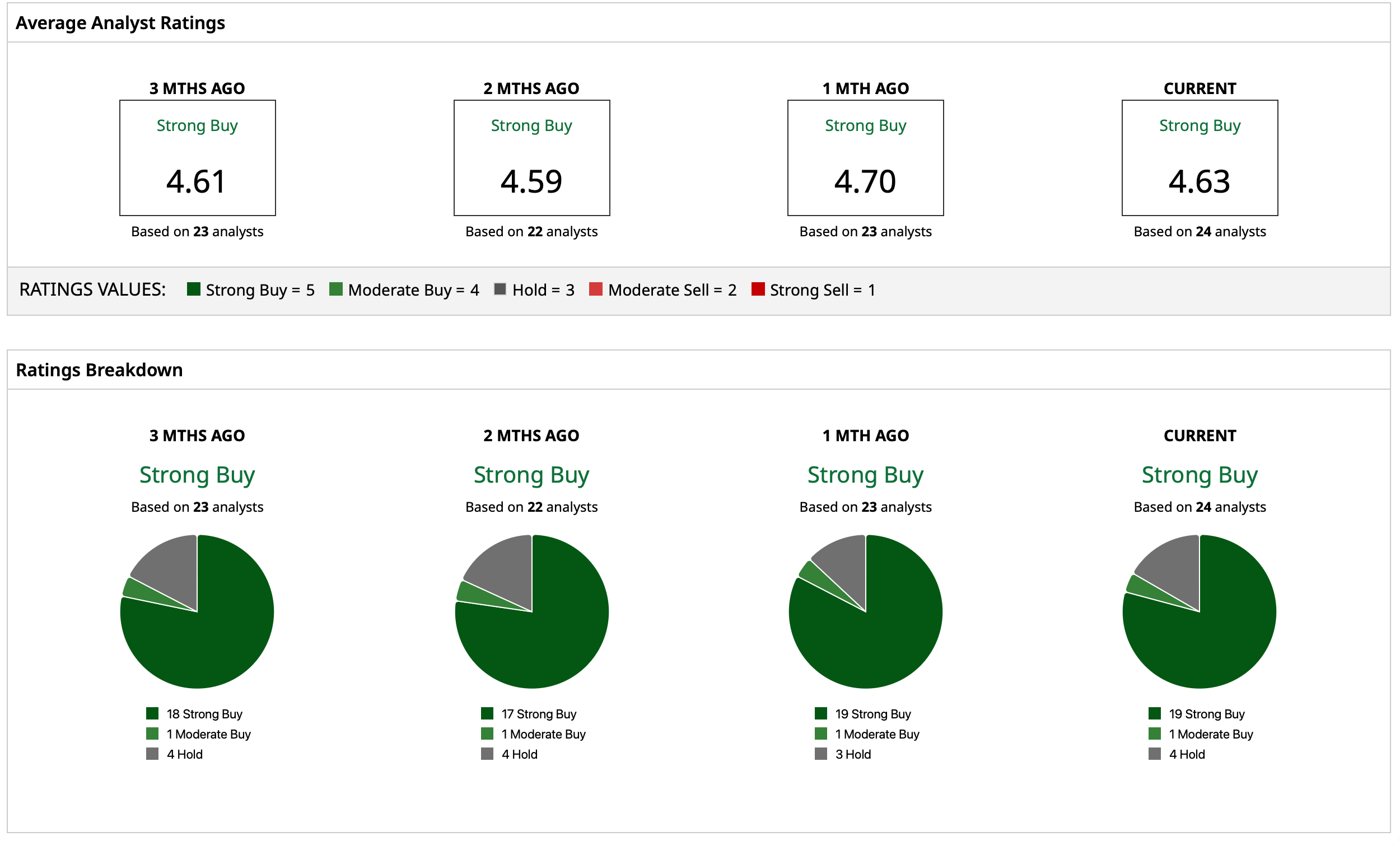
Thus, analysts have deemed SNDK stock to be a consensus “Strong Buy,” with a mean target price of $2,194.42. This denotes a potential upside of 15% from current levels. Out of 21 analysts covering the stock, 17 have a “Strong Buy” rating, one has a “Moderate Buy” rating, and three have a “Hold” rating.
On the date of publication, Pathikrit Bose did not have (either directly or indirectly) positions in any of the securities mentioned in this article. All information and data in this article is solely for informational purposes. For more information please view the Barchart Disclosure Policy here.