
- PRICING
- LIVE QUOTES
- LEARN
- HELP


EN
SouthState Bank (SSB) Stock Still Looks Below Fair Value As 85% Return Holds
SouthState Bank has delivered a strong 85.5% total return over five years, yet current valuation checks suggest the stock may still trade below what its fundamentals imply. The Excess Returns intrinsic value estimate and the market based multiples both point in the same direction, which puts extra focus on whether the market is underpaying for the bank's earnings power.
- Over the past 5 years, SouthState Bank has returned 85.5%, which raises the question of how much of that performance is already reflected in today's share price.
- Future loan growth and credit quality can support the case for further value creation, while any rise in funding costs or loan losses may weigh on how investors price the bank's equity.
- Across the broader checks, SouthState Bank screens as a high value stock, and the 5 out of 6 value score indicates the shares appear inexpensive on several fronts.
The issue now is whether SouthState Bank's current share price already reflects its long term return record or if the intrinsic value estimate still leaves a meaningful discount for new capital.
Scan beyond SouthState Bank and compare this setup with 31 high quality undervalued stocks that also screen well on fundamentals yet still trade as if the market is underestimating their earnings power.
Does SouthState Bank Look Undervalued on Excess Returns?
The Excess Returns model looks at how effectively SouthState Bank turns shareholder capital into profit after covering its cost of equity. It is essentially asking how much value the bank can create above a required return for investors.
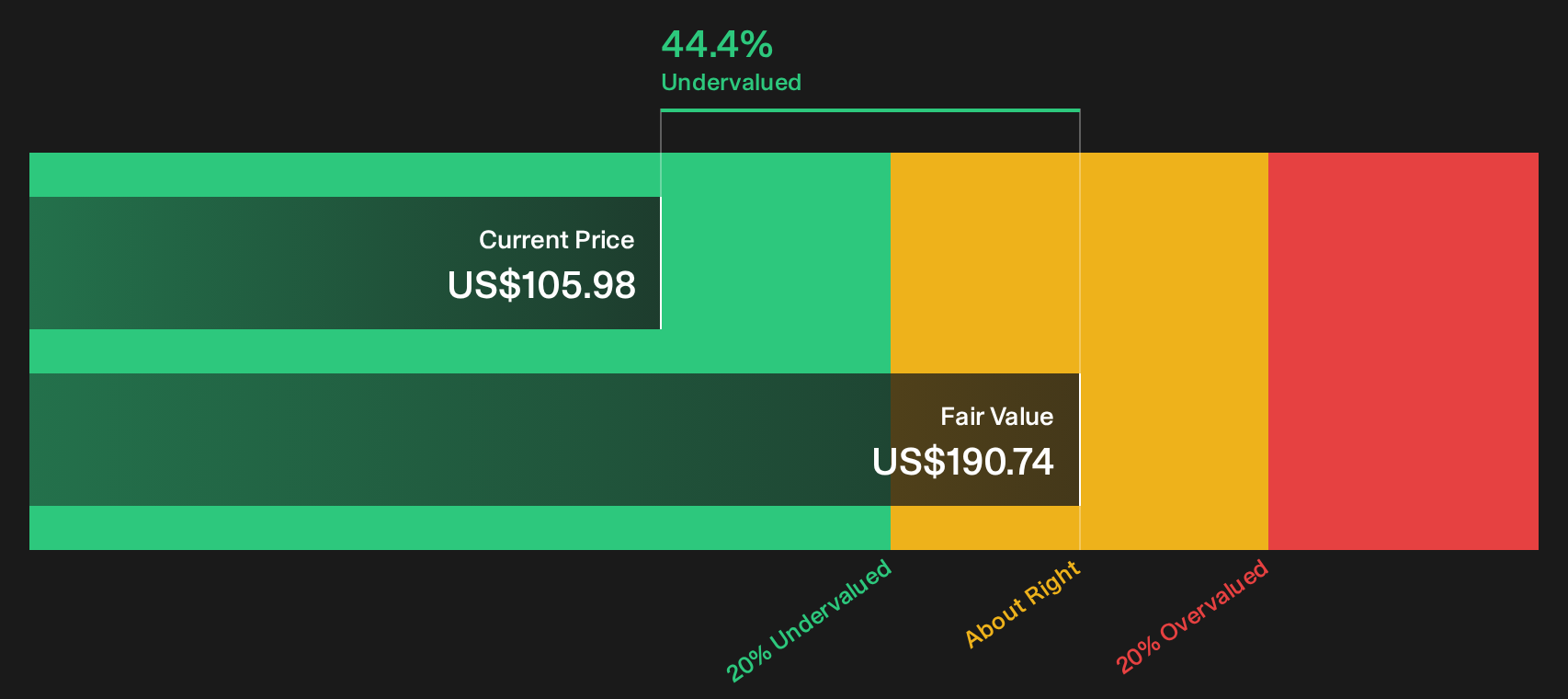
For SouthState Bank, the inputs are punchy. Book value sits at $94.17 per share, while stable EPS is estimated at $10.55 per share, based on forward return on equity expectations from 10 analysts. With a cost of equity of $7.44 per share, the model implies excess return of $3.11 per share, supported by an average return on equity of 10.26% and a projected stable book value of $102.79 per share from 11 analyst estimates.
When those pieces are pulled together, the Excess Returns framework points to an intrinsic value of about $190.74 per share. Compared with the current share price, that suggests the stock appears roughly 44.4% undervalued under this methodology.
On this Excess Returns view, SouthState Bank appears undervalued relative to the earnings power implied by its balance sheet and analyst projections.
Our Excess Returns analysis suggests SouthState Bank is undervalued by 44.4%. Track this in your watchlist or portfolio, or discover 31 more high quality undervalued stocks.
Is SouthState Bank a Bargain on Earnings?
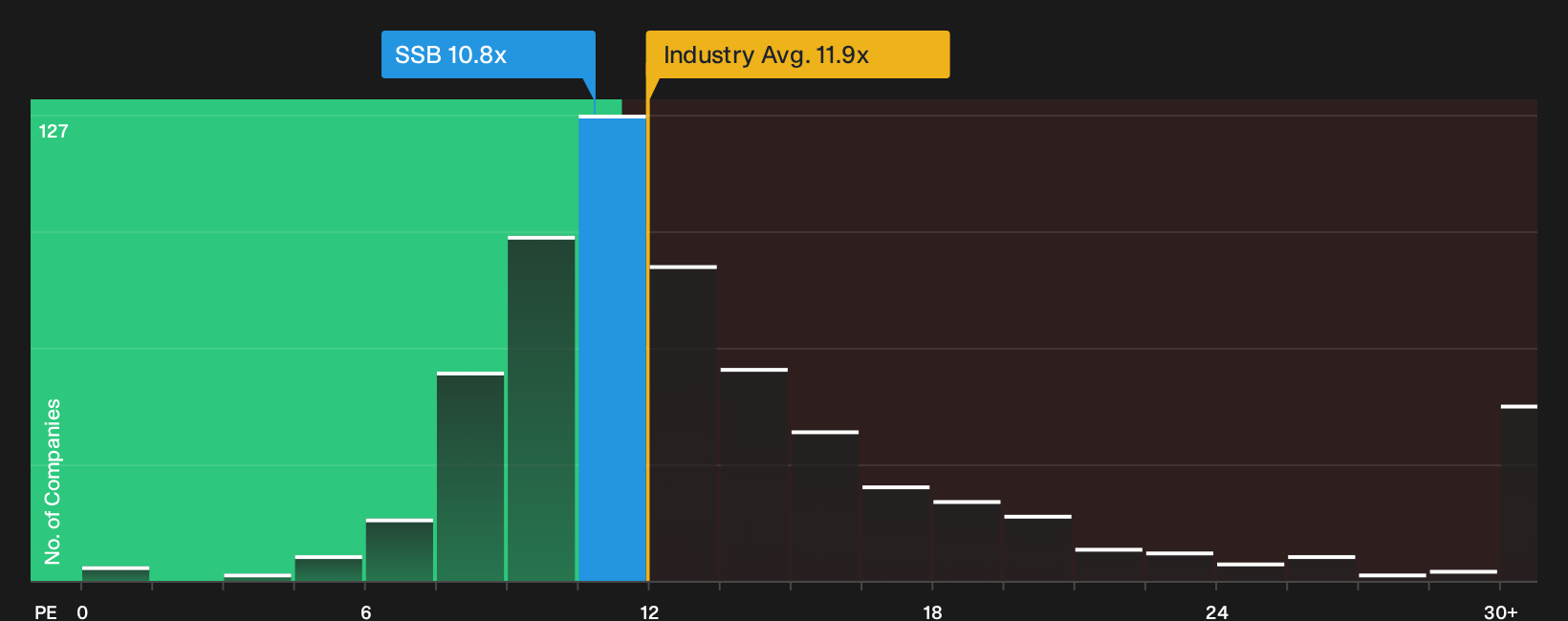
The P/E ratio is a relevant metric for SouthState Bank because earnings are a central yardstick for how investors assess regional lenders. On this measure, the stock trades at 10.8x current earnings, which is below both the broader Banks industry average of 11.9x and the peer group on 11.7x.
The fair P/E multiple for SouthState Bank is estimated at 12.2x, based on the business profile, size, sector and risk characteristics. Against that yardstick, the current 10.8x indicates the shares trade at a discount to what this framework suggests for the company’s earnings power.
On the P/E lens, SouthState Bank stock appears undervalued relative to both its sector and the fair multiple implied by its fundamentals.
See what the numbers say about this price — find out in our valuation breakdown.
The SouthState Bank Narrative: What Would Justify Today's Price?
Simply Wall St Narratives pick up where the SouthState Bank valuation puzzle leaves off by explaining which paths for future growth, profitability and earnings would need to occur for the shares to be worth materially more or materially less than they are today. Instead of relying on a single P/E or model output, each Narrative sets out the assumptions behind its view of fair value so you can track those inputs against actual results over time on the Community page.
Share a narrative on SouthState Bank's valuation case, set out your numbers on where its growth, margins and execution might go, and track how that thesis performs as fresh results come through.
Do you think there's more to the story for SouthState Bank? Head over to our Community to see what others are saying!
The Bottom Line
SouthState Bank screens as undervalued on both the intrinsic value estimate and on market multiples, which is a rare alignment. The gap between the intrinsic value view and the current share price hinges on whether the bank can keep earning attractive returns on equity without erosion from funding costs or credit losses. For investors, the real question is whether that discount reflects misplaced caution on earnings power or a sensible margin of safety for the risks around future loan quality and deposit pricing.
This article by Simply Wall St is general in nature. We provide commentary based on historical data and analyst forecasts only using an unbiased methodology and our articles are not intended to be financial advice. It does not constitute a recommendation to buy or sell any stock, and does not take account of your objectives, or your financial situation. We aim to bring you long-term focused analysis driven by fundamental data. Note that our analysis may not factor in the latest price-sensitive company announcements or qualitative material. Simply Wall St has no position in any stocks mentioned.
Have feedback on this article? Concerned about the content? Get in touch with us directly. Alternatively, email editorial-team@simplywallst.com