
- PRICING
- LIVE QUOTES
- LEARN
- HELP


EN
BioNTech (BNTX) Stock Stays Rich On Sales As Revenue Looks Weaker
BioNTech stock has given up much of its early Covid-era surge, with the share price declining about 73.9% over the past five years. Yet the current market still prices the business at levels that screen as expensive on broad valuation checks. For investors, the puzzle is whether a stock that has already retreated this far now offers value, or whether the current tag still asks too much of future performance.
- Over five years, the share price has fallen about 73.9%, which signals that the market has sharply reset expectations for BioNTech.
- Future demand for the company’s vaccine and immunotherapy pipeline can support valuation, but uncertainty around the durability and profitability of that revenue stream may weigh on how much investors are willing to pay.
- On a broad set of valuation checks, BioNTech leans expensive rather than like a clear bargain, with a value score of 2 out of 6.
The issue now is whether the current market price fairly reflects BioNTech’s risks and opportunities after such a steep multi year reset in the share price.
Broaden your watchlist beyond BioNTech by scanning 33 high quality undervalued stocks, which currently look cheaper on fundamentals than their recent share performance might suggest.
Does BioNTech Look Pricey on Sales?
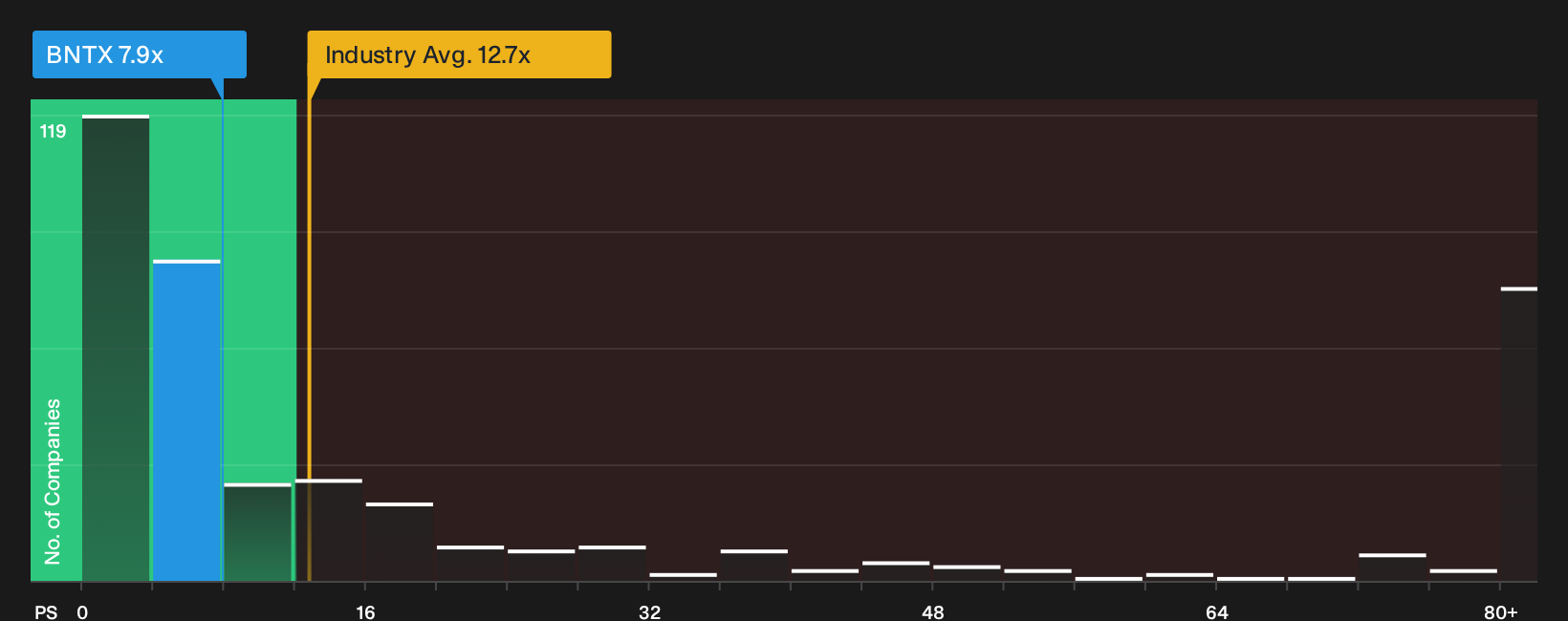
The P/S ratio fits BioNTech because sales are still the clearest anchor for valuation while earnings and free cash flow forecasts look uneven. On this yardstick, the stock trades on about 7.9x trailing revenue, compared with roughly 12.7x for the broader biotech industry and about 9.7x across closer peers.
That raw comparison makes BioNTech look cheaper than many listed biotechs. The more tailored fair P/S ratio, which folds in factors such as size, margin profile and risk, sits nearer 6.6x. The current 7.9x level is above that mark, so the share price implies a richer tag than this framework would suggest based purely on its fundamentals and risk profile.
On the P/S multiple, BioNTech currently appears overvalued relative to what this model would indicate as a more balanced price for the stock.
See what the numbers say about this price — find out in our valuation breakdown.
The BioNTech Narrative: What Would Justify Today's Price?
Simply Wall St Narratives pick up where the BioNTech valuation puzzle leaves off by spelling out which paths for growth, profitability and earnings would need to play out for the stock to end up worth materially more or materially less than today’s price. Each narrative links its number to a concrete view on how BioNTech's growth, margins and risk profile might evolve, which gives you something specific to revisit as fresh information emerges.
Community views on BioNTech sit far apart, with one camp leaning into the oncology opportunity while the other focuses on COVID reset risk and trial uncertainty.
Bull case: 20% undervalued
"Robust pipeline expansion in oncology with multiple late stage clinical trials for BNT327 and mRNA cancer immunotherapies across high prevalence cancers positions BioNTech to launch multiple new products…"
Read the full Bull Case to see why BioNTech could be undervalued
Bear case: 15% overvalued
"Falling COVID 19 vaccine demand in core markets including ongoing declines in U.S. vaccination rates and increased vaccine hesitancy globally is expected to materially reduce long term revenue from BioNTech's main commercial franchise…"
Read the full Bear Case to see why BioNTech could be overvalued
Do you think there's more to the story for BioNTech? Head over to our Community to see what others are saying!
The Bottom Line
On current market multiples, BioNTech screens as overvalued rather than as a clear bargain, even after a steep 5 year reset in the share price. Valuation now hinges less on past Covid cash flows and more on what the oncology and broader immunotherapy portfolio can realistically deliver in terms of commercially successful products. The crux for both bulls and bears is whether that pipeline can translate into durable, profitable revenue that justifies paying a premium P/S multiple from here.
This article by Simply Wall St is general in nature. We provide commentary based on historical data and analyst forecasts only using an unbiased methodology and our articles are not intended to be financial advice. It does not constitute a recommendation to buy or sell any stock, and does not take account of your objectives, or your financial situation. We aim to bring you long-term focused analysis driven by fundamental data. Note that our analysis may not factor in the latest price-sensitive company announcements or qualitative material. Simply Wall St has no position in any stocks mentioned.
Have feedback on this article? Concerned about the content? Get in touch with us directly. Alternatively, email editorial-team@simplywallst.com