
- PRICING
- LIVE QUOTES
- LEARN
- HELP


EN
3 U.S. Income Stocks With Inflation Linked Cash Flows
Inflation refuses to fade, the 10 year Treasury hovers near 5%, and rate expectations keep shifting under your feet. That mix can punish some stocks, yet it can also reward businesses with inflation linked contracts, regulated returns or real asset pricing power. This piece walks through three U.S. Inflation Linked and Real Asset Income Stocks that appear closely tied to today’s rate and price shocks and explains why that exposure matters for your portfolio decisions.
The three stocks in this piece are just a starting sample. The full screen surfaced 18 more U.S. Inflation Linked and Real Asset Income Stocks with equally compelling stories that are not covered here. To size up the full field, head straight to the U.S. Inflation-Linked and Real-Asset Income Stocks screener to identify, compare and analyze the highest conviction income ideas tied to inflation and real assets.
American Healthcare REIT (AHR)
Overview: American Healthcare REIT owns and operates senior housing, skilled nursing, and outpatient medical properties, aiming to deliver inflation resilient rental income from clinical real estate.
Operations: The REIT generates about $1.9b from integrated senior health campuses and $419 million from SHOP, with almost all revenue from the United States.
Market Cap: $12.7b
American Healthcare REIT fits the U.S. Inflation Linked and Real Asset Income Stocks theme because its senior housing and clinical facilities lean on real estate backed rents that can help keep cash flows aligned with persistent price and rate pressures.
"The combination of a rapidly growing 80+ demographic and a multi-year period of low new supply in senior housing and skilled nursing is expected to drive a persistent supply-demand imbalance, fueling both occupancy gains and rent growth across American Healthcare REIT's portfolio. This dynamic is expected to underpin above-trend revenue and net operating income growth over the next decade."
What really moves the needle for American Healthcare REIT is what happens if a single key assumption about future rent pricing power breaks.
If that rent thesis is the real swing factor, the full narrative for American Healthcare REIT shows how pricing power, leverage and payout ambitions could all be quietly re-rating in the background.

United Parcel Service (UPS)
Overview: United Parcel Service runs a global delivery and logistics network, moving packages and freight while adjusting prices and surcharges with economic conditions.
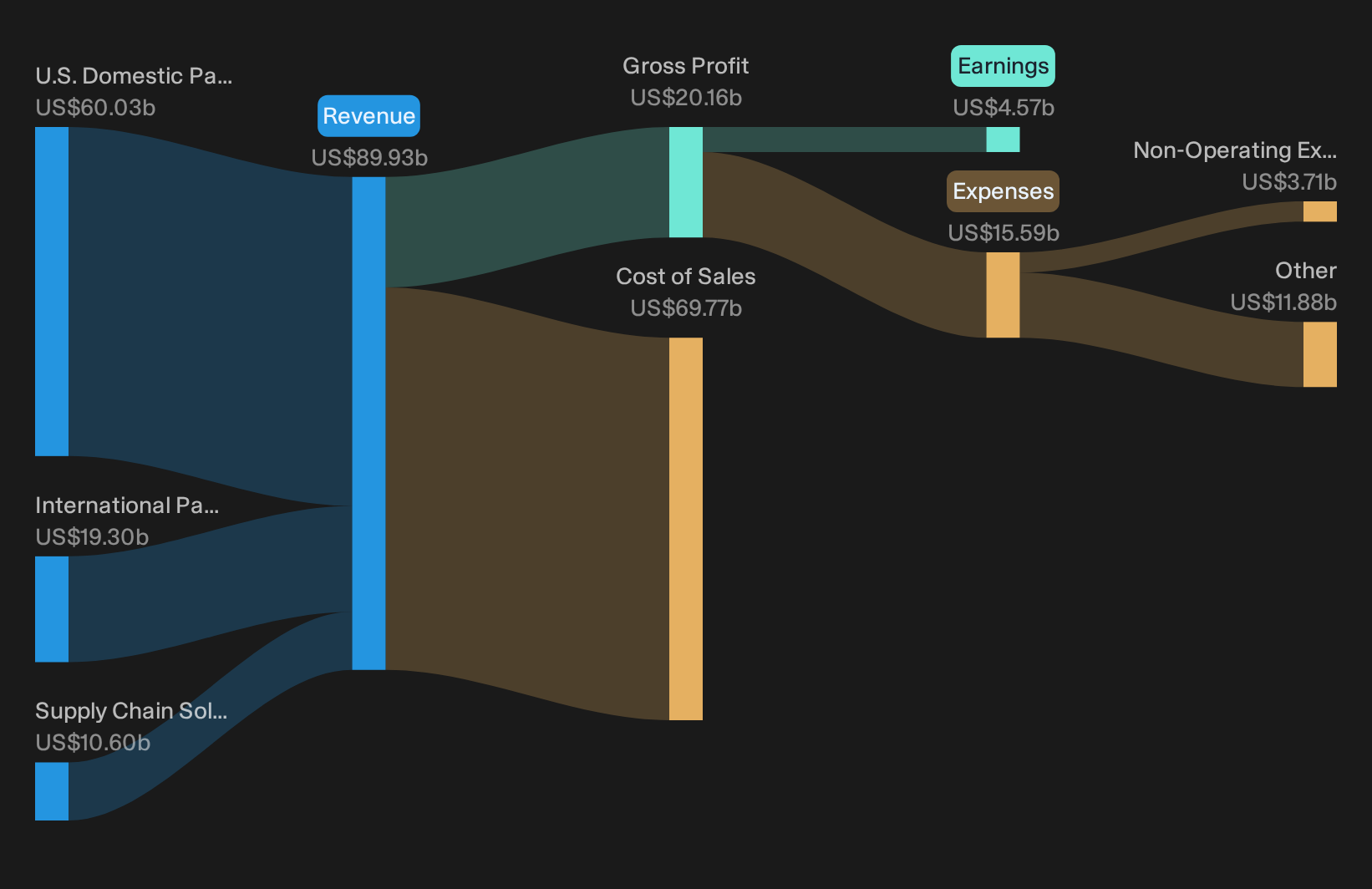
Operations: United Parcel Service generates about $60b from U.S. Domestic Package, $19.3b from International Package and $10.6b from Supply Chain Solutions.
Market Cap: US$85.5b
For this U.S. Inflation Linked and Real Asset Income Stocks theme, United Parcel Service matters because its global delivery network can regularly reset rates, apply fuel surcharges and lean on contract terms that help pass higher input costs through to shippers rather than absorbing them on its own balance sheet.
"Launched in early 2025, UPS's "Efficiency Reimagined" outlined the company’s largest network overhaul in company history. This multi-year initiative describes management's goals to streamline domestic operations."
What really matters next for United Parcel Service is how one unresolved cost pressure feeds through to pricing, margins and dividend appeal.
That cost question is exactly where the full narrative for United Parcel Service shows whether UPS’s pricing power, capital choices and income profile are quietly shifting in your favor.
CareTrust REIT (CTRE)
Overview: CareTrust REIT owns and leases skilled nursing and seniors housing properties, collecting long term rent from essential healthcare facilities.
Operations: CareTrust REIT generates about $571 million from investments in healthcare related real estate assets, with all rental income coming from the United States.
Market Cap: $9.3b
CareTrust REIT fits this inflation linked and real asset income theme because its long term healthcare leases are tied to essential senior care services.
"The recent acquisition of Care REIT and entry into the U.K. care home market significantly diversifies the asset, operator, and geographic mix. This positions CareTrust to potentially benefit from global growth in demand for senior housing and post-acute care, which may influence future revenues and provide some degree of downside protection to earnings."
What could really reshape the story for CareTrust REIT is how one unseen funding pressure interacts with its appetite for acquisition driven growth.
That funding puzzle is exactly where the full narrative for CareTrust REIT pulls together CareTrust REIT’s acquisition appetite, rent mechanics and balance sheet capacity to show what might really be accelerating beneath the surface.

Seeking Fresh Alternatives Before They Fly
Markets move fast. Breakout stories gain momentum, laggards keep dropping, and under the radar ideas do not stay quiet for long. Spot fresh setups before the crowd and act now.
- Target reliable cash flows by scanning a curated 6 dividend fortresses that focuses on businesses built to keep paying investors through thick and thin.
- Hunt for under the radar strength with a hand picked 17 high quality undiscovered gems that blends durable fundamentals with room for sentiment to catch up.
- Ride long term structural demand by reviewing a focused 39 power grid technology and infrastructure stocks packed with companies tied to grid upgrades, electrification and critical infrastructure build outs.
This article by Simply Wall St is general in nature. We provide commentary based on historical data and analyst forecasts only using an unbiased methodology and our articles are not intended to be financial advice. It does not constitute a recommendation to buy or sell any stock, and does not take account of your objectives, or your financial situation. We aim to bring you long-term focused analysis driven by fundamental data. Note that our analysis may not factor in the latest price-sensitive company announcements or qualitative material. Simply Wall St has no position in any stocks mentioned.
Have feedback on this article? Concerned about the content? Get in touch with us directly. Alternatively, email editorial-team@simplywallst.com