
- PRICING
- LIVE QUOTES
- LEARN
- HELP


EN
The wave of physical AI is here, who can equip machines with eyes that sense reality?
Two years ago, many people were still immersed in the hustle and bustle of big models generating text and drawing images. This year, the AI world has quietly taken a huge turn. AI is no longer just living on the screens of computers and mobile phones; it is stepping out of the virtual digital space and reaching out to touch the real physical world.
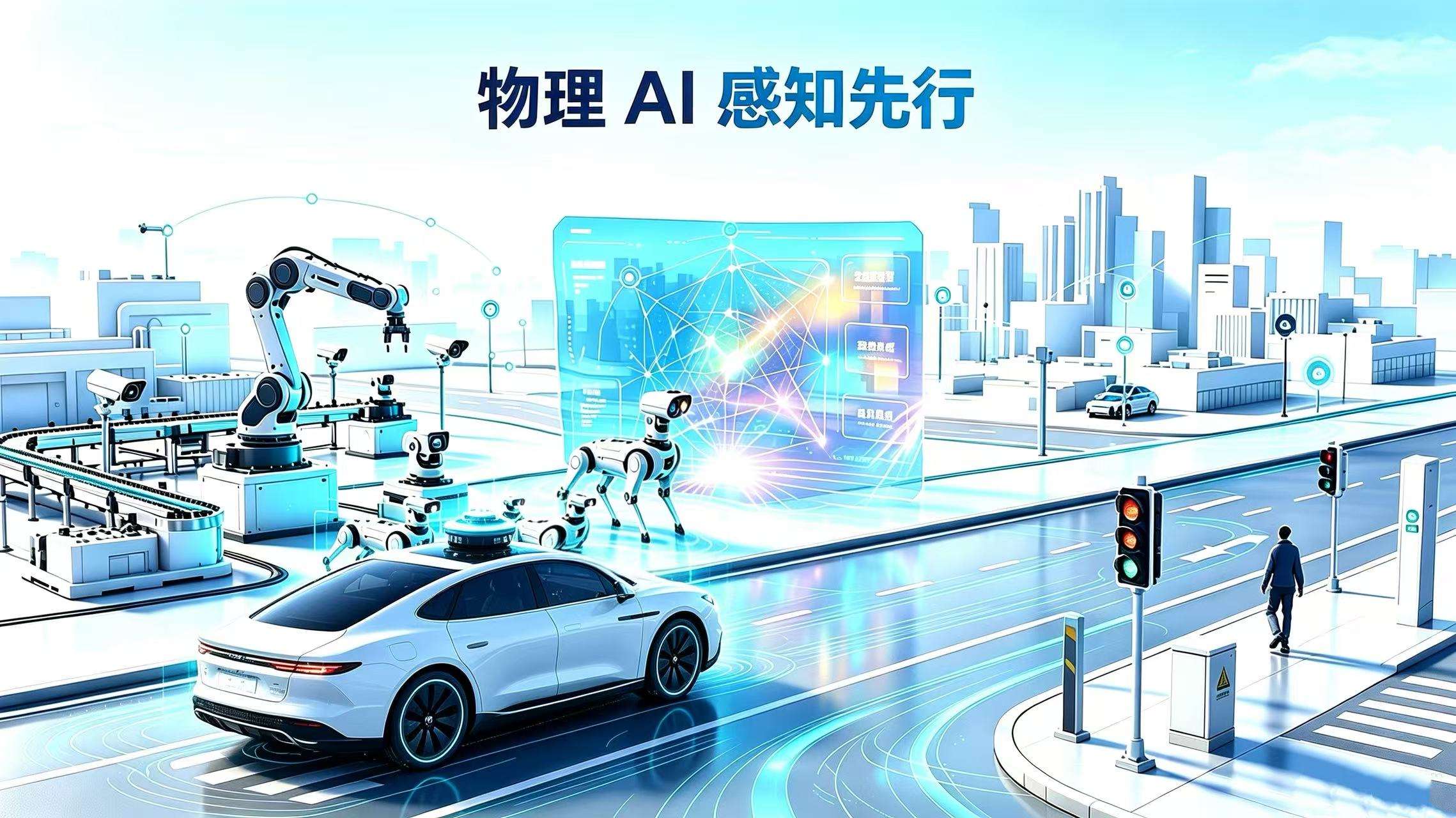
The Cybercab driverless taxi that Tesla (TSLA.US), which has recently been very popular online, has just put into trial operation is a very vivid sign of this transformation. This car without a steering wheel or pedals is essentially a complete physical AI system.

In addition to autonomous driving tracks, Nvidia (NVDA.US) is also betting significant resources in the same direction. Build a world model and a complete end-side tool chain for robots, and strive to sink AI computing power from expensive cloud servers to physical terminals one by one.
Today, most of the market's attention is focused on bright terminal products such as complete vehicles, robot bodies, and large general-purpose models, which provide a “visual sense” sensing layer behind them, which is often overlooked by everyone. Hong Kong stock company Haiqing Zhiyuan (01392) is a key player deeply involved in this easily undervalued field.
The market labeled Haiqing Zhiyuan “the first physical AI stock”; this is not an empty slogan. It didn't make an eye-catching robot machine, nor was it chasing the much-talked-about general-purpose big model; instead, it sank down and gnawed at the bottom of multispectral sensing.
No matter how sophisticated the algorithm is, it's just logic on paper. Just like Cybercab must first rely on sensors to clearly see roads, pedestrians, and obstacles, and convert the complex real world into signals that the machine can read before the model can complete judgment and output driving instructions; what Haiqing Zhiyuan captures is a world invisible to the human eye: infrared thermal radiation emitted by overheating equipment and ultraviolet arcs generated by faulty discharge. It is equivalent to translating hidden risks hidden in the industrial environment into data that can be analyzed by AI, which is equivalent to installing a pair of data that surpasses the human eye eyes.
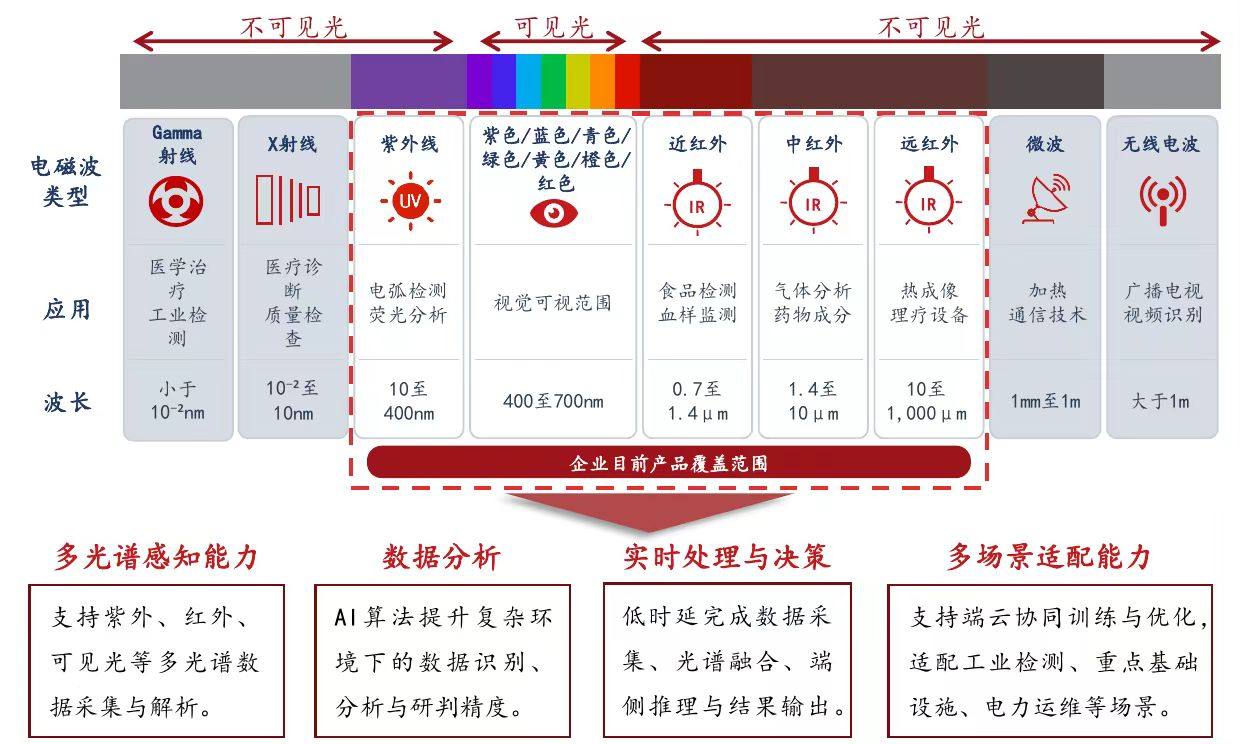
Looking at it, whether it's an autonomous vehicle, a humanoid robot, or inspection equipment that works back and forth in a factory, the starting point of all physical AI stories will always be perception. The machine must first “see” the real world before it can later understand the environment and perform actions.
If you can't keep up with the perception process, even the most powerful model is like a blind intelligent person, full of thoughts, but you can't clearly see everything that is happening around you.
At the same time as the industrial wave is rolling forward, the evaluation criteria for the capital market are also changing. Over the past two or three years, the market has frantically chased computing power and AI hardware concepts, and many targets have gained popularity based on stories alone. However, the trend has changed this year, and funding is no longer satisfied with the nebulous conceptual narrative. People are starting to ask the most simple questions:
Can this set of AI technology actually be implemented, and can it actually generate revenue?
The entire AI industry is completing the transition from “telling stories on the investment side” to “looking at cash on the output side”.
Coinciding with the official entry into force of a new round of adjustments to the Hong Kong Stock Connect, Haiqing Zhiyuan has reached its own liquidity milestone. It's just that the market didn't play the “once you get through, you rise” script that some people had anticipated. This group of newly included targets set off high and low, and a lot of short-term capital used a favorable window to cash out the profits, causing a stir in the market.
But really smart money is never held hostage by the market for just a few days. When short-term sentiment causes stock price fluctuations, it is just a moment for us to calm down and take a good look at the real success of the company.
Looking through the semi-annual report just disclosed by the company, we can see that this set of multispectral sensing technology has long gone out of the laboratory and has been implemented into tangible business results.
In the first half of 2026, the company achieved total revenue of 410 million yuan, an increase of 84.5% year on year; after excluding one-time listing expenses, adjusted net profit was 27.6 million yuan, an increase of 21.9% year on year, and revenue and profit increased simultaneously.
The most prominent of these was the multi-spectral AI large model's service revenue, which surged 382.5% year over year, and directly soared from 29.8% to 78% of revenue. Once a company that mainly sold hardware modules, now high-value-added AI services have become an absolute main engine of growth.
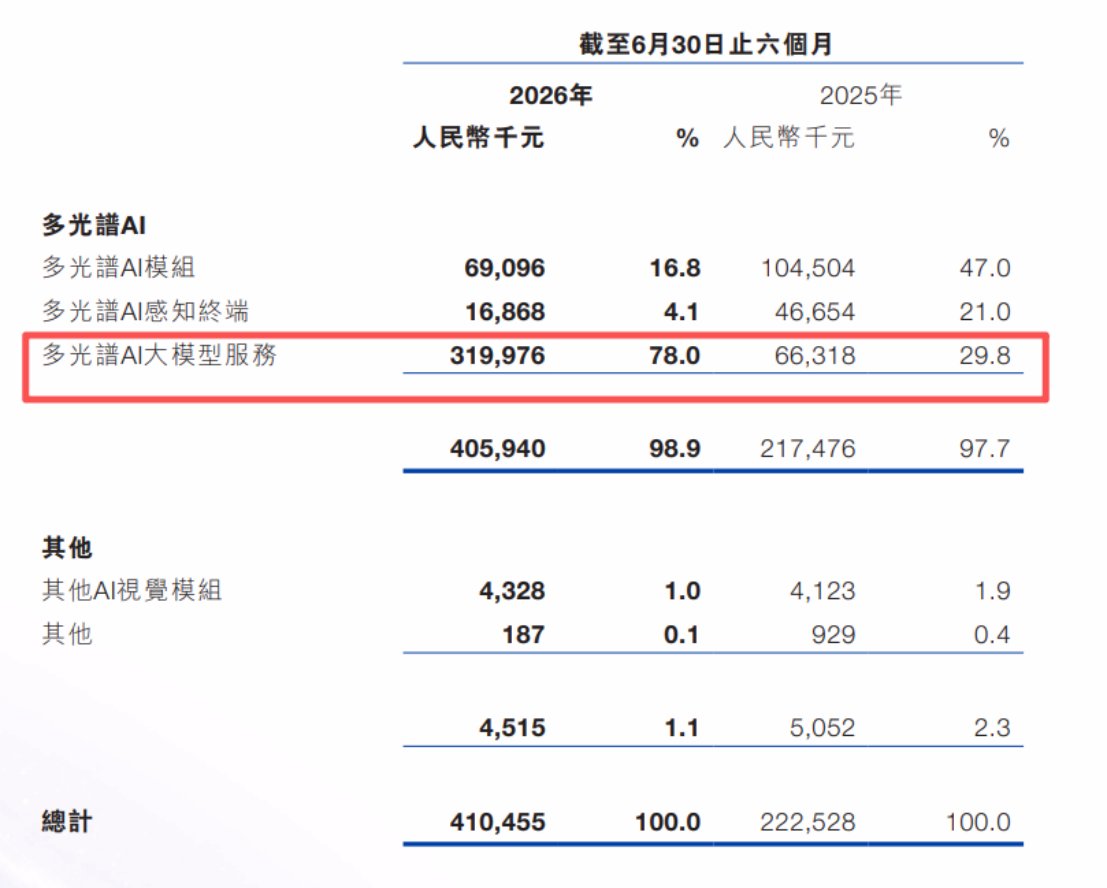
Of course, behind this report card, there are also hidden trade-offs that the company took the initiative to make. In order to focus resources on high-value businesses, the company took the initiative to shrink some low-margin hardware orders, and module-related revenue declined; the share of hardware support in large-scale projects also gradually suppressed the overall gross profit margin. However, as the proportion of high-margin high-margin model services continues to increase, the product structure continues to be optimized, and gross margin has a clear foundation for repair in the future.
What is even more rare is that while profits are growing, companies have not relied on cutting R&D to beautify reports. R&D expenses in the first half of the year were 35.109 million yuan, a sharp increase of 125.3% over the previous year. While landing commercial orders while continuing to cultivate at the bottom of technology, the financial content of this profit comes from.
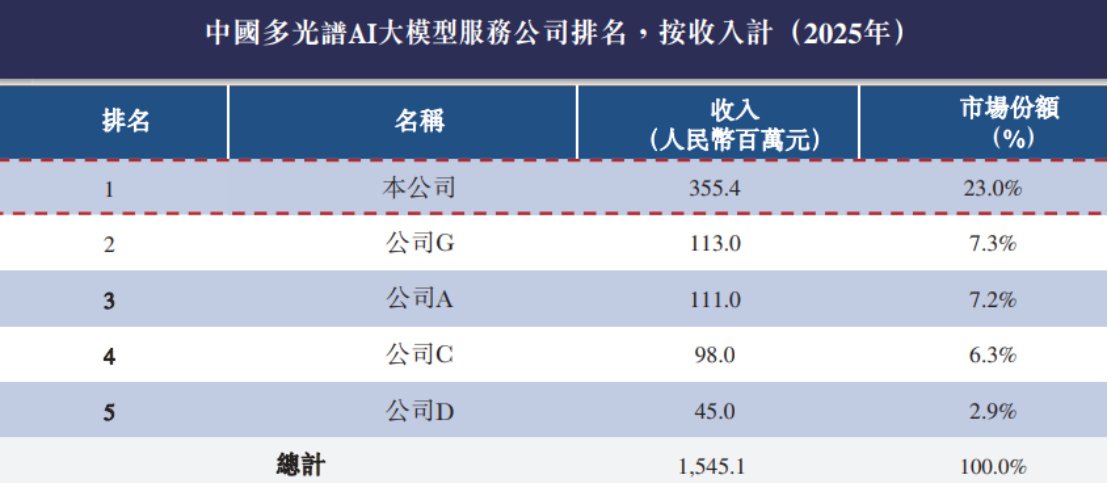
Looking at the industry as a whole, the market space for multispectral AI is rapidly opening up. According to Frost & Sullivan's data, the global market is expected to grow from 85 billion yuan in 2025 to 305.4 billion yuan in 2030, with China being the fastest-growing core market. According to the 2025 revenue statistics, Haiqing Zhiyuan already ranks first in the domestic multi-spectral AI large model service market with a market share of 23%.
In addition to technology, recognition from the government and industry has also accumulated little by little. Zhiyuan Genesis completed the generative AI filing by the State Internet Information Office, was selected for the Shenzhen Model Service Agency's proposed inventory list, and obtained a key compliance pass to conduct business for government enterprises and industrial customers; joined the Toubao Research Institute's TOP10 list of physical AI application practices, and stood side by side with leading technology companies; and was also awarded the Guangdong Provincial Manufacturing Industry Single Champion.
The technology is no longer limited to IDC's computer room, and is beginning to expand into more diverse application scenarios.
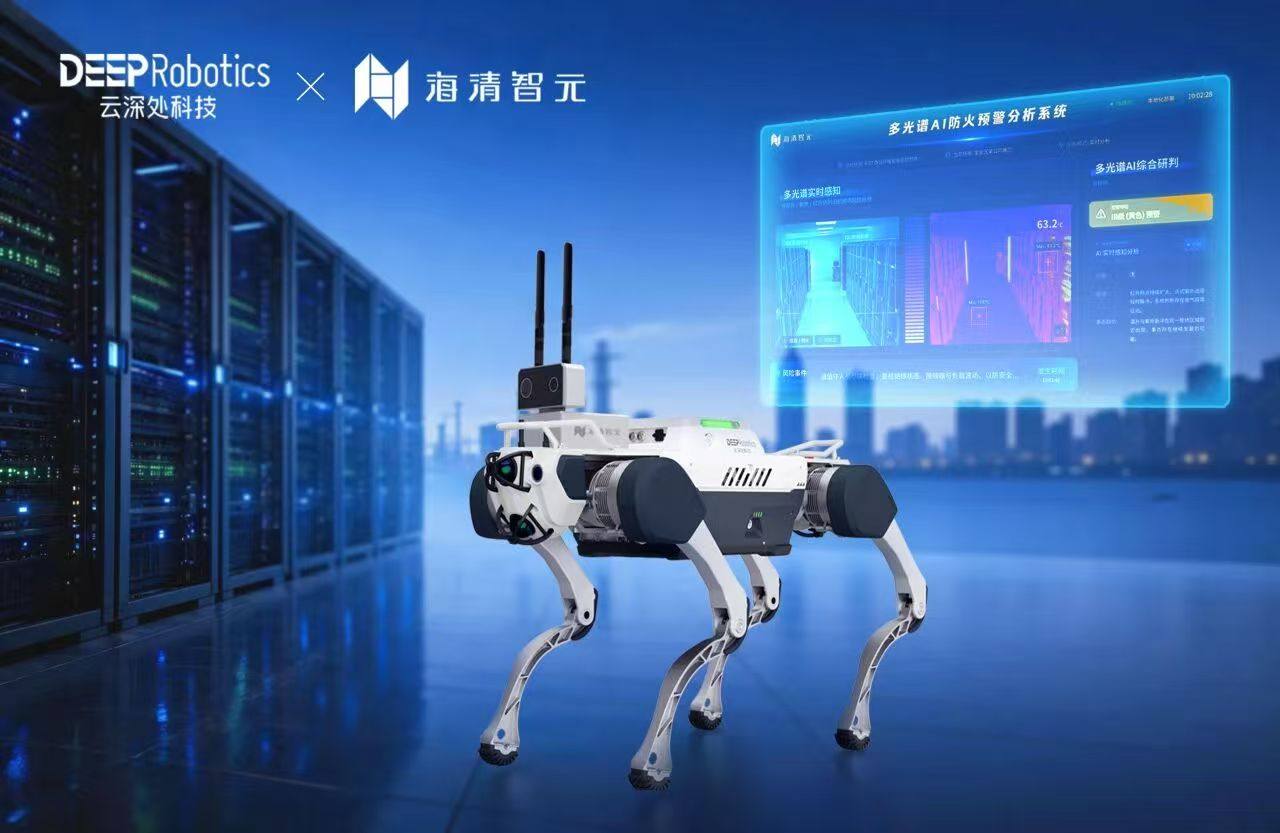
In August, Haiqing Zhiyuan and Yunshen Technology reached a cooperation to mount a multi-spectral sensing module on a four-legged inspection robot. Let robot dogs have “super eyes” to catch hidden electric arcs and high temperature hazards, and go deep into high-voltage substations, cable cladding, and energy storage facilities, and upgrade traditional regular manual inspections to uninterrupted pre-risk warning; on September 3, Academician Li Erping of the Chinese Academy of Engineering led an expert team to visit Haiqing Zhiyuan to conduct field research on the company's multi-spectral AI technology, product system and implementation scenario, focusing on multispectral sensing, robot control, and machine manufacturing collaboration, and jointly discuss subsequent industry cooperation ideas on this technology route, representing top industry experts Endorsed.
Looking ahead, the company's future growth path is clear enough.
IDC security operation and maintenance is a solid basic plan that has been verified by financial reports: existing customers are moving from pilot computer rooms to deployment throughout the park, directly raising customer unit prices; a large number of domestic intelligent computing centers have been completed one after another, and physical security is being transformed from optional configurations to what the industry needs, and the business is expected to further penetrate the entire computing power chain such as cabinets, battery rooms, and busbars.
At the same time, if the “multi-spectral + physical intelligence” power inspection model completes customer verification, there is an opportunity to open up a second growth curve; continuous iteration of the end-side model frees the large model from expensive central servers to terminal hardware, drastically lowering the deployment threshold, and is expected to expand the customer base from large state-owned enterprises to a large number of small and medium-sized enterprises; the layout of overseas markets will leave room for enterprises to imagine for a longer period of time.
The Hong Kong Stock Connect officially came into effect, opening the southbound liquidity door for Haiqing Zhiyuan, so that more mainland investors can see this hard technology company rooted in perceptions. At a favorable point of redemption, short-term capital will always choose to leave the market. The market fluctuates and fluctuates, which is the norm in the market. The rise and fall of just a few K-lines is only the result of a game of emotions and chips, and cannot change the pace at which the industry is moving forward.
From Tesla's driverless taxis to endless robotics projects, the era of physical AI has slowly begun. The market is keen to discuss the reasoning ability of big models and the execution actions of robots, but they often overlook the most advanced part: if machines can't see the real physical world, there's no way to talk about everything that comes after that.
Perception, which is often underestimated, is the most basic and inescapable entrance to physical AI. However, revaluation, which is part of the perception layer, is probably just beginning.