
- PRICING
- LIVE QUOTES
- LEARN
- HELP


EN
Boeing (BA) Stock Trades Below Fair Value After Recent Weakness
Boeing stock has been under pressure recently, yet the valuation signals are pulling in different directions, with the intrinsic value estimate pointing to meaningful upside while market based multiples lean expensive. That split leaves investors weighing whether the recent share price weakness has already absorbed much of the bad news or whether the current tag still bakes in a rich expectation set.
- The share price has fallen about 10.1% over the past month, which suggests sentiment has cooled even as longer term expectations around the business are still being debated.
- Strong cash generation and a large order backlog can support the intrinsic value case, while ongoing safety and regulatory issues may keep a lid on how much investors are willing to pay for Boeing in the near term.
- The broader valuation checks present a mixed picture rather than a clear bargain or clear overvaluation, with a value score of 3 pointing to some measures screening cheap and others screening rich.
The issue now is whether Boeing's current market price already reflects these cross currents or if there is still a gap between what the stock trades for and what the cash flows imply it is worth.
Compare Boeing's mixed valuation signals with a curated list of companies that combine cash flow strength with more straightforward pricing by checking 49 high quality undervalued stocks in the same session.
Is Boeing a Bargain on Cash Flow?
The Discounted Cash Flow (DCF) model values Boeing by projecting future free cash generation and discounting it back to today. On this view, the latest twelve month free cash flow sits around $527.5 million, yet the model assumes that cash flows recover from that low base and grow over time rather than stay stuck at current levels.
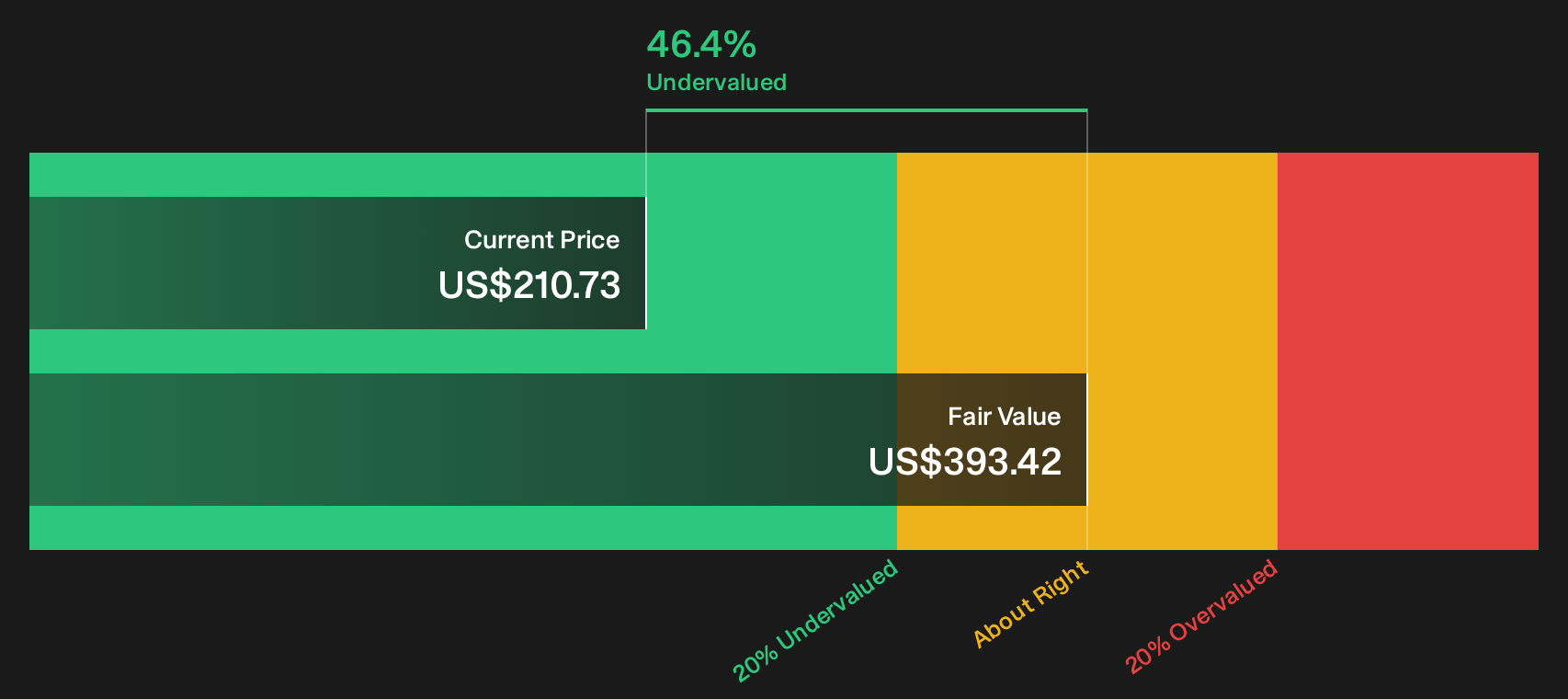
Feeding those projections into the 2 Stage Free Cash Flow to Equity framework produces an estimated intrinsic value of about $393 per share in dollar terms, which implies Boeing screens roughly 46.4% undervalued versus the current market price. The recent FAA safety fine and related quality issues help explain why the share price can lag a cash flow based estimate despite the model pointing higher. The DCF output indicates that Boeing appears undervalued, with the market pricing in more caution than the long run cash flow assumptions imply.
Our Discounted Cash Flow (DCF) analysis suggests Boeing is undervalued by 46.4%. Track this in your watchlist or portfolio, or discover 49 more high quality undervalued stocks.
Has Boeing Run Too Far on Earnings?
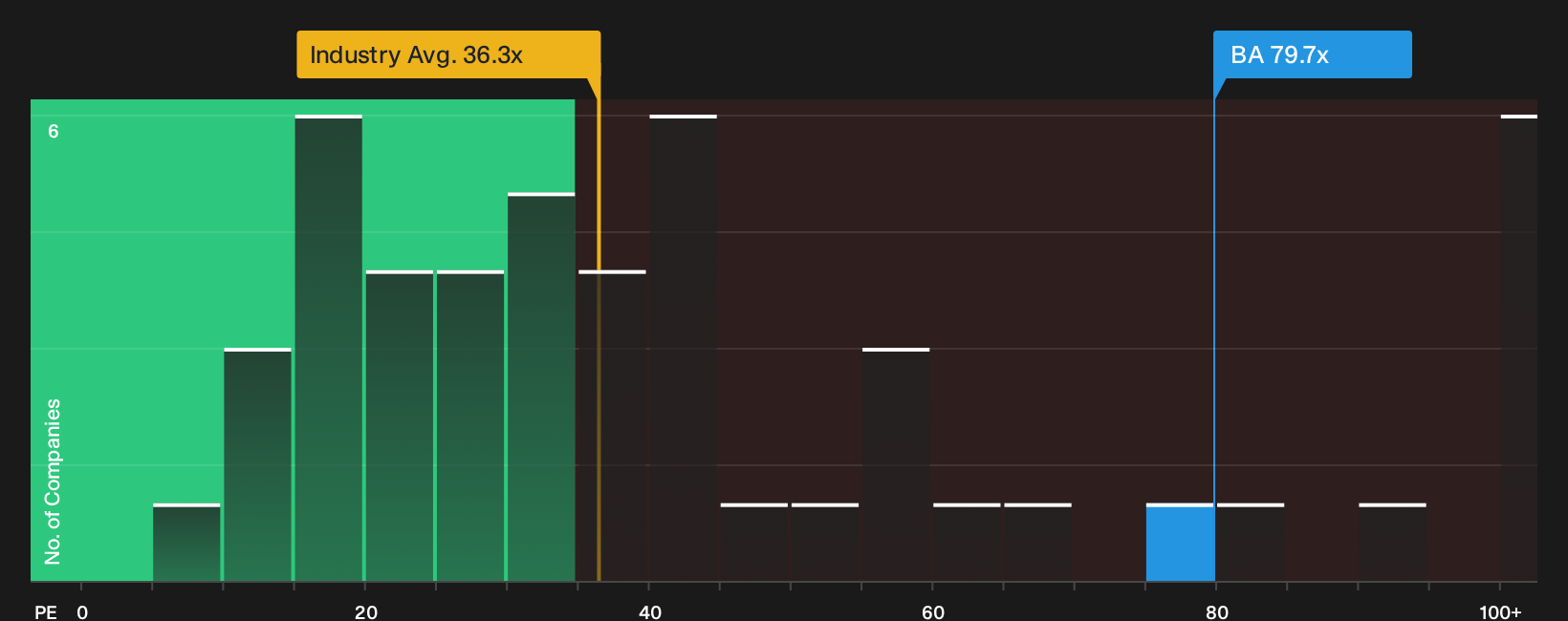
The P/E ratio is often the cleanest way to see what you are paying today for each dollar of Boeing earnings. On this yardstick, the stock trades on about 79.7x, which is more than double the Aerospace & Defense sector average of roughly 36.3x and also above the peer group mark near 31.3x.
A fair P/E, based on Boeing's profile, sits closer to 68.0x, so the current tag still carries a premium even after that adjustment. The gap suggests investors are paying up for the potential earnings recovery and large backlog while ongoing safety and regulatory issues remain in the backdrop. For anyone cross checking against the DCF work above, the cash flow model points in one direction, while the earnings multiple indicates a richer entry point.
On the P/E measure, Boeing shares appear overvalued compared with both tailored and sector benchmarks.
See what the numbers say about this price — find out in our valuation breakdown.
The Boeing Narrative: What Would Justify Today's Price?
Narratives pick up where Boeing's valuation gap leaves off by explaining which paths for growth, profitability and earnings would justify a meaningfully higher or lower share price from here, based on scenarios discussed on Simply Wall St's Community page. Rather than rely on a single multiple or discounted cash flow output, each narrative lays out the assumptions behind its view of fair value so you can compare those to Boeing's reported results over time.
Community views on Boeing could hardly be further apart, with one camp leaning into the backlog story while the other focuses on execution and balance sheet strain.
Bull case: 30% undervalued
"Boeing's vast $522 billion commercial backlog, with 5,900 aircraft sold firm into the next decade, positions the company to disproportionately benefit from the expected doubling of global air travel demand by 2040, ensuring long-term revenue expansion that could materially outpace GDP growth and industry peers…"
Read the full Bull Case to see why Boeing could be undervalued
Bear case: 32% overvalued
"What today''s price requires: At the same 10% discount, justifying $230.63 needs roughly 9.3% revenue growth, a 10% net margin, and a 25x exit multiple…"
Read the full Bear Case to see why Boeing could be overvalued
Do you think there's more to the story for Boeing? Head over to our Community to see what others are saying!
The Bottom Line
Boeing presents a split decision. The Discounted Cash Flow (DCF) work points to sizeable upside on cash generation and backlog strength, while the P/E framework flags the stock as overvalued relative to sector and tailored benchmarks. That clash largely comes down to timing and confidence. Intrinsic value hinges on cash flows normalising; the multiple reflects how much investors are willing to pay today for that recovery story. The real hinge from here is whether execution and safety issues ease enough for earnings to catch up to the cash flow potential, or whether the current discount is simply the market correctly pricing persistent risk.
This article by Simply Wall St is general in nature. We provide commentary based on historical data and analyst forecasts only using an unbiased methodology and our articles are not intended to be financial advice. It does not constitute a recommendation to buy or sell any stock, and does not take account of your objectives, or your financial situation. We aim to bring you long-term focused analysis driven by fundamental data. Note that our analysis may not factor in the latest price-sensitive company announcements or qualitative material. Simply Wall St has no position in any stocks mentioned.
Have feedback on this article? Concerned about the content? Get in touch with us directly. Alternatively, email editorial-team@simplywallst.com