
- PRICING
- LIVE QUOTES
- LEARN
- HELP


EN
If You Invested $10,000 in Beyond Meat Stock During Its IPO, You’d Have Just $150 Today
When the plant-based food revolution started to gain some real momentum a few years back, everybody thought Beyond Meat (BYND) was going to win big. Beyond Meat was the first big plant-based company to go public, and investors went nuts in the days and weeks after its initial public offering (IPO). Share prices jumped from $25 in May to more than $234 in July.
Armed with that enormous momentum, it’s easy to understand why an investor might have wanted to put $10,000 in BYND stock at the time. But they sure would be kicking themselves over it now.
Based on Beyond Meat’s current split-adjusted share price of $11.26, a $10,000 IPO stake in the company would now be worth a measly $150. Given the stock’s steady decline over the last five years, that number will probably be even lower by the time you’ve finished reading this.
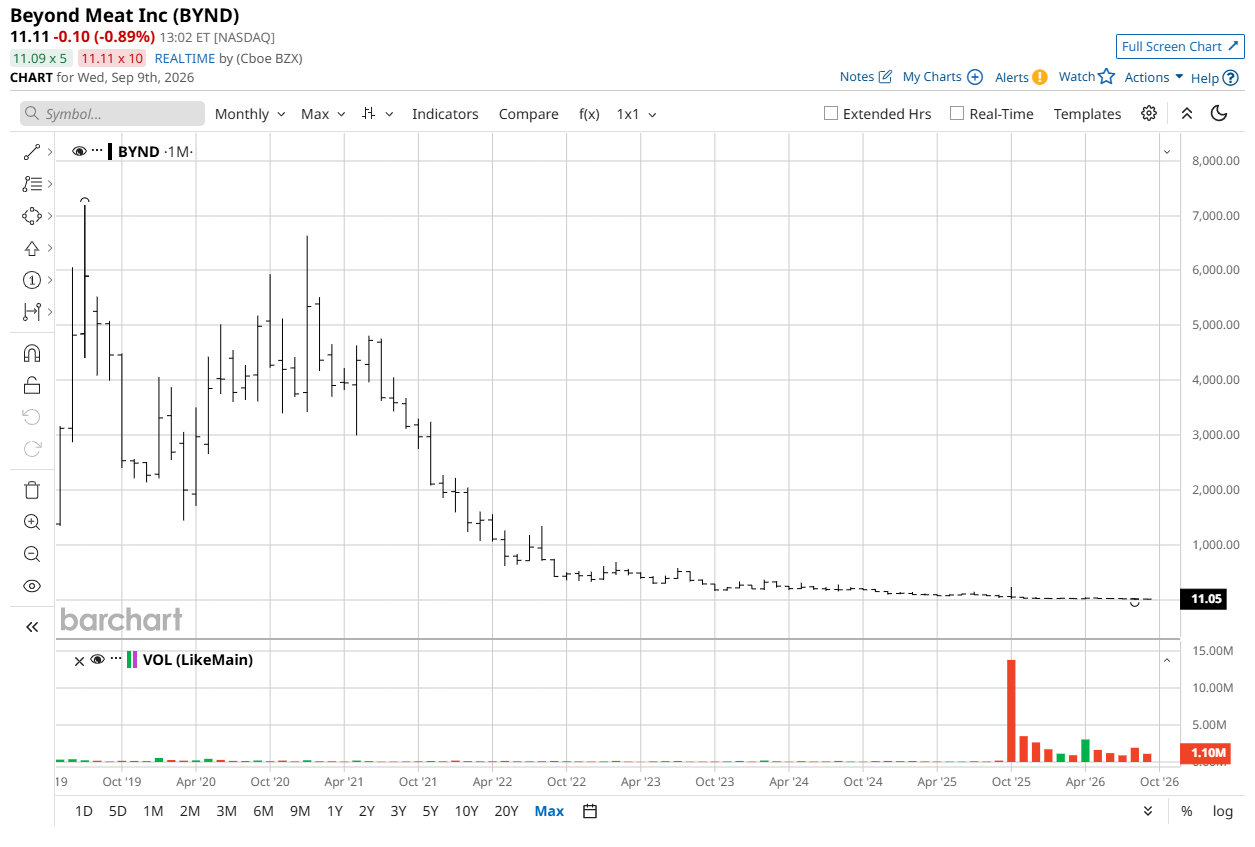
Things have gone from bad to worse for this company. Last month, BYND shares recently became so cheap that the company had to execute a 1-for-30 reverse stock split just to get its share price back above Nasdaq's minimum bid requirement.
That’s a staggering collapse for a business that was one of Wall Street’s hottest growth stories only a couple of years ago. So, where did it all go wrong? And more importantly, what cautionary lessons can we extract from Beyond Meat?
From $25 IPO Darling to Penny Stock
Let’s be honest: The math behind that original $10,000 is heartbreaking. At Beyond Meat’s $25 IPO price, $10,000 would have bought you 400 shares. And given the mania that followed, you probably would have been very smug about your early investment.
Beyond Meat was already sitting at $46 when it opened on day one, and a frenzy followed. Investors were all betting that consumers were ready to replace real meat with Beyond Meat’s plant-based alternatives, and loads of big restaurants and grocery chains started adding the company’s products to their shelves and menus.
For a few short, happy months, it looked like Beyond Meat’s stock could do no wrong. Shares were within touching distance of the $240 mark by July, which would have catapulted that investment of $10,000 up to almost $96,000.
Fast-forward to August 2026, and those shares aren’t worth a whole lot. In August, the company had to execute a reverse split and combine every 30 shares into just one. That would’ve turned your 400-share holding into about 13.33 split-adjusted shares. And at a current value of $11.26, that means your shares are only worth about $150.
That represents a loss of roughly 98.5% from the original investment.
This colossal destruction of shareholder value was a long time coming, and Beyond Meat’s biggest problem was pretty simple: The company never managed to turn the huge excitement around plant-based alternatives into a durable mass-market business. Revenue peaked a long time ago, and it’s only been headed in the wrong direction. The company only brought in $343.4 million in revenue in 2023, and that dropped to $275.5 million last year.
There were a few fundamental problems the company just couldn’t correct.
First and foremost, its products were more expensive than real meat, and inflation made consumers too price-sensitive to pay extra for a plant-based alternative. Consumer interest has also steered away from processed foods over the last couple of years, which is tough luck for a company whose products are manufactured in a lab.
But there was also competition. Beyond Meat wasn’t the only company betting big on plant-based burgers, and upstarts like Impossible Foods broke Beyond Meat’s initial market monopoly. That reduced sales figures, which didn’t marry well with Beyond Meat’s dangerous reputation for burning up cash.
The company’s operations ate $144.9 million in cash in 2025. That’s not great for a business that only generated $275.5 million in revenue, which is probably why the company was sitting on $415.7 million in debt by the end of last year.
Long story short: Beyond Meat isn’t going to fold today or tomorrow. But the company has spent years trying to keep the business alive, and things are only headed in one direction. That’s definitely not what investors saw when they were paying almost $240 for BYND in 2019.
Beyond Meat Is a Lesson in What Happens After the Hype
So, what’s the key takeaway in all this? A low share price doesn’t necessarily mean a stock is cheap. And more important still, a stock can plummet 90% but still have another 90% to fall.
Even if you decided to bet on Beyond Meat after its 2019 peak, you probably thought you were getting a bargain. Instead, the business has only continued to deteriorate. The company keeps chugging along, raising capital and converting debt into equity, but last month’s reverse split has made the stock look even worse without changing the company’s fundamental economics.
Simply put, a company that’s trading at $1 isn’t automatically cheaper than a company trading at $100. You have to consider the value of the entire business, share dilution, and how much cash the underlying business is actually capable of bringing in.
If nothing else, Beyond Meat's current market value should serve as a cautionary tale. Investors bought into Beyond Meat’s story before the business proved it could deliver the numbers. But all the company really ever had was a story, and all the hype surrounding it turned out to be nothing but hype.
That’s probably an important lesson to remember as we continue to grope our way through the current AI boom.
On the date of publication, Nash Riggins did not have (either directly or indirectly) positions in any of the securities mentioned in this article. All information and data in this article is solely for informational purposes. For more information please view the Barchart Disclosure Policy here.