
- PRICING
- LIVE QUOTES
- LEARN
- HELP


EN
Learn Why The Bull Case For Citi Stock Could Change Following China Brokerage Approval
- Citigroup expanded its wealth management capabilities and funding toolkit, appointing Elizabeth McElherne to lead its Alternatives and Investment Manager Solutions platform and issuing a series of callable senior unsecured notes alongside a long dated zero coupon bond.
- The live cross border US dollar payment with DBS using Swift’s blockchain based Digital Ledger, together with anticipated approval for a wholly owned China brokerage, points to Citigroup pushing simultaneously into digital infrastructure and onshore Chinese capital markets access.
- Given this combination of blockchain based payments progress, new China brokerage expectations and bond issuance, it is worth asking how these moves reshape Citigroup’s broader investment narrative.
Scan how Citigroup’s push into tokenized payments, China brokerage access and long dated funding compares with other banks by reviewing the curated list of solid balance sheet and fundamentals (24 results) in the same space.
Citigroup Investment Narrative Recap
To own Citigroup, you need to believe the bank can turn a sprawling global platform into steadier, higher quality fee and interest income while keeping regulatory and technology costs under control. The near term story still hinges on execution in services, markets and wealth, plus delivery on cost and risk targets. The latest wealth management appointment and fresh bond issuance do not radically change that setup. They sit more in the background of day to day catalysts, while the biggest swing factor remains whether ongoing transformation spend actually feeds through to sustainably better returns, rather than just higher expenses.
The new head of the Alternatives and Investment Manager Solutions platform is the announcement that ties closest to this news cycle. Citigroup is putting a seasoned private markets operator in charge of a product shelf that spans private equity, real estate, hedge funds and ETFs. For you, the link to catalysts is simple. A better run alternatives platform can support wealth fees and deepen client relationships, but only if it scales without adding disproportionate complexity or operational risk at a time when regulators are already focused on Citi’s control environment.
Yet there is a less comfortable angle to this story that only becomes clear once you look at ...
Read the full Citigroup narrative to see the case behind these numbers.
Citigroup's analyst narrative points to revenue of US$106.2b and earnings of US$21.9b by 2029. That profile assumes 9.1% yearly revenue growth and an earnings increase of about US$5.4b from current earnings of US$16.5b.
Citigroup's forecasts put fair value at $154.00 against $136.74, a 13% uplift to its current price.
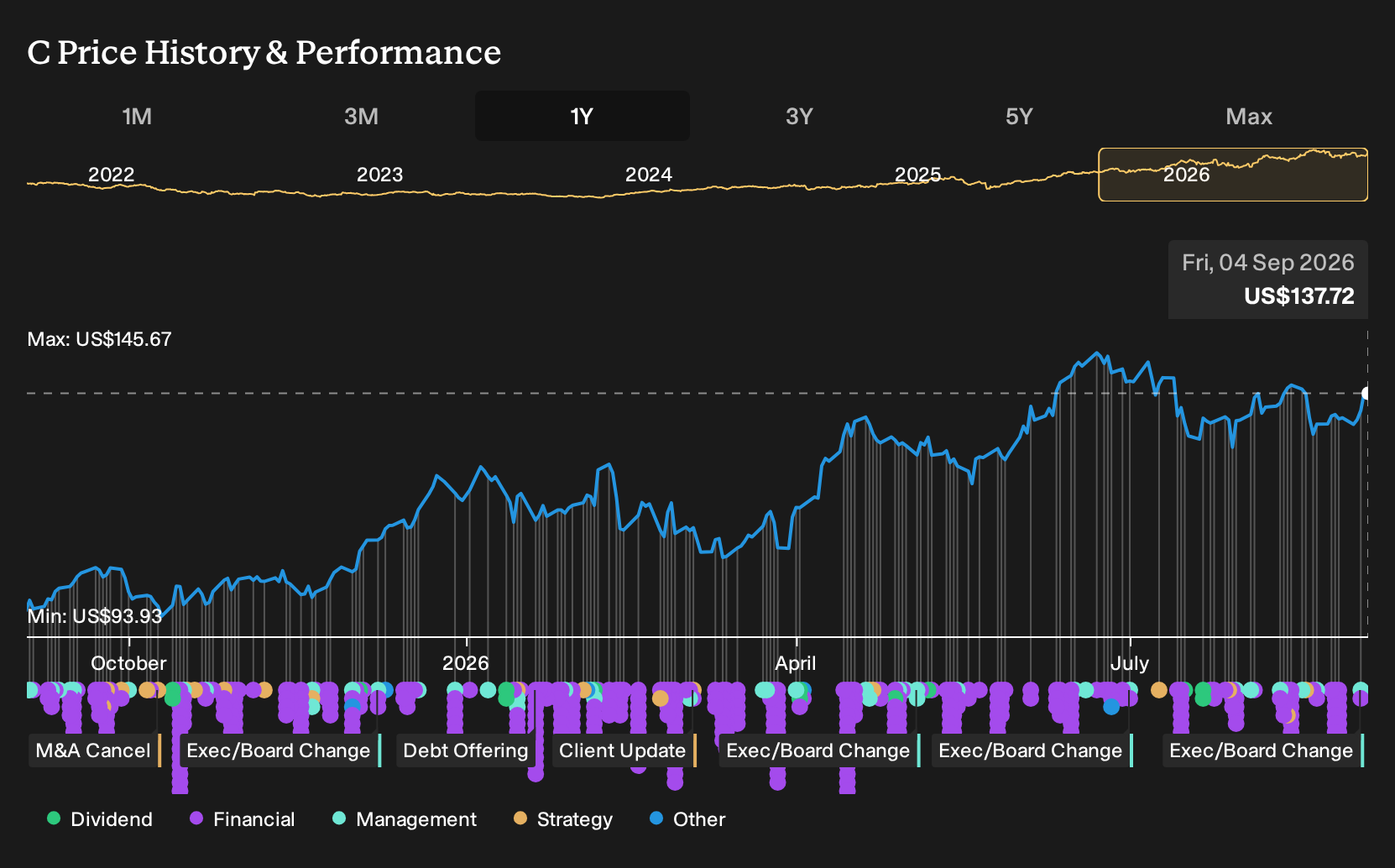
Exploring Other Perspectives
One alternate angle to watch is the bullish wealth catalyst. The most optimistic analysts were already pencilling in revenue of about US$109.2b and earnings near US$24.0b by 2029, helped by richer fee income. Citigroup expanding its AIMS leadership could nudge those expectations again, so it makes sense to compare several viewpoints.
If you want to see how other investors frame Citigroup’s potential, compare the 4 other fair value estimates for Citigroup with the analyst narrative.
Form Your Own Verdict
Disagree with existing narratives? Extraordinary investment outcomes rarely come from following the herd, so go with your own analysis.
- A great starting point for your Citigroup research is our analysis highlighting 4 key rewards that could impact your investment decision.
- See our latest analysis for Citigroup. The report includes a comprehensive fundamental analysis summarized in a single visual, the Snowflake, making it easy to evaluate Citigroup's overall financial health at a glance.
Looking for more investment ideas beyond Citigroup?
If Citigroup is only one piece of your watchlist, it can help to scan for other companies with balance sheets, cash flows and income profiles that fit your risk tolerance and return goals.
- If you want to stay focused on sturdier businesses, start with a 82 resilient stocks with low risk scores that may suit a more defensive approach.
- For investors hunting for quality at a discount, compare Citigroup with a broader 49 high quality undervalued stocks that filters for strong fundamentals and pricing that could appeal to value driven portfolios.
- If future growth stories are your priority, widen the search to a 17 high quality undiscovered gems that screens for under the radar companies with solid financial traits.
This article by Simply Wall St is general in nature. We provide commentary based on historical data and analyst forecasts only using an unbiased methodology and our articles are not intended to be financial advice. It does not constitute a recommendation to buy or sell any stock, and does not take account of your objectives, or your financial situation. We aim to bring you long-term focused analysis driven by fundamental data. Note that our analysis may not factor in the latest price-sensitive company announcements or qualitative material. Simply Wall St has no position in any stocks mentioned.
Have feedback on this article? Concerned about the content? Get in touch with us directly. Alternatively, email editorial-team@simplywallst.com