
- PRICING
- LIVE QUOTES
- LEARN
- HELP


EN
McKesson (MCK) Stock Still Looks Reasonable Following Third Party Cyberattack
McKesson stock has logged a very strong multi year run, yet the current share price still sits well below an intrinsic value estimate that points to the business trading at a discount. Recent headlines about a cyberattack add a clear risk question on top of what is otherwise a broadly cheap valuation read.
- Over 5 years, McKesson has delivered a return of about 347%, which is a very large gain that already prices in a lot of past execution.
- The confirmation of data theft tied to third party apps may weigh on perceived operational risk, while continued reliable cash generation from its distribution activities can support the valuation case.
- The stock screens as undervalued on the Discounted Cash Flow (DCF) intrinsic value estimate and on market multiples, and the broader checks lean cheap with a value score of 5.
The issue now is whether McKesson's current share price already reflects the cyber risk headlines or if the discount to intrinsic value still offers a meaningful margin of safety.
Compare McKesson's valuation gap and recent cyber risk headlines with other hand picked opportunities screened for 49 high quality undervalued stocks that also pair solid fundamentals with discounted prices.
Is McKesson Still Cheap on Cash Flow?
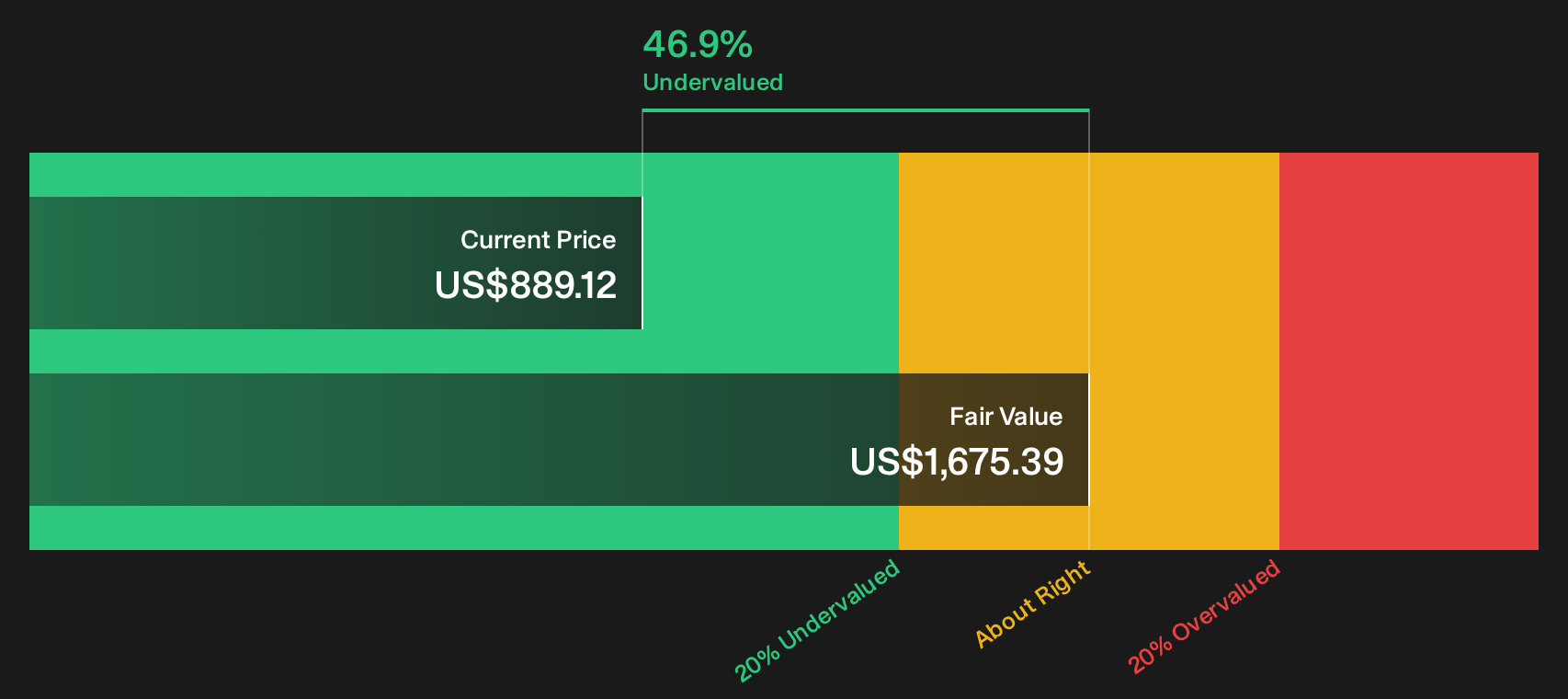
The Discounted Cash Flow (DCF) model used here estimates what McKesson’s potential future cash generation could be worth in today’s dollars. Based on the latest twelve-month numbers, the business produced roughly $6.0b of free cash flow, which is then projected to grow over time before fading to a steadier pace. On those assumptions, the DCF output points to an intrinsic value of about $1,675 per share.
Compared with the current share price, that implies the stock trades at a 46.9% discount to this cash flow based estimate. The recent confirmation of data theft tied to third-party applications helps explain why the market may be keeping McKesson below that intrinsic value line, even while cash generation remains central to the story.
On this DCF view, McKesson appears undervalued relative to the cash flows the business is expected to produce.
Our Discounted Cash Flow (DCF) analysis suggests McKesson is undervalued by 46.9%. Track this in your watchlist or portfolio, or discover 49 more high quality undervalued stocks.
Does McKesson Look Undervalued on Earnings?
P/E is a clean way to compare how the market prices each dollar of McKesson earnings against other healthcare stocks. It keeps the focus squarely on what the business already earns rather than on more complex forecast assumptions.
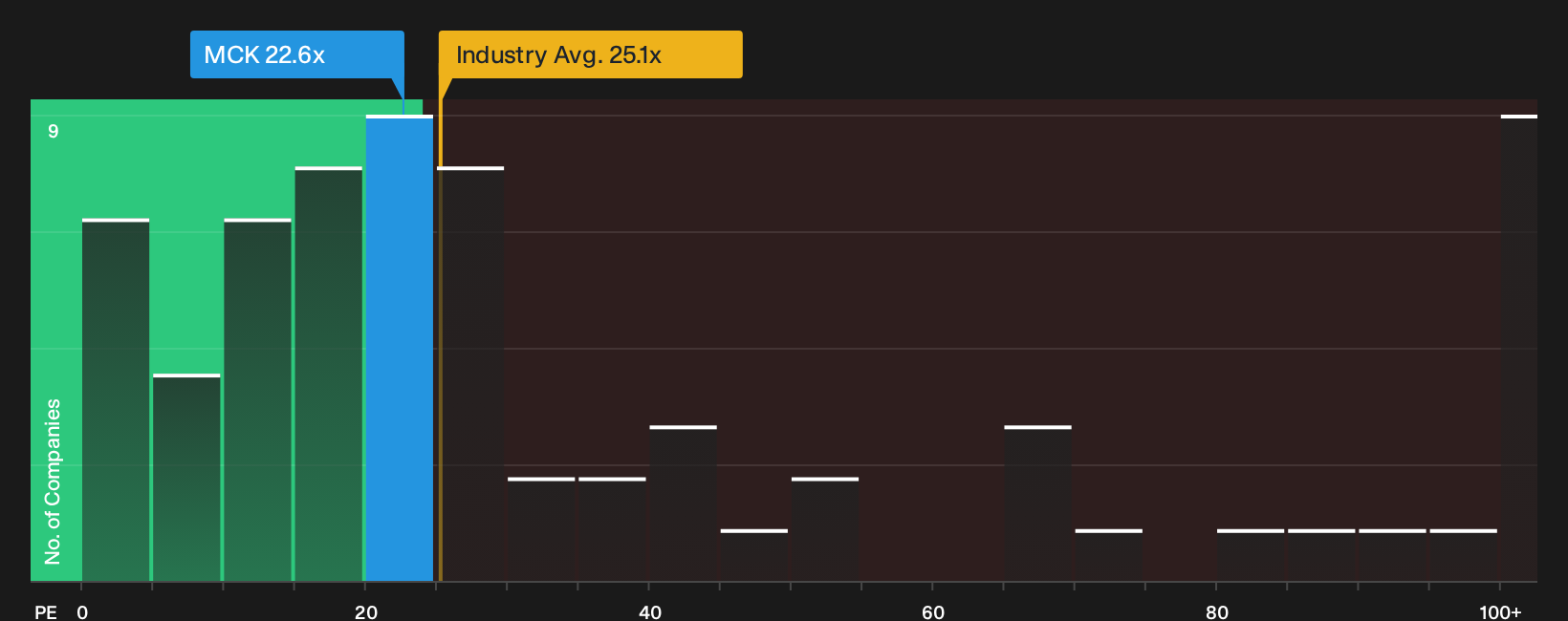
McKesson trades on a P/E of about 22.6x, which sits below both the healthcare sector average of around 25.1x and the peer group on roughly 26.5x. The gap is larger when you compare it with a more tailored fair multiple of about 32.5x, which reflects factors such as the company’s scale, profitability profile and risk level. That fair ratio highlights a sizeable difference between what investors currently pay for McKesson’s earnings and what this model suggests might be reasonable.
On this earnings yardstick, McKesson stock appears inexpensive relative to both its peers and a more customised fair P/E level.
See what the numbers say about this price — find out in our valuation breakdown.
The McKesson Narrative: What Would Justify Today's Price?
Simply Wall St Narratives pick up where the McKesson valuation puzzle leaves off by explaining what would need to happen to future growth, profitability and earnings for the shares to be worth materially more or less than today’s price. Each Narrative presents its fair value as a thesis about McKesson's business that can be tracked over time rather than treated as a static snapshot, and they are available on the company’s Community page for ongoing reference.
Share a narrative on McKesson that sets out a numbers-based view on whether the recent third-party cyberattack and data theft meaningfully changes the long-term case, then track how that thesis holds up as fresh results and updates hit the Simply Wall St community feed.
Do you think there's more to the story for McKesson? Head over to our Community to see what others are saying!
The Bottom Line
For McKesson, both the Discounted Cash Flow (DCF) intrinsic value view and the earnings multiple work point in the same direction. Each framework tags the shares as undervalued, even after a very strong five year return profile, which is unusual without a clear overhang.
The cyberattack and data theft headlines are that overhang. The key question now is whether those operational and reputational risks materially change McKesson’s ability to keep turning its distribution footprint into dependable cash flows, or whether the current markdown proves to be a value trap that correctly prices a higher, more permanent risk level.
This article by Simply Wall St is general in nature. We provide commentary based on historical data and analyst forecasts only using an unbiased methodology and our articles are not intended to be financial advice. It does not constitute a recommendation to buy or sell any stock, and does not take account of your objectives, or your financial situation. We aim to bring you long-term focused analysis driven by fundamental data. Note that our analysis may not factor in the latest price-sensitive company announcements or qualitative material. Simply Wall St has no position in any stocks mentioned.
Have feedback on this article? Concerned about the content? Get in touch with us directly. Alternatively, email editorial-team@simplywallst.com