
- PRICING
- LIVE QUOTES
- LEARN
- HELP


EN
IPO outlook | Revenue has skyrocketed and losses have just been reversed. Starstar Tianhe is sprinting to a Hong Kong stock IPO and hidden worries
The market's understanding of AI infrastructure is changing after large models enter the large-scale training and inference phase.
In the past, it was easier for capital markets to focus attention on GPUs, servers, and computing power centers, but as model parameters, training data, and inference requests continue to expand, how data can be efficiently stored, managed, and delivered to the GPU with sufficiently low latency is becoming an important bottleneck in AI infrastructure.
As the largest independent distributed AI storage solution provider in China, Beijing Star Tianhe Technology Co., Ltd. (“Star Sky”) officially submitted a prospectus to seek listing on the motherboard through the Hong Kong Stock Exchange's 18C (Special Technology Company) channel.
According to the prospectus, the company is the largest independent distributed AI storage solution provider in China by installed capacity in 2025, with a market share of about 10.6%; however, if we expand our vision to the entire Chinese data storage market, the company ranks about 10th to 15th in terms of revenue, with a market share of only about 0.1%. In the distributed AI storage market, which includes independent and non-independent manufacturers, the revenue share is about 2.7%.
However, as an independent storage manufacturer, Tianhe faces double scrutiny in the capital market: on the one hand, can the living space and premium logic of independent storage actually be established in a giant ecosystem full of powerful players and a closed source bundle? On the other hand, the company just turned a loss into a profit in 2025, but operating cash flow continues to flow out and upstream hardware prices fluctuate drastically. What is the “gold content” of its financial quality?
Betting on “data gravity”? Can independent storage overcome the clash of giants
According to the Zhitong Finance App, there is a recognized classification red line in the enterprise-level IT storage market: one category is “non-independent vendors”, which provide bundled storage that is deeply tied to their own proprietary hardware, and the software is generally only compatible with self-produced servers; the other category is “independent suppliers” represented by Star Sky, which focuses on software-defined storage (SDS), and their software can be deployed flexibly across third-party hardware and heterogeneous computing power platforms from different manufacturers.
Looking at the closed loop of monetization, Tianhe's core business logic is to assume end-to-end responsibility for system design, hardware selection, procurement and deployment, and after-sales operation and maintenance by outputting a proprietary distributed storage software stack. Its delivery model is divided into “software-based solutions” (delivering only the software layer, customer-owned hardware) and “all-in-one” (pre-integrating self-developed software into designated hardware as a single deliverable).
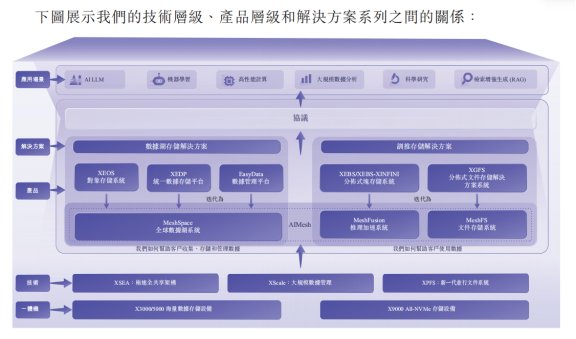
Often, customers are often unable to obtain actual benefits from simply purchasing hardware or software; hardware and software are deeply collaborated across the entire solution, and all-in-one devices are priced and contracted as a single deliverable. Furthermore, late-stage AI storage services (including value-added services such as warranty, maintenance, renewal, and capacity expansion after deployment) form a highly sticky closed loop of subsequent monetization.
With the explosion of AI model parameters, the amount of data in mainland China is expected to soar from about 50 ZB in 2025 to more than 150 ZB in 2030, with unstructured data accounting for a very high proportion.
Among them, Tianhe's distributed architecture supports linear expansion of PB or even EB-level storage pools, which directly drives the “capacity addition” generated by existing customers due to data volume expansion. According to the prospectus, the company's overall net dollar retention rate (NDR) performance was impressive, rising from 46.5% in 2023 to 91.9% in 2024, to 132.5% in 2025, and reaching a record high of 160.0% in the first half of 2026.
This retention performance confirms the commercial law of enterprise-level storage “data gravity”: once the customer's core business data and AI workflow are deeply embedded in the platform, the migration costs will be unbearably high, and customers can only choose to make additional purchases as the data capacity grows.
In terms of average customer unit price, according to the prospectus, the average selling price of the company's AI data lake solution rose sharply from RMB 192,700 in 2024 to 255,300 yuan in 2025, and to 497,600 yuan in the first half of 2026; the average sales price of Xuntui storage solutions also jumped to 494,900 yuan in the first half of 2026.
Behind the increase in customer unit prices, AI customers have accelerated overall investment in data infrastructure related to artificial intelligence, leading to an increase in the procurement capacity of individual projects and the continuous expansion of the project scale. At the same time, the proportion of one-stop “all-in-one” deliveries has increased significantly. The Zhitong Finance App learned that in the first half of 2026, the share of all-in-one computers in the company's total revenue rose sharply from 42.7% in 2025 to 55.3%.
Among them, since the all-in-one computer includes hardware production value, the total amount of a single contract is far higher than that of a pure software project, thus increasing the customer unit price performance at the sales level. Overall, Tianhe's closed loop of monetization is a commercial rolling model of “using software instead of hardware, locking in inventory with data gravity, and using a one-stop all-in-one to increase customer unit price”.
Financial highlights and hidden concerns behind hard-core technology
To evaluate a specialty technology company that is in a period of rapid growth and applies “Chapter 18C”, the focus of financial analysis is usually on the balance between “revenue elasticity, gross profit structure, R&D efficiency” and “cash consumption rate, capital structure, and liquidity safety.”
Looking through Starstar Tianhe's prospectus, the company's finance showed a very tense picture: on the one hand, the company's performance reached a “bright inflection point” in 2025, successfully turned a loss into profit, achieved annual profit of RMB 7.137 million, and continued to maintain a marginal profit (RMB 307,000) in the first half of 2026, mainly due to the sharp increase in revenue driven by the explosion of AI demand and significant operating leverage.
According to the prospectus, as the core underlying technology matures, the company's R&D expenses rate dropped sharply from 65.9% in 2023 to 28.9% in 2025, and further diluted to 22.3% in the first half of 2026. This is mainly due to the unified and modular R&D process implemented by the company in various business lines, which allows for extensive reuse of core components, greatly improving the output efficiency of each engineer and reducing the incremental cost of developing new solutions.
However, behind this beautiful report card, there are also deep concerns about a sharp drop in gross margin, continued loss of cash flow, and potential obligations outside the balance sheet.
The first is the deterioration of the gross profit structure. During the track record period, Tianhe's comprehensive gross margin stabilized at a high level of around 63% in 2024 and 2025, but it plummeted to 51.8% in the first half of 2026. Among them, the root cause of the “decline” in gross profit margin is that the product portfolio is skewed towards low-margin integrated machines.
According to the Zhitong Finance App, the gross margin of Starstar Tianhe pure software solutions is over 99%, while the gross margin of all-in-one computers is extremely low due to the large number of outsourced third-party hardware components (such as SSD, HDD, memory, CPU, and network cards), which even dropped to 18.9% in the first half of 2026.
At the same time, as the global AI explosion triggered strong demand for high-performance storage media, there was a structural imbalance between supply and demand, and prices continued to rise. Not only was Tianhe unable to completely pass on the cost increase to downstream customers, but instead was forced to prevent the risk of supply cuts by increasing hardware procurement reserves, causing its gross margin space to be squeezed.
In addition, in 2023-2025 and the first half of 2026, Star Tianhe's net cash flow was -153 million yuan, -39.266 million yuan, -254.59 million yuan, and -93.48 million yuan, respectively. Operating activities have never generated positive cash flow.
As of June 30, 2026, the company's cash and cash equivalents had been consumed to the point where only RMB 26.335 million remained, and it was in an extremely tight state. In order to maintain operating and inventory reserves, the company had to increase bank loans of RMB 28.19 million in the first half of 2026.
In terms of the competitive landscape, although Starstar Tianhe won the title of “China's largest independent distributed AI storage supplier” and “China's second largest distributed AI storage supplier” according to the distributed AI storage installed capacity in 2025, its revenue share in the overall data storage market is only 0.1%, and its revenue share in the distributed AI storage market is only 2.7%. Compared with non-independent giants with large server production lines and customer networks, there is still a gap in market power and hardware procurement price power.
In addition, the risk of customer concentration revealed in the prospectus is also high. The top five customers accounted for 55.5% of revenue in the first half of 2026, the largest customers accounted for 22.1%, and most of the top five customers were distributors. In the future, if the stability of distribution channels or the procurement cycle of major terminal projects fluctuate, it will directly cause severe shocks in the company's revenue.
When visiting Hong Kong this time, Starstar Tianhe plans to use the net capital raised to strengthen the R&D of next-generation AI native storage platforms, vertical industry adaptation, ecosystem compatibility (cooperating with leading GPU/CPU suppliers for compatibility certification), and the construction of localized sales and demonstration centers in major economic hubs.
Overall, Tianhe showcased a hard-core technical target that runs wild on the AI gold track, has excellent technical barriers and high customer stickiness, but is also subject to cash flow pressure, gross profit restructuring, and giant attacks. Its performance after launch will be an important litmus test for the real valuation anchor of China's software-defined storage in the AI era.