
- PRICING
- LIVE QUOTES
- LEARN
- HELP


EN
Should Japan Housing Exit Require Action From KKR (KKR) Investors?
- KKR and Weave Living recently completed a full exit from their Japan multi-family partnership through a recapitalisation with a Southeast Asian investor, involving 14 long-stay furnished properties in Tokyo, while Weave continues as investment, asset, and operating manager.
- The recapitalisation converts a large residential portfolio into liquidity for KKR while still keeping fee potential and future acquisition options open through Weave’s ongoing management role.
- The next section examines how converting the Japan multifamily portfolio into cash, while retaining management roles, affects KKR's investment narrative.
Scan how KKR’s latest portfolio moves compare with other capital allocators repositioning for the next leg of returns by reviewing the hand picked 17 high quality undiscovered gems in this space.
KKR Investment Narrative Recap
To own KKR, you generally need to believe in its ability to keep growing fee based earnings from a broad alternatives platform while managing the lumpiness that comes with performance income. The Japan multifamily recap turns a large real estate position into cash, which can support future deals and potentially smooth capital allocation, but it does not meaningfully change the near term story. The key swing factor still sits in fundraising and deployment across private credit and asset based finance, while the biggest near term risk is pressure on asset quality or liquidity if those books are tested.
The fresh appointments of Jonty Edwards in London and Paula Weisshuber in Frankfurt sit closest to the current credit narrative. KKR is pushing deeper into European capital solutions and corporate debt markets, and these hires add senior coverage across sponsors and issuers. For you, the interest is in execution. Strong origination in Europe could support fee related earnings and future carry, yet it also increases exposure to competitive pressure and potential underwriting mistakes if deal quality weakens.
That said, the more interesting tension shows up when you set this growth push against KKR's dependence on performance fees and then ask what happens if …
Read the full KKR narrative to see the case behind these numbers.
What The KKR Forecasts Are Asking You To Believe
KKR's current analyst narrative leans heavily on what the earnings and revenue models are baking in over the next few years. You are being asked to focus less on this quarter's fee income noise and more on where the profit pool could sit by the back half of the decade. The gap between today's numbers and those projections is where most of the risk and opportunity lives.
On revenue, the consensus view is blunt. Analysts are modeling a 13.9% yearly decline over the next three years, even as they expect profit margins to rise from 9.3% today to 39.6% by around 2028. That mix implies a business that could be doing less top line volume but earning far more on every dollar that does come through, which fits a story where performance fees and higher margin credit products carry more of the load.
Earnings expectations make that trade off very clear. Forecasts point to profit of US$5.4b by about 2028, compared with US$2.0b today. That is roughly a 2.7x increase in the earnings base over four years, even as the revenue line is modeled to contract each year. For you, that highlights how much faith the market is placing in fee mix, operating leverage, and capital deployment, rather than simple growth in assets or headline sales.
For these numbers to line up with current analyst price targets, KKR would need to trade on a P/E of 35.7x those 2028 earnings, compared with 61.2x today and a reported 26.7x for the broader US capital markets peer group. The implied de rating already built into the model gives some cushion, but it also means much of the heavy lifting comes from actually delivering those higher earnings and wider margins, not multiple expansion.
One other moving part is share count. Analysts expect the number of shares on issue to increase by about 0.31% a year over the next three years. That is small on its own, though it still matters if you care about per share economics and whether future equity issuance or stock based compensation starts to eat into the benefit of higher aggregate earnings.
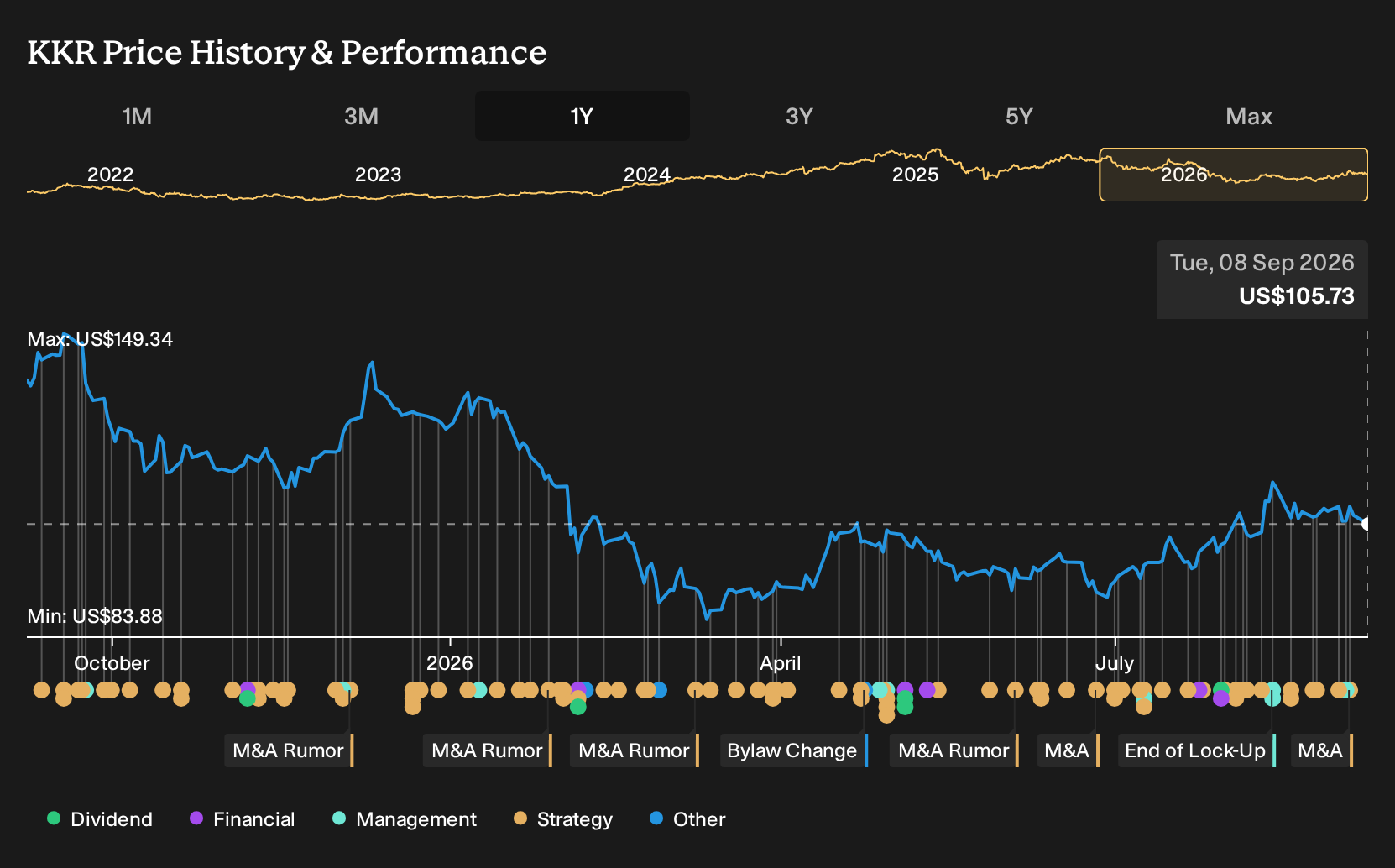
The valuation sketch that falls out of these assumptions is specific. The consensus price target sits at US$164.47, with the bullish end up at US$187.00 and the cautious view closer to US$135.00, against a recent share price of US$137.39 as of early September 2026. The midpoint implies roughly 16.5% upside if the forecasts play out, but the spread between the high and low targets shows there is disagreement on how sustainable those margin and earnings paths might be.
KKR's narrative projects US$13.7b revenue and US$5.4b earnings by 2028. This setup assumes a 13.9% yearly revenue decline and roughly a US$3.4b earnings increase from US$2.0b today.
KKR's forecasts put fair value at $140.24 against $105.73, implying a 33% upside to its current price that could narrow quickly.
Exploring Other Perspectives
You can read KKR’s latest moves in Europe very differently if you worry about competitive pressure in private credit. The most bearish analysts were already modeling a 21.5% yearly revenue decline to about US$12.4b and earnings near US$6.0b by 2029. Those pre news assumptions may shift once this exit and the new hires are fully digested.
If you want to see how other investors are framing KKR’s upside and downside, check out the 5 other fair value estimates for KKR.
Form Your Own Verdict
Don't just follow the ticker; dig into the data and build a conviction that's truly your own.
- A great starting point for your KKR research is our analysis highlighting 4 key rewards that could impact your investment decision.
- See our latest analysis for KKR. The report includes a comprehensive fundamental analysis summarized in a single visual, the Snowflake, making it easy to evaluate KKR's overall financial health at a glance.
Looking For More KKR Investment Ideas?
If KKR has sharpened your focus on fee based models and resilient cash generation, it can be useful to line it up against other businesses with different strengths. That comparison helps you decide whether KKR deserves more capital in your portfolio or whether other opportunities offer a better fit for your risk and income goals.
The Simply Wall St Screener can surface stocks that match very specific criteria, from balance sheet strength to income potential. A few useful angles to consider are:
- If capital preservation sits high on your list, you may want to review companies in the 82 resilient stocks with low risk scores to see which businesses score well on stability and downside protection.
- For investors focused on quality at a sensible entry point, the 49 high quality undervalued stocks can help you spot stocks where fundamentals and price look out of sync.
- If reliable payouts matter to your plan, you could scan the 6 dividend fortresses to find high yielding companies that may support a steadier income stream.
This article by Simply Wall St is general in nature. We provide commentary based on historical data and analyst forecasts only using an unbiased methodology and our articles are not intended to be financial advice. It does not constitute a recommendation to buy or sell any stock, and does not take account of your objectives, or your financial situation. We aim to bring you long-term focused analysis driven by fundamental data. Note that our analysis may not factor in the latest price-sensitive company announcements or qualitative material. Simply Wall St has no position in any stocks mentioned.
Have feedback on this article? Concerned about the content? Get in touch with us directly. Alternatively, email editorial-team@simplywallst.com