
- PRICING
- LIVE QUOTES
- LEARN
- HELP


EN
The risk of a “big return” of Japanese capital is heating up! Japanese bond yields are approaching a 30-year high, and US bond holdings of over a trillion US dollars are receiving attention
The Zhitong Finance App learned that as Japanese treasury yields rise to a high level in nearly 30 years, a risk that has been discussed by the global market for a long time is receiving renewed attention, that is, whether Japan's huge overseas capital will begin to flow back into the local market. Although there are currently no signs of large-scale capital withdrawal from overseas assets, some investment institutions warn that as the attractiveness of Japanese treasury bond yields continues to increase, the market may be underestimating the rate at which Japan's capital flow changes, and the possible impact of this change on yen, US bonds, and the global financing environment.
Japan has been implementing an ultra-low interest rate policy for a long time, so domestic investors have to go overseas to find higher profits, and as a result, it has become one of the world's most important capital exporters. Currently, the amount of overseas assets held by Japanese investors is close to 5 trillion US dollars. At the same time, Japan is still the largest overseas holder of US Treasury bonds, with holdings of about 1.1 trillion US dollars.
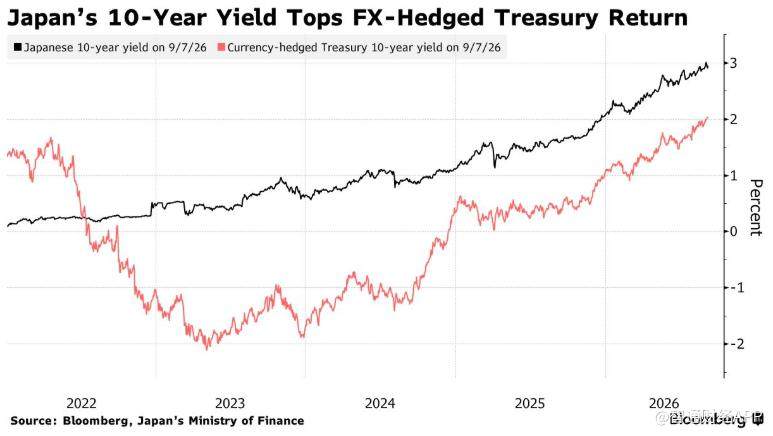
However, the logic of this investment, which has continued for many years, is changing. Last week, Japan's 10-year treasury bond yield hit 3% for the first time since 1996. Inflationary pressure, government spending prospects, and market expectations that the Bank of Japan may speed up the pace of interest rate hikes are jointly driving the yield on Japanese treasury bonds to continue to rise.
Meanwhile, the yen has accumulated a cumulative increase of about 4% since September, making it the best performing G10 currency. Whether the Japanese Government Pension Investment Fund (GPIF) will increase Japan's domestic bond allocation ratio has also become the focus of market attention.
Japan's Minister of Health, Labor and Welfare Kenichiro Ueno, who is responsible for overseeing the GPIF, said on Tuesday that the fund is still studying whether it is necessary to re-examine the current asset allocation.
Ales Koutny, head of international interest rates for active funds at Vanguard Asset Management, said that if Japan's domestic yield continues to rise, Japan may gradually keep more capital in the country, and this is not only related to the yen and Japanese treasury bonds, but may also affect US treasury bonds, European bonds, and the wider global financing environment.
The market is particularly concerned about whether GPIF will be a potential catalyst for capital return. If GPIF increases the allocation of domestic bonds in Japan and encourages other pension funds, insurance institutions, and individual investors to take similar actions, the scale of Japan's overseas capital return may be quite impressive.
Deutsche Bank previously estimated that in an upward scenario involving pension funds, insurance companies, and individual investors making extensive adjustments to asset allocations, the potential amount of capital flowing to Japanese domestic assets in the next few years could reach up to 440 billion US dollars.
Ashwin Binwani, founder of private investment firm Alpha Binwani Capital, believes that the market still underestimates the “large-scale return of capital” that may occur in Japan.
It is worth noting that Japanese capital does not require large-scale sell-off of existing US bonds and other overseas assets, which may have an impact on the global market. As long as Japanese investors invest less new capital overseas in the future, it may weaken an important force that has supported global bond demand for a long time, thereby putting upward pressure on long-term borrowing costs in the US and other economies.
From a yield perspective, the competitiveness of Japanese treasury bonds with domestic investors has increased markedly. Since the hedging cost of the US dollar is currently close to 3%, the yield of 10-year US Treasury bonds calculated in yen after being hedged against exchange rate risk is about 2%, which is about 1 percentage point lower than Japanese treasury bonds for the same period.
In other words, for Japanese investors who need to hedge against the US dollar exchange rate, Japan's 10-year treasury bonds can now provide higher actual returns, which is clearly different from the environment where large amounts of Japanese capital poured into overseas bond markets in the past few decades.
However, at least judging from the current actual capital flow, the so-called “big return” of Japanese capital has yet to actually occur.
Shoki Omori, chief Japanese fixed income strategist at Deutsche Bank, said that as of August this year, Japanese life insurance companies had basically not clearly sold foreign bonds; banks were only moderately reducing their holdings, while pension trust funds continued to increase overseas assets.
The current strategy adopted by Japanese investors is more to reduce exchange rate hedging rather than directly withdrawing overseas funds. Omori estimates that the exchange rate hedging ratio for new overseas bond investments in Japan has dropped to about 40% this year from 62% in 2024. As the original hedging positions expire, more and more overseas investment options are being added without exchange rate hedging.
This also means that whether overseas bonds remain attractive to Japanese investors in the future will increasingly depend on the trend of the yen.
If the yen continues to appreciate, the momentum for the return of Japanese capital may increase further. As more and more Japanese investors hold overseas bonds without exchange rate hedging, the appreciation of the yen will directly erode the return on investment after converting these assets into yen, and at the same time reduce the appeal of low-cost yen financing and investing in high-yield overseas assets.
After the yen broke through the important mark of 155 yen to the US dollar, some analysts expect the yen's upward trend to accelerate further. If the Bank of Japan continues to tighten monetary policy and the Japan-US gap narrows further, the need for Japanese investors to continue to allocate large amounts of capital to overseas markets may also decline.
However, there are still clear differences on Wall Street as to whether the return of capital is about to occur. Stephen Spratt, a strategist at Société Générale, said that the risk of capital returning from Japan does exist, but it is still unclear which types of investors will take the lead in large-scale withdrawal of overseas capital.
Some analysts believe that the real factor preventing Japanese institutions from increasing the allocation of domestic bonds is no longer that the yield is not high enough, but investors are not convinced that the yield on Japanese treasury bonds is close to the top.
Masayuki Nakajima, a senior strategist at Mizuho Bank, said that the 3% 10-year Japanese Treasury bond yield is already quite attractive, regardless of the historical level or asset liability management perspective. But while there is still uncertainty about how much inflation, fiscal policy, and Japanese treasury yields can rise, large institutions are still reluctant to increase their long-term bond positions too soon.
He pointed out that compared to the absolute level of return, it is more important whether the yield can be stabilized. Once investors believe that the yield on Japanese treasury bonds has stabilized, which is also at the level of 3%, it may attract far stronger buying than at present.
James Athey, fund manager of Marlborough Investment Management, believes that the conditions required for the return of Japanese capital are actually basically in place. As Japanese domestic bond yields rise, Japan-US spreads narrow, expectations of further interest rate hikes from the Bank of Japan increase, and the yen begins to appreciate, the economic impetus for Japanese investors to reallocate their assets continues to increase.
Athey said that considering the current appeal of Japanese domestic bonds compared to overseas bonds, he was surprised that more Japanese institutions have yet to transfer bond investments back to the country.