
- PRICING
- LIVE QUOTES
- LEARN
- HELP


EN
After the Dip, Intel’s $20 Billion Raise Is Not the Red Flag It Originally Looked Like
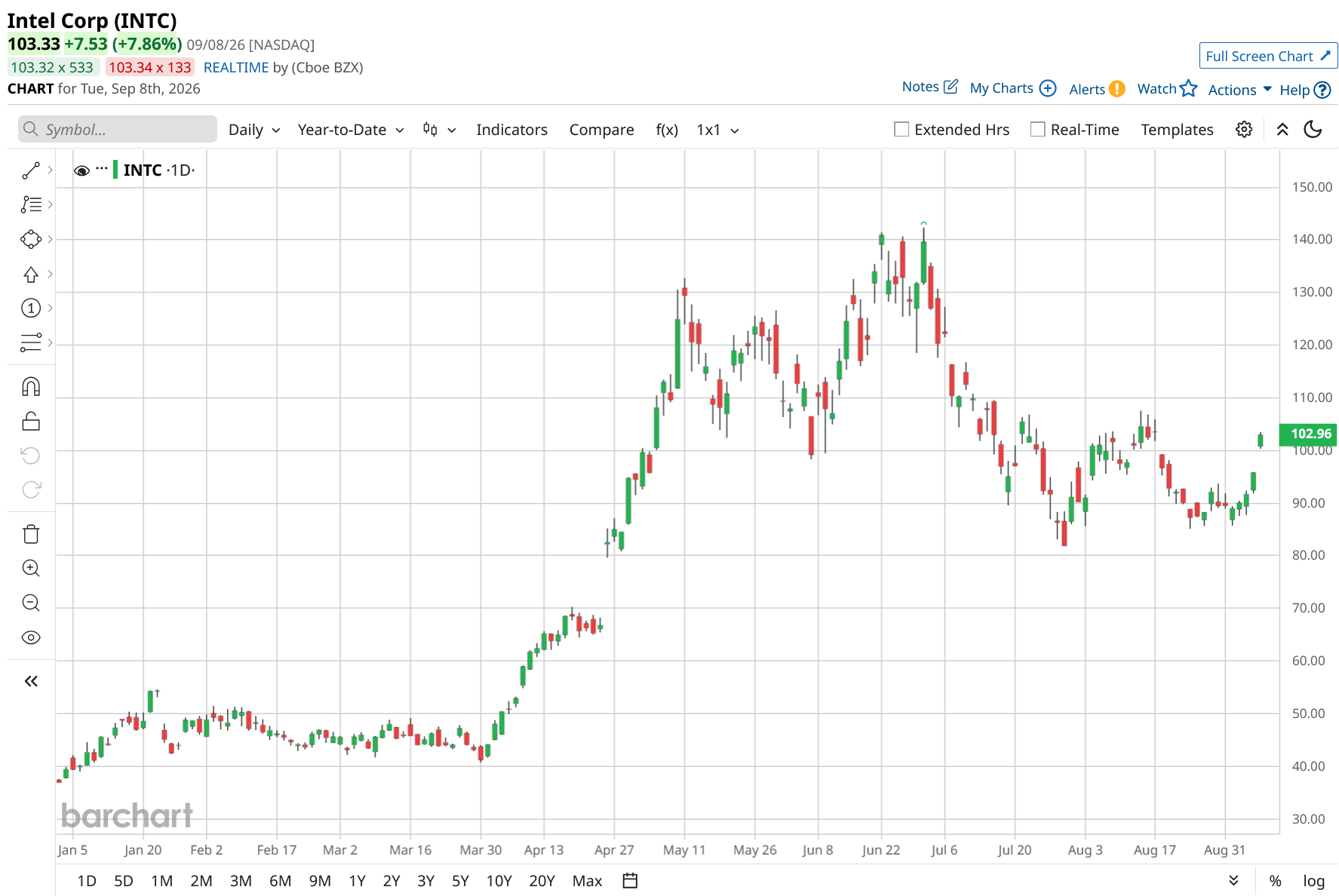
On Aug. 11, Intel (INTC) announced a $20 billion capital raise. Many saw it coming, and to be fair to Intel, we're going to see much more of this going forward from other companies. The day after the news came out, INTC stock closed at just below $101. It then had a 13% decline, and considering the size of the offering, that price drop prices in the risks associated with stock dilution. This is partly why the stock is bouncing back up, and I think investors have a good chance of accumulating the stock while it's under pressure.
Intel’s latest raise offers an important clue about how investors should view the company’s turnaround. It suggests management is raising capital to fund a specific multi-year plan rather than simply addressing short-term financial pressure. The latest raise further strengthens Intel’s broader turnaround narrative, which is already gaining momentum. A growing list of foundry customers, government support, and a process roadmap are all contributing to that progress. Analysts are also becoming increasingly positive on INTC stock.
About Intel Stock
Intel Corporation is a global semiconductor company that designs, develops, manufactures, markets, and sells computing and related technology products. The company operates through the DCAI, CCG, and Intel Foundry segments. Its product portfolio includes client and server CPUs, GPUs, wafer fabrication and semiconductor manufacturing services, networking and connectivity products, and AI and edge computing solutions.
Over the last 12 months, Intel’s stock has surged sharply by 320%, far outperforming the S&P 500’s ($SPX) 18% gain during the same period. The rally was driven by a 10% stake from the U.S. government and a $5 billion Nvidia (NVDA) investment. But since hitting a high of over $142 in late June, the stock has fallen to around $100. The dip came mainly due to dilution from a roughly $23 billion equity raise and ongoing foundry losses.
The Pieces of Intel’s Turnaround Are Coming Together
A major part of Intel’s turnaround case is the financial support behind the company. The U.S. government holds a roughly 10% stake in the company. While Nvidia has invested another $5 billion as part of a plan to co-develop data center and PC chips. That level of financial and strategic support gives Intel additional room to execute a turnaround that would otherwise require significantly more financial flexibility. At the same time, the manufacturing strategy is beginning to deliver tangible progress. The company’s 18A node is now shipping at scale from its Arizona fab. Reported yields have risen above 85%, pointing to a meaningful improvement in cost efficiency.
In addition, Intel is beginning to attract customers to its foundry business. Amazon (AMZN) and Microsoft (MSFT) have both signed early agreements for custom chips. The company has also joined Elon Musk’s Terafab project in Austin, where it will help develop, manufacture, and package chips for the venture. The improvement is not limited to manufacturing either. Intel’s latest quarter revenue rose more than 24% year-over-year (YoY), while its Data Center and AI Segment revenue grew 59%.
What the $20 Billion Raise Actually Means
The size of the raise is less important than what the company plans to do with the money. UBS analyst Timothy Arcuri estimates that Intel will spend roughly $20 billion on capital expenditures in 2026, with investment rising to between $28 billion and $30 billion in 2027 and approaching $40 billion annually in 2028 and 2029. Those projections help explain why the latest financing matters. The money is not simply being raised to address a funding shortfall but to finance a foundry expansion that will require significantly more investment over the coming years. Analyst Timothy Arcuri also expects some of the company’s upcoming foundry agreements to include pre-payments and other financial commitments. Potential customers include Apple (AAPL) for M-Series chips, Alphabet's (GOOG) (GOOGL) Google for EMIB-T packaging, SpaceX (SPCX), and AMD (AMD). He described the raise as a strong endorsement of Intel’s confidence in its foundry roadmap. Another notable detail is that the federal government did not participate in the financing. Commerce Secretary Howard Lutnick reportedly approved the move without increasing Washington’s existing position. That suggests the company is becoming more capable of raising commercial capital without relying further on government support.
The Turnaround Still Comes at a Price
Intel’s improving turnaround story does not mean the company is close to generating positive free cash flow. UBS analyst Timothy Arcuri projects Intel will burn approximately $1 billion in free cash flow in 2027 and another $4 billion in 2028. Free cash flow is not expected to turn positive until 2029. The foundry opportunity also carries execution risk, as potential deals with AMD, Apple, Google, and SpaceX remain anticipated rather than completed. Until those agreements are formally signed, investors should treat them as potential catalysts rather than established revenue sources.
The $20 billion raise should not necessarily be viewed as a red flag. Instead, the capital appears to be supporting a foundry expansion that is already attracting meaningful interest from customers. The company is still several years away from profitability, but several pieces of the turnaround are moving in the right direction. A growing list of foundry customers, government support, improving manufacturing yields, and Nvidia’s investment are all developing in Intel’s favor.
What Are Analysts Saying About INTC Stock?
Bank of America Securities reaffirmed a “Buy” rating on INTC stock and kept its price target unchanged at $145. However, UBS took a more cautious stance and cut its price target. The firm lowered its price target from $121 to $112 and reiterated a “Hold” rating, viewing the raise positively but flagging dilution from the offering. UBS also expects Intel to say free-cash-flow negative until 2029. This shows that analysts remain divided on the stock’s short-term outlook.
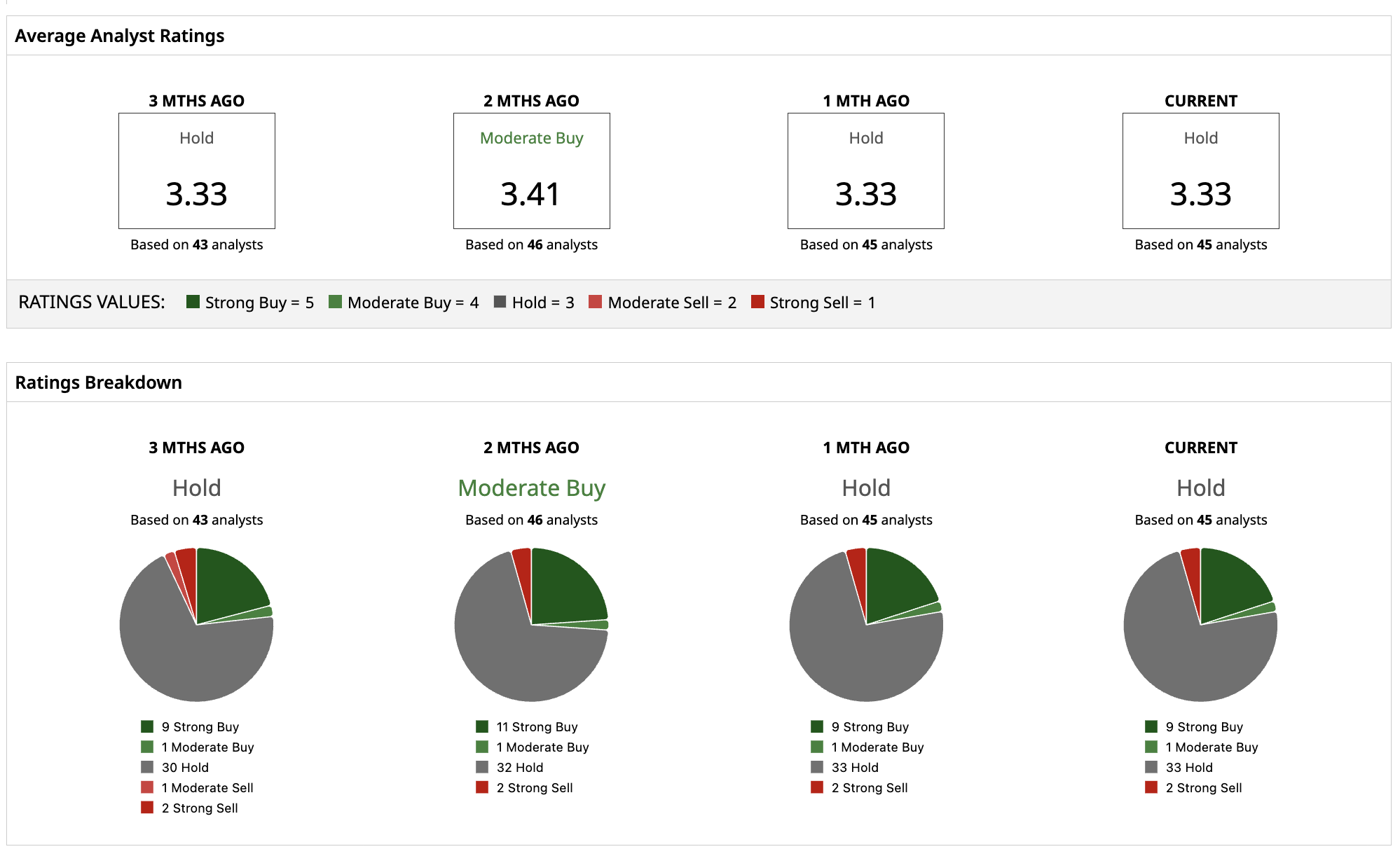
According to 45 Wall Street analysts covering INTC stock, it carries a consensus “Hold” rating. Their median price target is $113.37, which offers a further 10% upside from the current share price. The highest price target of $200 suggests that the stock could almost double, implying an impressive 94% upside from here.
On the date of publication, Jabran Kundi did not have (either directly or indirectly) positions in any of the securities mentioned in this article. All information and data in this article is solely for informational purposes. For more information please view the Barchart Disclosure Policy here.