
- PRICING
- LIVE QUOTES
- LEARN
- HELP


EN
Palladium Battle for Control Near the $1,400 Level
Scarcity, Sanctions, and the Fed: What Is Driving Palladium Right Now
Palladium has been one of the more volatile stories in the metals complex this year. After capitulating from a high near 2200 in late January, the market slid through the first half of 2026, eventually printing a nine month low near 1177 in June. Since then, sentiment has shifted noticeably. Spot palladium traded near $1,353 an ounce on September 3, up roughly 1.35% on the day and up about 4.65% over the prior 24 hours, before extending gains to trade above $1,400 by September 5. The renewed strength has been driven largely by fresh worries over South African output. The Johnson Matthey PGM Market Report projects South Africa's primary palladium supply at roughly 557,000 ounces for 2026, but ongoing labor strikes and persistent power shortages have raised doubts about whether that figure is achievable. Impala Platinum CEO Nico Muller recently told reporters that fresh investment in new South African PGM production is highly unlikely given rising costs and thin margins, reinforcing the view that the country's contribution to global supply is more likely to shrink than expand.
Russia remains the single largest source of mined palladium, with Norilsk Nickel accounting for roughly 40% to 43% of global output. Sanctions tied to the war in Ukraine continue to force Russian metal through rerouted channels such as Armenia and Swiss bonded warehouses, an arrangement widely viewed as fragile. Sibanye Stillwater has appealed a US International Trade Commission ruling on anti dumping duties tied to Russian palladium imports, though the broader push for steep US tariffs on Russian metal lost momentum after the underlying trade case stalled in May. On the demand side, the World Platinum Investment Council now projects a 297,000 ounce deficit for 2026, pushing back an expected market surplus that had previously been penciled in for 2026 toward 2028. Hybrid vehicle production, which remains heavily reliant on palladium loaded catalytic converters, continues to support automotive demand, forecast near 7.8 million ounces for 2026, or about 85% of total palladium demand. Layered on top of this supply story is a cautious macro backdrop. The US Dollar Index firmed into the low 98.00 area heading into Friday's Nonfarm Payrolls report, with markets positioning for the print and its implications for the Federal Reserve's next move on interest rates, a dynamic that continues to keep precious metals broadly sensitive to shifting rate cut expectations.
What the Market Has Done
- Since price capitulated in January, putting in a high near the 2200 level, the market has been trending down in a block stepped manner.
- This decline has formed three consolidation ranges so far.
- In the most recent consolidation range 3, buyers held the 1200 area and have steadily stepped up bids within the range.
- Most recently, buyers were able to probe above the 1400 area.
- Prices are currently chopping around this level as buyers and sellers battle to take control.
What to Expect in the Coming Weeks
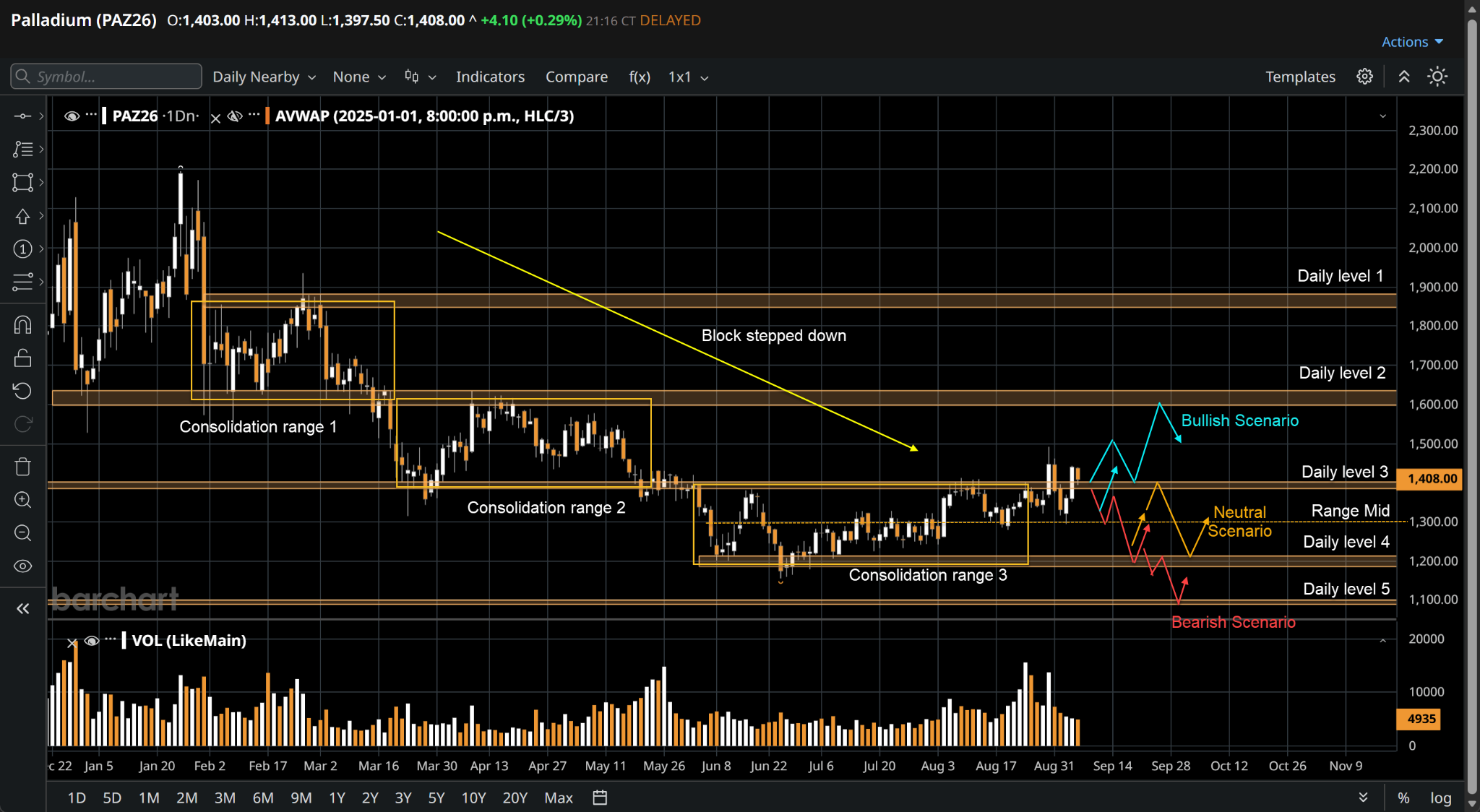
The key level to watch is the 1400 area (Daily Level 3).
Bullish Scenario
- If buyers are able to accept and hold above 1400, or quickly reclaim above it if the market probes below, expect a move up through consolidation range 2 toward 1600 (Daily Level 2).
- A possible trigger for this scenario is a further escalation in South African supply disruptions, such as an extended strike or worsening power shortages, combined with a fresh round of US or European sanctions targeting Russian palladium flows, together tightening already limited available supply.
Bearish Scenario
- If buyers fail to defend 1400, expect a move down to the 1300 area (consolidation range 3, mid).
- If there is no responsive buying at that level, expect a breakdown below consolidation range 1 and a further move down to 1200 (Daily Level 4), and possibly down to 1100 (Daily Level 5).
- A possible trigger for this scenario is a broader strengthening of the US dollar on hawkish Federal Reserve repricing, alongside a resolution of South African labor disputes or confirmation that Russian supply continues moving through rerouted channels without further disruption.
Neutral Scenario
- If the market rotates back within consolidation range 3 after multiple attempts to probe 1400 or 1200 (Daily range 4), expect two way rotation within consolidation range 3 to build up more value.
- A possible supporting condition for this scenario is a lack of fresh macro or geopolitical catalysts, leaving the market to digest recent supply headlines without a clear resolution in either direction.
Conclusion
Palladium sits at a genuine inflection point, both technically and fundamentally. On the chart, the market's block stepped decline from the January high has given way to a defended base near 1200 and a fresh test of the 1400 area, a level that will likely decide whether the next leg is a resumption higher toward 1600 or a slide back toward the lower end of the recent range. Underneath the price action, the fundamental picture remains genuinely unsettled: a structural supply deficit, fragile Russian export channels, and deteriorating South African production capacity all argue for continued tightness, while a resilient US dollar and an uncertain Federal Reserve path argue for caution. Watch how price behaves around 1400 in the sessions ahead, since the reaction there may say as much about where palladium is headed next as any single headline.
We are a professional-grade futures brokerage engineered by traders to provide the high-performance architecture and futures trading platform required for serious market participation. We serve as a professional technical partner for traders who prioritize data integrity and objective analysis. Take the next step in your professional evolution and Open an Account today.
Disclaimer:
This article is provided for informational and educational purposes only and does not constitute financial, investment, or trading advice. The analysis presented reflects the author’s market observations and opinions at the time of writing and is not a recommendation to buy or sell any futures contract, security, or financial instrument. Futures trading involves significant risk and is not suitable for all market participants. Losses may exceed initial margin deposits, and market conditions can change rapidly.
Any scenarios, levels, or market expectations discussed are hypothetical in nature and are intended solely to illustrate potential market behavior. They do not represent actual trading results and should not be interpreted as guarantees of future performance. Past performance, market behavior, or historical price action are not indicative of future outcomes.
Readers are solely responsible for their own trading decisions and risk management. Always conduct independent research, consider your financial situation and risk tolerance, and consult with a qualified financial professional, if necessary, before engaging in futures or derivatives trading.