
- PRICING
- LIVE QUOTES
- LEARN
- HELP


EN
Can Broadcom (AVGO) Hold Its Valuation Edge After Mixed Guidance?
Broadcom stock has pulled back in recent weeks, yet both the Discounted Cash Flow (DCF) intrinsic value estimate and market multiple checks still lean toward the shares pricing in less than what the business may be worth over a typical 5 year holding window.
- Over 5 years, Broadcom has delivered a total return of about 6.8x, which puts the recent slump into context as a move inside a very large multi year gain.
- Heavy spending on AI infrastructure and Broadcom's push into enterprise AI software can support cash flow expectations, while margin pressure and rising financial commitments tied to AI buildouts may limit how much investors are willing to pay for that growth.
- On Simply Wall St's composite checks, Broadcom screens as broadly cheap, with a value score of 5.0 out of 6, and the DCF intrinsic value estimate sitting about 23.9% above the recent share price.
The stock's next move may depend on whether the current discount to intrinsic value and earnings based measures offers enough compensation for the recent volatility and AI related risks.
Spot similar AI infrastructure stories at work and compare Broadcom against a curated list of 55 AI infrastructure stocks.Is Broadcom Still Cheap on Cash Flow?
The Discounted Cash Flow (DCF) model values Broadcom on the cash it is expected to generate for shareholders over time. On the latest numbers, the business produced about $39.6b of free cash flow over the last twelve months in its reporting currency, and the model assumes those cash flows keep growing rather than shrinking.
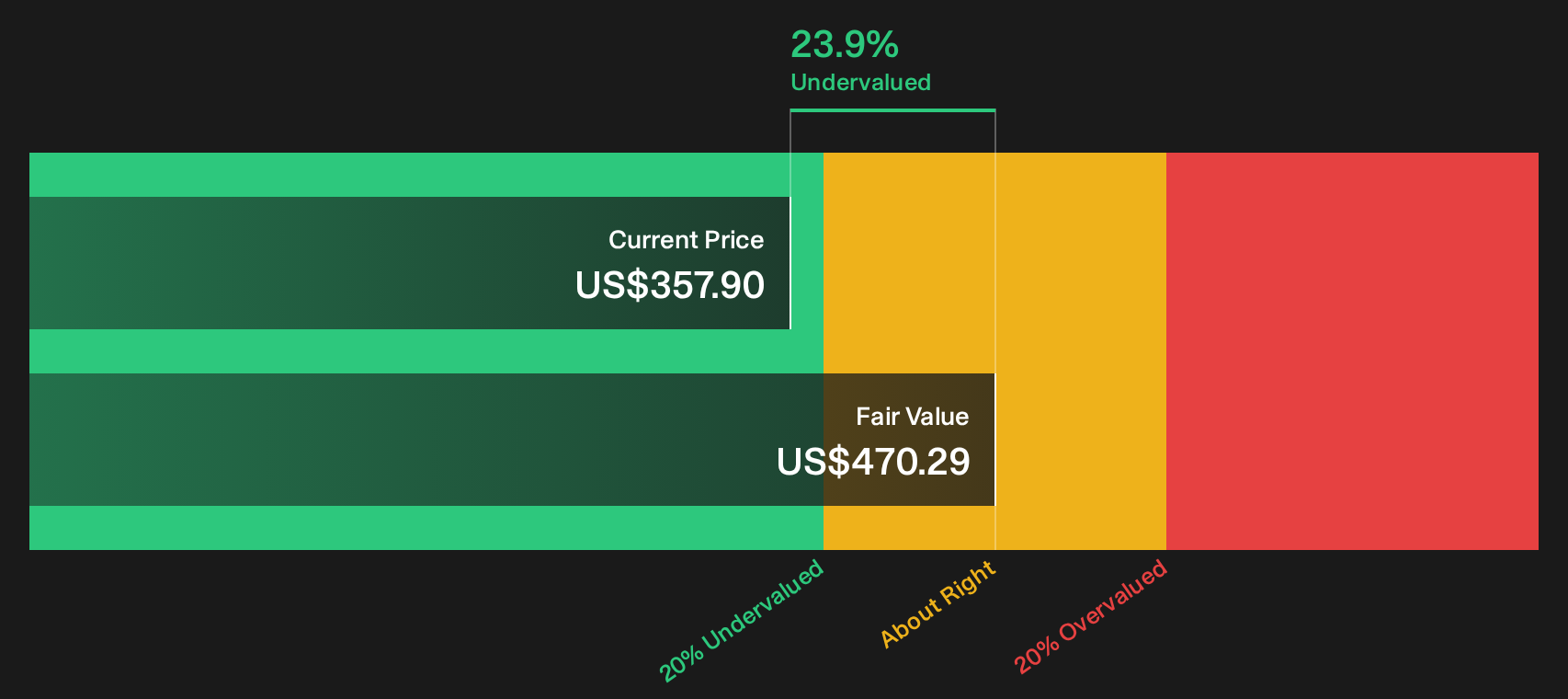
On that basis, the DCF points to an estimated intrinsic value of about $470 per share, which sits roughly 23.9% above the recent market price. The Q3 2026 update, where AI chip revenue and AI infrastructure software drew plenty of attention but guidance and margin questions pulled the share price back, helps explain why the market price still trails the value implied by Broadcom’s cash flows.
Put together, the discounted cash flow work suggests Broadcom stock currently looks undervalued relative to its projected cash generation.
Our Discounted Cash Flow (DCF) analysis suggests Broadcom is undervalued by 23.9%. Track this in your watchlist or portfolio, or discover 49 more high quality undervalued stocks.
Is Broadcom a Bargain on Earnings?
The price-to-earnings (P/E) ratio suits Broadcom because earnings have become a key yardstick for how investors weigh its mix of AI chips and infrastructure software.
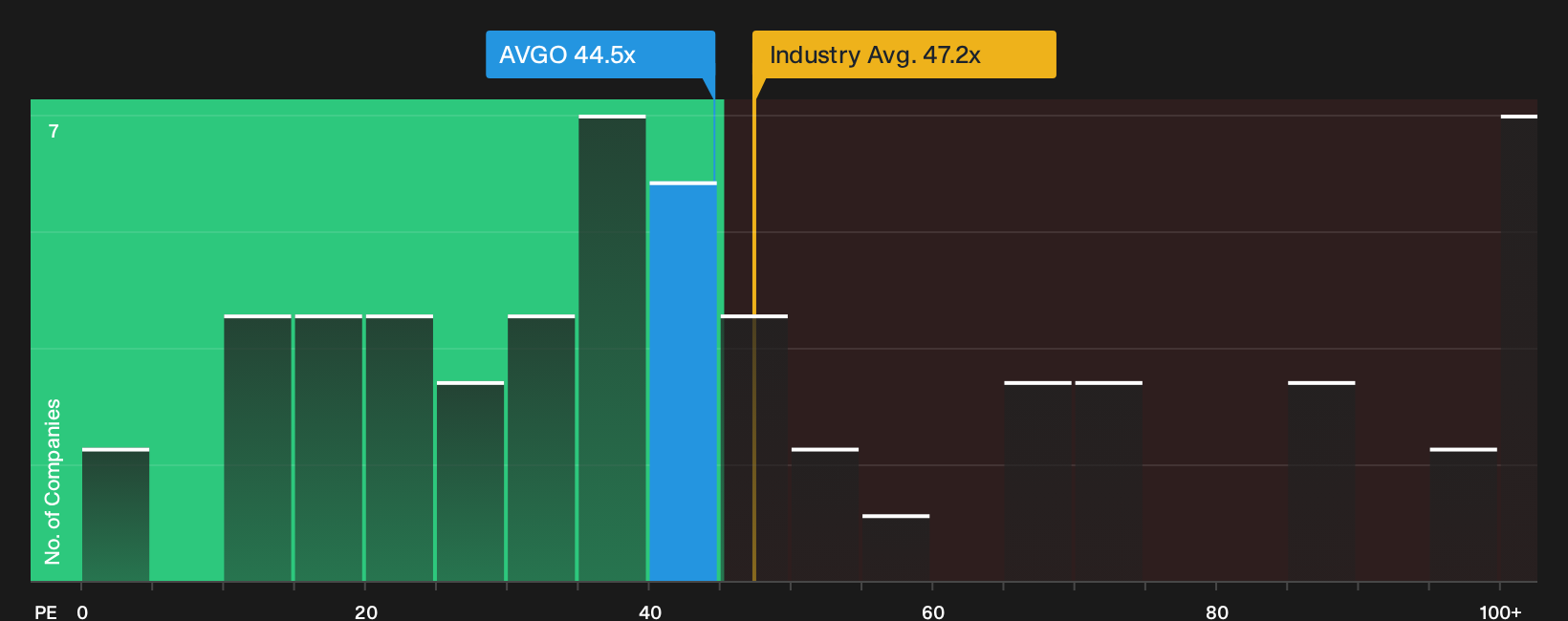
The stock trades on a P/E of about 44.5x, which is below both the broader semiconductor sector on roughly 47.2x and a peer group average near 61.6x. A more tailored fair multiple that factors in Broadcom's size, profitability profile and risk comes out higher again at about 52.8x. That highlights a gap between what buyers are currently paying for each dollar of earnings and what this framework suggests might be reasonable.
The recent pullback after strong Q3 numbers and mixed guidance has left Broadcom trading at a discount to both sector benchmarks and this fair ratio, even with AI exposure very much in focus.
On these earnings multiples, Broadcom stock appears undervalued on a relative basis.
See what the numbers say about this price — find out in our valuation breakdown.
The Broadcom Narrative: What Would Justify Today's Price?
Simply Wall St Narratives pick up where Broadcom's valuation puzzle leaves off by spelling out which assumptions on growth, margins and earnings would need to hold for the stock to be worth markedly more or less than the current share price. These Narratives are available on the company's Community page. Each scenario links a fair value estimate to a clear storyline around Broadcom's potential catalysts and key risks, so you can track over time which version seems to be unfolding.
Community views on Broadcom are split, with one camp arguing the stock underprices a digital infrastructure powerhouse while another highlights valuation risk after a strong run.
Bull case: 45% undervalued
"Broadcom has spent decades positioning itself at critical points within the technology stack where performance, reliability, and scale matter most..."
Read the full Bull Case to see why Broadcom could be undervalued
Bear case: 38% overvalued
"Broadcom demonstrates exceptional business metrics, presenting high growth, high margins, a wide moat, and operates in a promising industry..."
Read the full Bear Case to see why Broadcom could be overvalued
Do you think there's more to the story for Broadcom? Head over to our Community to see what others are saying!
The Bottom Line
Broadcom screens as undervalued on both the Discounted Cash Flow (DCF) intrinsic value estimate and its earnings multiples, which line up rather than conflict. The recent volatility and sharp move in the share price now hinge on a simple question. Either AI driven cash generation and software traction are strong enough to close that valuation gap over time, or the market is correctly discounting future margin pressure and capital demands. The crux for investors is whether current AI infrastructure spending ultimately supports robust, sustainable free cash flow or whether those commitments cap how far the P/E and intrinsic value can converge.
This article by Simply Wall St is general in nature. We provide commentary based on historical data and analyst forecasts only using an unbiased methodology and our articles are not intended to be financial advice. It does not constitute a recommendation to buy or sell any stock, and does not take account of your objectives, or your financial situation. We aim to bring you long-term focused analysis driven by fundamental data. Note that our analysis may not factor in the latest price-sensitive company announcements or qualitative material. Simply Wall St has no position in any stocks mentioned.
Have feedback on this article? Concerned about the content? Get in touch with us directly. Alternatively, email editorial-team@simplywallst.com