
- PRICING
- LIVE QUOTES
- LEARN
- HELP


EN
Store Expansion Plan Might Change The Case For Investing In Loblaw Stock (TSX:L)
- Loblaw Companies has been investing the remaining CAD 1,200 million of its 2026 capital plan into new and refurbished grocery stores, pharmacies and new formats across Canada, alongside early steps to grow T&T Supermarket in the United States.
- The push toward hard discount banners such as No Frills and Maxi, rural small-box formats and expanded pharmacy services shows Loblaw Companies reshaping its physical network around value, convenience and healthcare demand rather than just adding floor space.
- With Loblaw Companies accelerating 2026 store openings and renovations, we will now assess how this heavier capital spend shapes its investment narrative.
Loblaw Companies Investment Narrative Recap
An investor in Loblaw Companies needs to be comfortable with a retailer leaning harder into value formats, healthcare services and capital-heavy store projects while facing steady e commerce and regulatory pressure. The remaining CA$1,200 million earmarked for 2026 tilts the near term story toward execution. The core short term swing factor is whether this burst of openings, refurbishments and concept tests sustains traffic and basket size without noticeable margin strain. The biggest near term risk is that higher fixed costs and discount mix weigh on profitability if consumer spending or pricing conditions soften.
The most relevant recent development is the acceleration of hard discount formats such as No Frills and Maxi and the rural small box concept in Dutton, Ontario. That shift directly links to the key catalyst investors often watch in Loblaw Companies, the balance between volume growth and margin pressure as more shoppers trade down. Discount formats can support market share and keep store traffic resilient but they usually carry lower unit economics. The risk is that heavier investment in these banners and concepts takes longer to translate into efficient scale than the capital outlay suggests.
Even so, there is a quieter pressure point in Loblaw Companies' story that deserves a closer look before you lean in fully...
Read the full Loblaw Companies narrative to see the case behind these numbers.
Loblaw Companies' current analyst narrative points to CA$71.4b revenue and CA$2.8b earnings by 2029, based on 3.1% yearly revenue growth and an earnings increase of about CA$0.1b from CA$2.7b today.
Loblaw Companies' forecasts put fair value at CA$68.80 compared to CA$63.31, a 9% upside to its current price that may not last much longer.
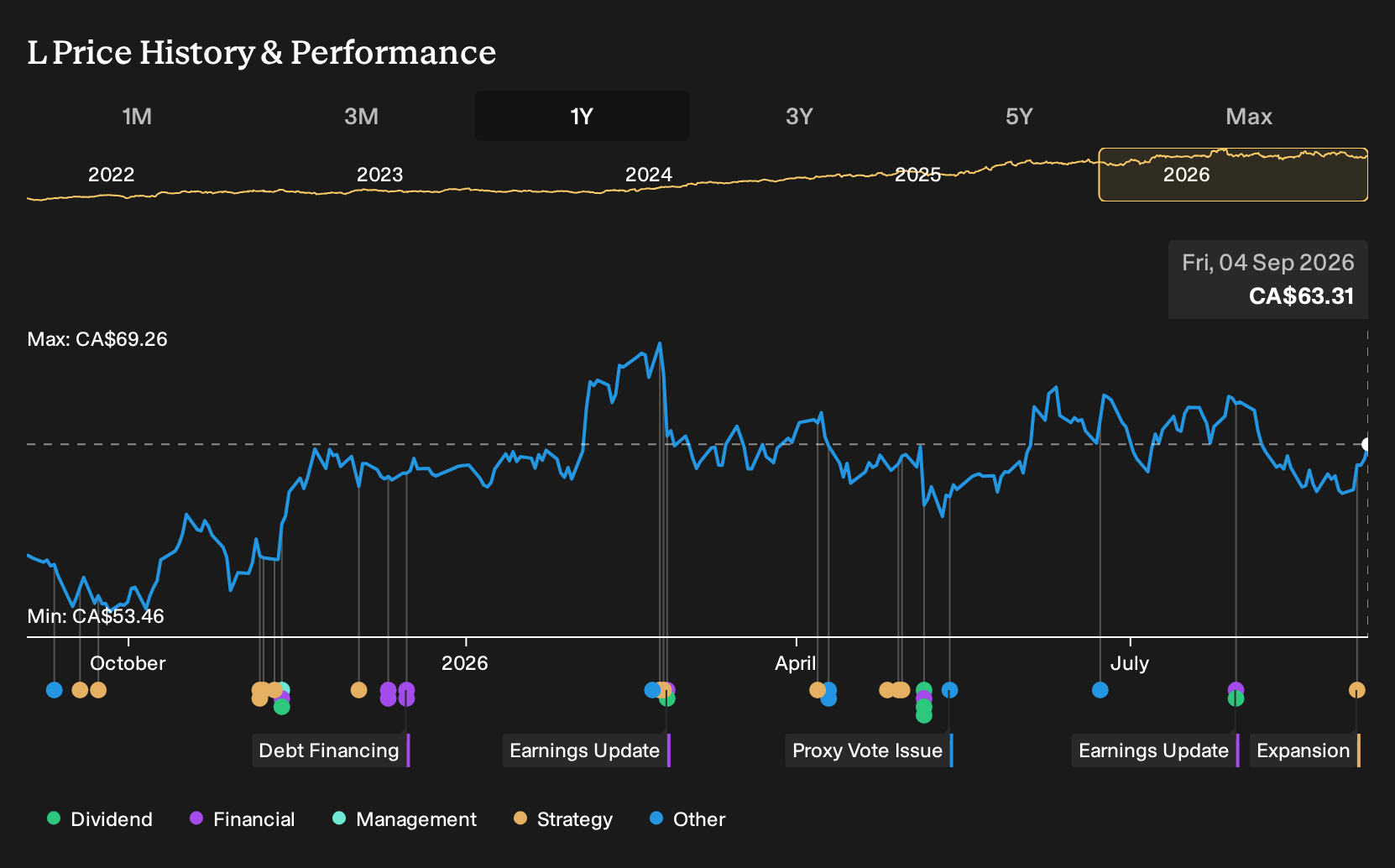
Exploring Other Perspectives
One alternate view says the bigger risk for Loblaw Companies is digital disruption rather than store overbuild. Those more pessimistic analysts were assuming revenue of about CA$70.6b and earnings near CA$3.5b by 2029, yet still set a fair value closer to CA$53.58. That gap shows how sharply opinions can differ, and the new expansion plans could lead those forecasts to shift.
If you want to see how other investors are valuing Loblaw Companies, review the 4 other fair value estimates for Loblaw Companies.
Reach Your Own Conclusion
Disagree with existing narratives? Extraordinary investment returns rarely come from following the herd, so trust your own analysis and judgment.
- A great starting point for your Loblaw Companies research is our analysis highlighting 2 key rewards and 1 important warning sign that could impact your investment decision.
- See our latest analysis for Loblaw Companies. The report includes a comprehensive fundamental analysis summarized in a single visual, the Snowflake, making it easy to evaluate Loblaw Companies' overall financial health at a glance.
Looking for more Loblaw Companies style investment ideas?
If the Loblaw Companies story has highlighted how much structure and balance sheet strength can matter, it often helps to widen the lens and compare it with other businesses that share similar traits or offer different risk and income profiles.
- For investors who care most about resilient balance sheets and solid fundamentals, start with a curated list of solid balance sheet and fundamentals (7 results) that filters for financial strength first.
- If upside potential is your focus, broaden your watchlist with a focused set of 13 high quality undervalued stocks where quality and pricing look more aligned with long term returns.
- For readers who want income alongside stability, scan through a group of 2 dividend fortresses that aim to combine higher yields with staying power through different cycles.
This article by Simply Wall St is general in nature. We provide commentary based on historical data and analyst forecasts only using an unbiased methodology and our articles are not intended to be financial advice. It does not constitute a recommendation to buy or sell any stock, and does not take account of your objectives, or your financial situation. We aim to bring you long-term focused analysis driven by fundamental data. Note that our analysis may not factor in the latest price-sensitive company announcements or qualitative material. Simply Wall St has no position in any stocks mentioned.
Have feedback on this article? Concerned about the content? Get in touch with us directly. Alternatively, email editorial-team@simplywallst.com