
- PRICING
- LIVE QUOTES
- LEARN
- HELP


EN
Britain was the most “hurt” under the wave of sell-offs in the global bond market: the cost of issuing bonds may have reached the highest level in nearly 30 years, and the pressure on the new finance minister before the budget is proposed has increased sharply
The Zhitong Finance App learned that due to a sharp rise in yield and pressure on government finances driven by a wave of global bond sell-offs, the UK is about to face the most expensive debt issuance since at least 1998.
According to people familiar with the matter, the UK is promoting the benchmark treasury bonds due in January 2056 with a yield of about 0.75 to 1 basis point higher than the 2055 treasury bond yield. This will be the highest level of yield faced in the sale of British Treasury bonds since the Office of Debt Management was established in 1998.
In the past few weeks, amid the wave of sell-offs in the global bond market, British treasury bonds have been hit the hardest in major developed economies, and their yield is currently hovering at a high level for decades. Behind this round of sell-offs, the market is concerned about the impact of inflation caused by energy prices, the continued expansion of government deficits, and supply pressure brought about by large-scale issuance of corporate bonds by enterprises under the artificial intelligence (AI) boom.
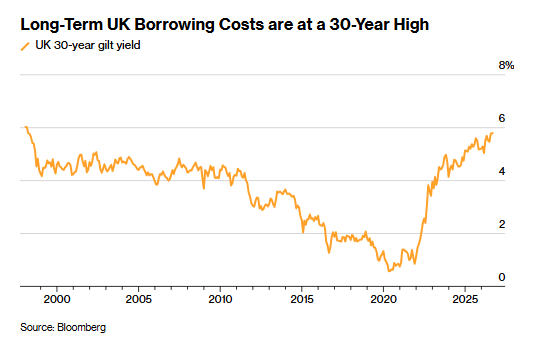
The current UK treasury bond issue is expected to be priced later on Tuesday local time. It is an additional issue of the first batch of 5.9 billion pound bonds issued in May 2025. At that time, the coupon interest rate was 5.405%, setting a record for syndicated issuance at the time. Megum Muhic, capital markets strategist at the Royal Bank of Canada, predicts that the offering is expected to raise up to £5 billion. On Tuesday, the yield on UK 30-year treasury bonds was 5.83%, hitting its highest point since May 1998 last week.
In recent times, the cost of issuing bonds in other countries has also risen. Last month, the US 30-year treasury bond auction rate hit a new high since 2001; interest rates on German treasury bonds issued through syndication groups were the highest since 2011. The UK issued 900 million pounds of 25-year inflation-linked treasury bonds last week, with a yield of 2.496%, setting a record.
Borrowing costs have risen, doubling the pressure on British Chancellor of the Exchequer John Healy on the eve of next month's budget announcement. According to estimates, due to rising bond yields, the UK government's room for maneuver under its fiscal rules has shrunk by nearly half since spring, from £23.6 billion to about £11.8 billion.
In her first important speech after taking office as Chancellor of the Exchequer, Healy said that she will continue to strengthen Britain's credibility in the international bond market on the basis of her predecessor. He stressed on Monday that fiscal discipline “is the cornerstone of all of this administration's promises.”
According to data from the UK Office for National Statistics, the UK public sector's net debt as a share of GDP has risen from about 85% in the 2019-20 fiscal year to over 94% at the end of July, the highest level since the 1960s. According to House of Commons library data, interest expenses on debt reached 7.7 billion pounds in July; in the 2025-26 fiscal year, for every £1 spent by the government, 8 pence was used to pay interest on debt.
Prime Minister Andy Burnham said in September last year that Britain should not be “bound by the bond market,” but since entering Downing Street in July, he has promised to abide by fiscal rules while seeking some “flexibility.”
The bookkeepers for this UK treasury bond issue include Bank of America Securities, Goldman Sachs International Bank, J.P. Morgan Chase, Santander Bank, and UBS Investment Bank.