
- PRICING
- LIVE QUOTES
- LEARN
- HELP


EN
Weak yen dividends have subsided! Japanese car companies' profits may be under heavy pressure, and Toyota may become the biggest victim
The Zhitong Finance App notes that Toyota and other Japanese car companies are facing the risk of loss of profits. Previously, the yen exchange rate rose to its highest level in more than six months.
On Tuesday, the yen fell below the 153 yen mark (that is, more than 153 yen per dollar) against the US dollar, reaching its highest level since February this year. This has put pressure on many of Japan's export-oriented automobile manufacturers, as their profit forecasts are partly based on the assumption that the yen will weaken.
Toyota's expectations for the exchange rate are the most pessimistic, setting an assumed exchange rate of 1 US dollar to 160 yen. The world's largest automaker said in August that for every 1 yen appreciation of the yen, its annual operating profit would be reduced by about 50 billion yen ($326 million).
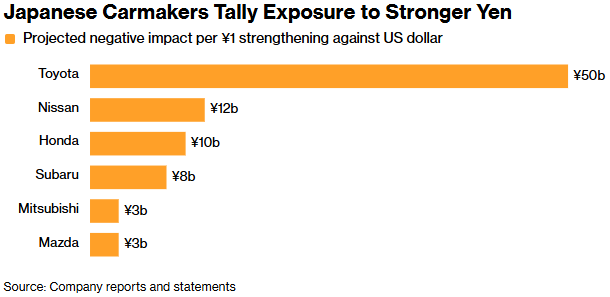
Japanese automakers count the impact of a stronger yen
Exchange rate fluctuations are a source of uncertainty faced by Japanese car companies, highlighting the economic costs brought about by drastic currency fluctuations. When earnings from overseas are sent back to Japan, a stronger yen will weaken the value of those earnings, thereby harming companies with large sales from the US and Europe.
The current performance of the yen exceeds the assumptions of all Japanese car companies except Nissan. Nissan expects the exchange rate of the yen to the US dollar for the fiscal year ending March 2027 is 150 yen. Toyota and Suzuki raised their exchange rate forecasts in August compared to May.
For a long time, Japanese car companies have been inclined to adopt conservative monetary assumptions, which helped them meet or exceed expectations when announcing results. Furthermore, many car companies produce cars and even parts close to the final sales market, thus creating a natural safe haven because production costs can be paid in the same currency.
Toyota is better able to withstand the risks associated with adopting a weaker yen assumption. Its benefits are among the most diversified in the global industry, covering financial services and other businesses, which provides it with additional operational flexibility to offset adverse exchange rate fluctuations.
Although the weakening yen threatened to push up inflation and import prices within Japan, it also provided a breath of relief for the island's largest exporters to help them cope with the pressure brought about by US tariffs, soaring oil prices, and supply chain blockages.
In late June, the yen exchange rate fell to its lowest point since 1986, prompting the US and Japan to launch their first joint intervention in 15 years.