- PRICING
- LIVE QUOTES
- LEARN
- HELP


EN
Lululemon (LULU.US)'s performance plummeted 18% after the results, and it fell back during the year. Analysts judged: the time to bottom out
The Zhitong Finance App learned that the stock price of Lululemon (LULU.US), a leader in high-end yoga sportswear, after handing over another season's poor earnings report, plummeted 18% to about $100. For value investors, this price is quite tempting — the stock has fallen by a total of 52% during the year, the brand is still globally known, and a new CEO is about to take office. Looking at the logic of going long is not difficult to understand, but as far as current fundamentals are concerned, the bottom line may still have to wait.
Growth engine “stalled”: yoga pants sales plummeted 20%
According to Seeking Alpha columnist On the Pulse, the core of the problem is not that quarterly results fall short of expectations, but that Lululemon is losing growth momentum in its core business area. According to the data, Lululemon's second-quarter revenue fell 4%, comparable sales fell 9%, revenue in the American region fell 8%, and comparable sales in the US plummeted 12%. Management then lowered its full-year results guidance again, and expects revenue to continue to decline by 10%-11% in the third quarter. The fundamentals seem to continue to deteriorate.
The market originally expected Lululemon's revenue for the second quarter to be about US$2.46 billion; actual revenue was US$2,416 million. The slightly lower than expected revenue was insufficient to explain such a sharp sell-off. The real problem was the drastic reduction in guidance.
As can be seen from the table below, Lululemon's performance in the second quarter was not like a temporary decline; it was more like the core demand engine was still going backwards.
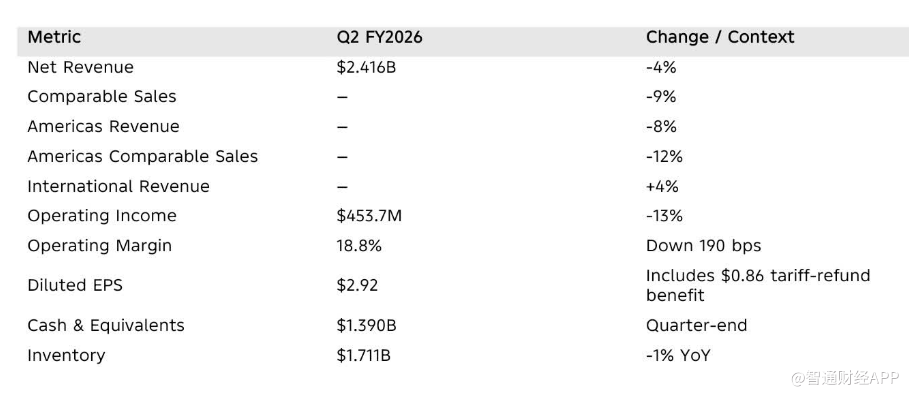
The international market is still contributing to growth, but it is not enough to remedy the decline in the American region. International revenue increased 4%, while revenue in the Americas declined sharply by 8%. If the business in the American region only naturally declined from a very high base, this huge contrast would probably be acceptable. However, a comparable 12% drop in sales in the Americas reveals a deeper problem — whether in physical stores or online channels, there is a marked decline in consumers.
Judging from the category structure, there are obvious challenges at the product level. According to reports, sales of Lululemon's iconic yoga pants have plummeted by 20%, and this is not a one-off issue. Yoga pants were once the core product that established the brand's unique position. Lululemon is currently trying to shift demand to looser styles, but so far, the performance of the new category has not been able to make up for the decline in previous bestsellers.
Lululemon's stalled performance cannot simply be attributed to macroeconomic issues. In the same consumer environment, international business grew, while the American market declined by 8%. Competition from companies such as Alo Yoga and Vuori is becoming increasingly intense, and Lululemon himself admits that product freshness and marketing have not reached the desired level. Falling stock prices will not fix the brand's appeal; it will only make investors choose to wait and see and wait for management to come up with a real solution.
Heidi O'Neill will officially take over as CEO on September 8, and her history at Nike is compelling. But the core question is: the product planning cycle is measured in months. When will the influence of the new management be transmitted to the terminal shelf?
The downgrade of guidelines is the real “miss”
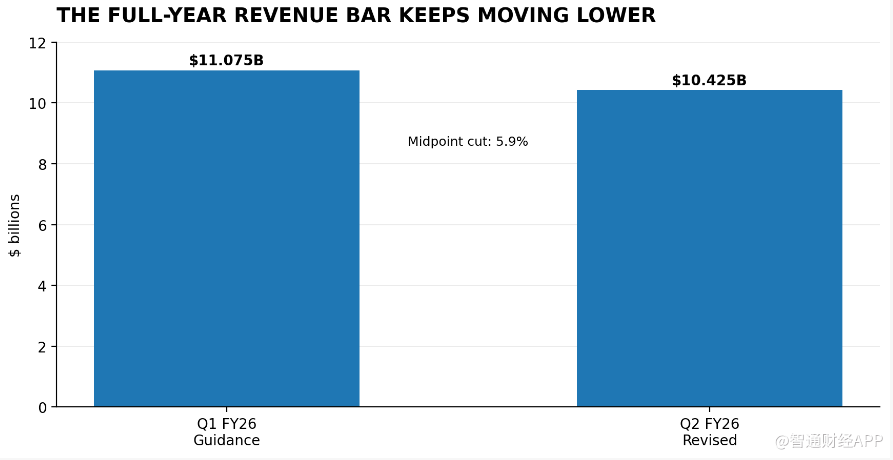
After the first quarter earnings report, Lululemon predicted full-year revenue of US$110-11.15 billion for fiscal year 2026, with diluted earnings per share of US$10.95-11.15. The latest outlook for the 2026 fiscal year has declined to revenue of US$10.35 to US$10.5 billion, with earnings per share of US$9.48-9.73.
In median terms, revenue expectations were cut by about 5.9% within a quarter, and the EPS median was reduced by about 13.1%. What is even more worrisome is that the revised EPS guidelines have taken into account the tariff rebate benefits ($0.86 per share) confirmed in the second quarter. After excluding this factor, the decline at the management level was more severe than the superficial figures showed.
The support point for bearish logic is not that revenue collapse is required, but whether profit forecasts continue to face downward pressure — this is the current trend. The company expects third-quarter revenue of US$2.29 to US$2.32 billion, a year-on-year decrease of 10%-11%, and diluted earnings per share of US$0.93-0.98. Judging from these figures, there are no clear signs that an inflection point has arrived.
Lowering the guidelines objectively lowered the threshold for new CEOs, but a lower starting point alone did not constitute a driving force for fundamental improvements. Before a recovery judgment is formed, it is worth paying more attention to whether product adjustments can actually drive a recovery in passenger flow. This will take time to test.
The “moisture” of gross margin
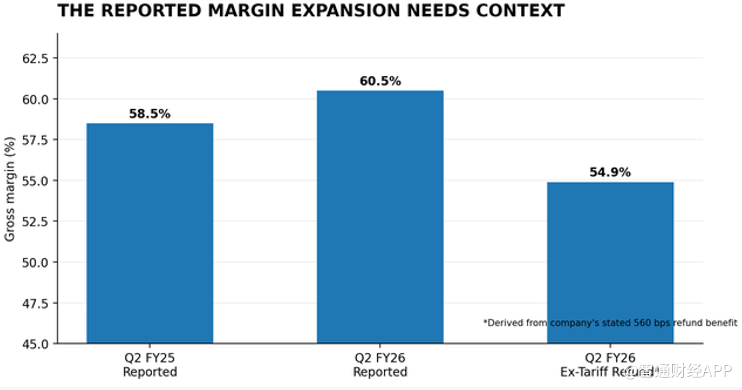
Gross margin is the most prominent data point in the multiple arguments — gross margin increased by 200 basis points to 60.5% during the quarter, which is really remarkable in the context of declining revenue. However, after splitting the details, the conclusion was different.
Lululemon confirmed $134.5 million in tariff rebates and related interest of $4.1 million during the quarter. According to the company's disclosure, this tax refund raised gross margin by 560 basis points and contributed $0.86 per share to earnings. Excluding this portion of the gain, the adjusted gross margin was approximately 54.9%, down from 58.5% in the same period last year. The return of cash from tax refunds is real and should not be ignored, but it is not an improvement at the operational level. Once the one-time factor is removed, gross margins are still under pressure.
The change in operating margin was more intuitive — even though the same tax refund contributed 560 basis points of profit, the operating margin fell 190 basis points to 18.8%. Even if sales decline, companies can temporarily maintain profits by controlling costs, but for high-end consumer brands, the benefits that cost control can bring are limited.
Be wary of undervaluation traps
Valuation is currently the strongest bullish argument. At a price close to $100, Lululemon is no longer an overvalued growth stock.
Based on the company's updated profit guidelines, the price-earnings ratio of about 10.4 times is indeed low for a company with historical profitability like Lululemon. Even after excluding the $0.86 tax rebate benefit per share, the price-earnings ratio is about 11.4 times. The valuation is still attractive, but fundamentals have yet to support it.
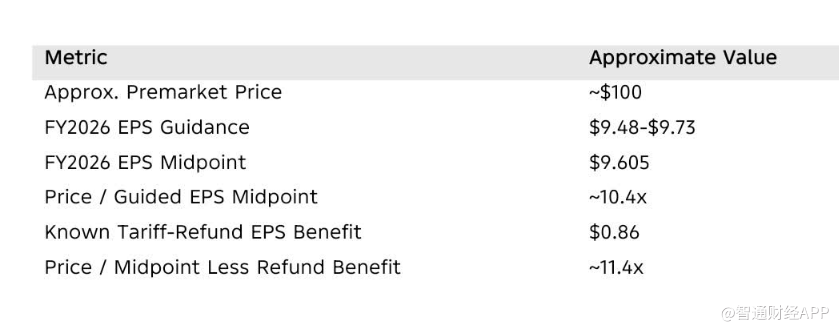
The premise of cheap valuations is that the profit base is stable, and Lululemon's profit expectations continue to decline. This forms a typical “dilemma reversal valuation trap”: investors see a low multiple and assume that a return to the mean will inevitably occur, while ignoring that the profit base continues to decline. A more prudent strategy might be to wait for the revenue trend to substantially reverse before buying at a higher multiple, rather than entering the market because the current book is “cheap.”
Recovery is yet to be achieved; caution is paramount
On the Pulse says it needs to wait for three key signs before changing its pessimistic stance:
First, comparable sales in the US need to improve substantially from the current level of -12%;
Second, the performance of the new category must prove that the gap in yoga pants can be effectively filled, rather than maintaining sales by simply relying on discount promotions;
Third, profit guidelines need to stop being lowered.
The new CEO is clearly the most likely catalyst. Heidi O'Neill has extensive experience at Nike and has driven the development of several major consumer and apparel brands. If she can shorten the product development cycle, optimize product strategies, and restore brand popularity, Lululemon's recovery can be fully anticipated. The company's cash reserves of $1.39 billion and continued profitability also mean that this is not a balance sheet crisis, and there is still room for the new management to play.
This is where the complexity of the problem lies: lululemon's value has not been permanently damaged, yet evidence of recovery is yet to emerge, and the odds of bottoming out are unclear. Stocks are cheaper, but business hasn't gotten any better.
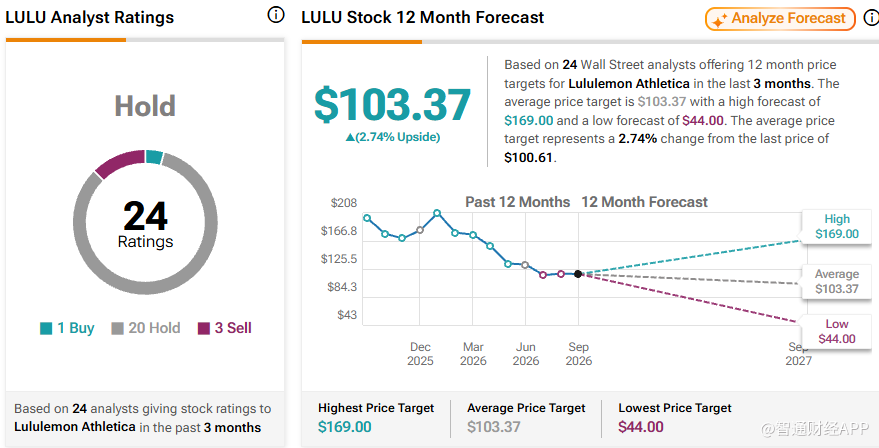
Overall, Wall Street analysts are cautious about Lululemon. The consensus rating is “hold”, and the average target price is $103.37, which is 3% higher than the current stock price.