
- PRICING
- LIVE QUOTES
- LEARN
- HELP


EN
Qiang Fei Nong ignites the expectations of Wall Street hawks! UBS joins the ranks of “turning eagles”: from predicting “no movement throughout the year” to raising interest rates by 25 basis points each in September and December
The Zhitong Finance App learned that the strong performance of the US non-farm payrolls data for August, which exceeded market expectations by nearly three times, is forcing Wall Street institutions to urgently rewrite the script of the Federal Reserve's policy path. On September 7, UBS officially overturned the previous forecast of “staying on hold for the whole of 2026” and switched to expecting the Federal Reserve to raise interest rates by 25 basis points each in September and December, with a cumulative total of 50 basis points for the whole year. Citigroup and Macquarie are also simultaneously adjusting interest rate forecasts, and the global financial market's pricing for the September rate hike has risen to nearly 60%.
UBS's 180-degree shift: from “no change throughout the year” to “raising interest rates twice during the year”
UBS Global Wealth Management clearly stated in its latest report that the hawkish signals released by Federal Reserve Chairman Kevin Walsh at the Jackson Hole annual meeting, the continued risk of inflation caused by supply bottlenecks, and the strong performance of the August non-farm payrolls data “are enough to change previous interest rate judgments.”
According to the data, the number of people employed in non-farm payrolls in the US increased by 162,000 in August, almost three times the market forecast of 55,000. The unemployment rate remained low at 4.1%, and the July data was revised up from a decrease of 23,000 previously announced to an increase of 21,000. UBS pointed out that the report removed the weak labor market as the “last barrier” that prevented interest rate hikes.
UBS further distinguished two interest rate hike scenarios in the report: if AI-related capital expenditure, productivity increases, and corporate profit growth drive the US economy to remain strong, the rate hike may be a relatively “benign” austerity; however, if inflation continues to stick and economic growth starts to slow, it may evolve into a more unfavorable “stagflationary” austerity.
Citi and Macquarie switched to Eagles at the same time: interest rate cuts were drastically delayed, and interest rate hikes were brought forward
After the employment data was released, Citigroup adopted a more aggressive adjustment — the forecast for when to cut interest rates was drastically delayed. The Federal Reserve is now expected to cut interest rates by 25 basis points each in June, September, and December 2027, compared to the previous forecast for October, December, and January 2027. Andrew Hollenhorst, Citigroup's chief US economist, said the report “favors the hawkish position of the Federal Reserve because it removes the weak labor market as an immediate cause of concern.”
Macquarie, on the other hand, advanced the benchmark forecast for the first rate hike from December to September. It is expected that the Federal Reserve will raise interest rates by 25 basis points in September, and maintain the judgment of raising interest rates by another 25 basis points in the first quarter of 2027.
Deutsche Bank strategist Henry Allen further warned that investors may be underestimating the amount of interest rate hikes needed to curb inflation — “The Fed's shallow interest rate hike cycle, which the market continues to digest, is not in line with their past rate hike cycles.”
Market pricing: The probability of interest rate hikes in September rises to 60%, waiting for the “final blow” of CPI
The CME “Federal Reserve Watch” tool shows that as of September 8, the probability that the market will raise interest rates by 25 basis points in September has risen to 58%, and the probability of keeping interest rates unchanged is 42%. This probability is significantly higher than the level of less than 50% before the August non-agricultural data was released.
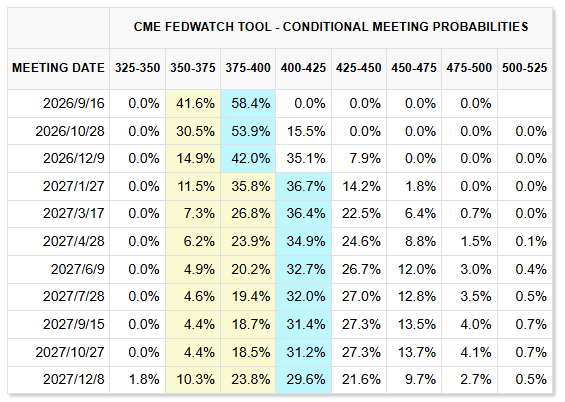
However, the final piece of the puzzle before the FOMC meeting on September 16 will be the August Consumer Price Index (CPI) report released this Friday. Bank of America Securities expects the core CPI to rise 0.22% month-on-month in August, believing that “this is enough to convince Federal Reserve Chairman Walsh that inflation has not been fully controlled, thus supporting another rate hike.”
Federal Reserve Governor Waller said that if inflation data improves in the next few weeks, he is inclined to keep borrowing costs unchanged, indicating that there are still differences within the committee. But as UBS pointed out, in the face of August's non-farm payrolls data, the labor market is no longer a variable that blocks interest rate hikes — inflation data will be the “final hammer” in deciding whether to raise interest rates in September.