
- PRICING
- LIVE QUOTES
- LEARN
- HELP


EN
Arbitrage trading liquidation risks are heating up! The rise of the yen accelerated: rising above 155 triggered a stop-loss order, and the 152 area became the next target
The Zhitong Finance App learned that the stop-loss order was triggered after the exchange rate of yen against the US dollar broke through 155 and is approaching the highest level since this year. The 152 region has become the focus of attention of traders. The yen rose 0.4% to 153.80 on Tuesday. It had already risen 1.2% overnight, with a cumulative increase of nearly 4% this month, making it the best-performing currency among the G10 currencies. According to a trader familiar with the trading situation, who asked not to be named, a fall below 155 in the USD/JPY exchange rate triggered a large number of stop-loss orders and forced options traders to sell the dollar.
The current trend of the yen was not caused by a single factor. Some traders pointed out that there was insufficient liquidity in the market around the US holidays, while others believed that the yen broke through 155 to accelerate an already upward trend. Last week, as market expectations for the Bank of Japan's interest rate hike heated up, the yen began to strengthen, and market sentiment was drastically reversed. Furthermore, market speculation about a possible adjustment in the asset allocation of the Japanese government's pension investment fund also supported the yen exchange rate.
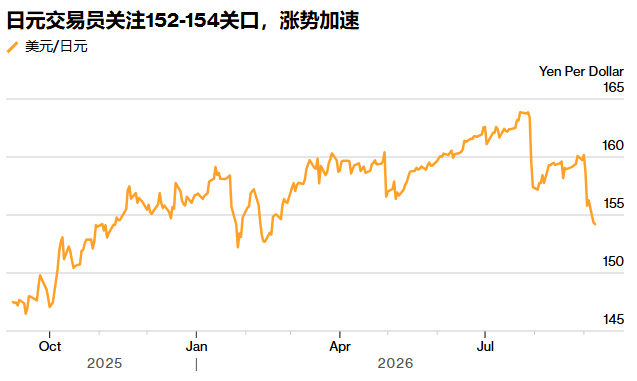
Rodrigo Catril, strategist at National Australia Bank, said: “An overnight break below the support zone clearly opens the door for further decline. USD/JPY seems likely to test levels around the previous lows of 152.27 and 152.10.”
The 152.10 region is the strongest level of the yen against the US dollar since this year. As upward momentum increases, the importance of this region is becoming more and more prominent. Technical indicators also indicate that after falling below the support level around 155, 152 may become the next target.
The analysis indicates that forex traders are turning their attention to the next threshold of USD/JPY, and the 152 region may be a candidate target as the downside gains momentum. Motonari Sakai, head of foreign exchange transactions at Mitsubishi UFJ Trust Bank, said that if the yen rises above a low of 154, the next target will probably directly point to the 152 yen range.
The trend of the yen gradually improved, and the options market also confirmed this. Although Monday is an American holiday, the volume of global foreign exchange contract transactions is still impressive. Among them, the yen cross market is particularly active. The surge in one-year yen forward contracts highlights the scale of the yen's short recovery. These short positions are currently being carried out against the euro, the pound, and the Swiss franc. This will further increase the downward pressure on USD/JPY.
The speed of this move has raised concerns that Japanese yen financing arbitrage transactions may result in wider liquidation of positions. In this type of transaction, investors borrow yen at low cost and invest in higher-yielding assets elsewhere.
Rinto Maruyama, senior interest rate and foreign exchange strategist at SMBC Nikko Securities, said, “Our basic view is that a fall below 154 may trigger further liquidation of yen arbitrage transactions and the establishment of more stop-loss orders, thus leaving room for further appreciation of the yen.” He also added that the reduction in holdings also meant that investors had an opportunity to re-establish short positions in the yen.
According to the data, the yen experienced a decline of more than 1% against high-yield currencies such as the Brazilian real and the South African rand. A senior foreign exchange options trader at Nomura Securities pointed out that “the era of easy arbitrage trading is over, and the scale of cross-border capital flowing from Japan to the US may have substantially changed.”
Currently, the focus of the market is turning to the US CPI data released on Friday to find clues about the future of the Federal Reserve's policy. In Japan, investors will pay close attention to Bank of Japan Governor Hajime Takada's speech to judge the pace of future interest rate hikes. Earlier, Takada made it clear that future interest rate hikes will not be rigidly limited to 25 basis points, and that continuous rate hikes are possible under normal circumstances. This statement is only three months since the interest rate hike in June. If interest rates are raised again on September 18, it will be the fastest pace of austerity during Kazuo Ueda's tenure.
The bigger test will be next week's Bank of Japan policy meeting. The probability that the overnight index swap market is expected to raise interest rates by 25 basis points is as high as 97%, raising the threshold for policymakers to send a hawkish enough signal to maintain the appreciation of the yen.
“The yen is at a crossroads,” said Catril. Raising interest rates next week is a necessary condition, but to maintain the yen's recent gains, the Bank of Japan needs to release hawkish signals and reaffirm market expectations that the possibility of raising interest rates again before the end of the year is greater than not raising interest rates.”