
- PRICING
- LIVE QUOTES
- LEARN
- HELP


EN
LME copper prices hit a record high! Tariff arbitrage resonates well with favorable supply and demand: at a time when AI demand becomes a “new engine”, Chile's exports fell to a one-year low
The Zhitong Finance App learned that copper prices have been rising for several weeks on the London Metal Exchange (LME), driven by expectations that US President Donald Trump will expand the imposition of US tariffs on refined metal imports, eventually reaching a record high. The price of LME's three-month benchmark futures rose 0.8% to $14,533 per tonne, breaking the previous record set in January, before declining somewhat.
Copper prices have risen 17% since this year, and 47% in the past 12 months, mainly due to long-term supply and demand imbalances. Large, old copper mines around the world are struggling to meet the copper demand for data centers, renewable energy, and power grids — a background that has been emphasized by copper price bulls for many years.
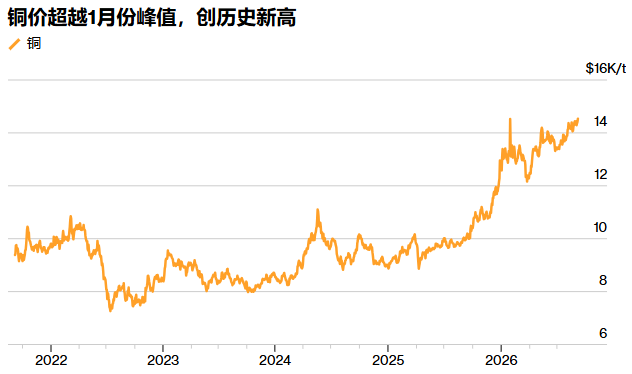
But short-term factors have come to the spot—in particular, hundreds of thousands of tons of copper were shipped to the US this year, and traders are trying to profit from America's higher copper prices. Although the US Department of Commerce was scheduled to submit a report to the White House two months ago to suggest the necessity of imposing tariffs, the market is still digesting the possibility of imposing tariffs on raw copper imports.
Tariffs drive copper prices higher
Although total global inventories are still high, these stocks are currently highly concentrated in the US due to declining metal stocks in LME's vast global network. This led to short term supply constraints, putting pressure on short position holders, and driving prices to record highs amid weak demand.
Cristián Cifuentes, a senior analyst at Cesco, a Chilean copper think tank, said: “This is more due to metal transfers due to tariffs rather than excess final demand. This is a partial shortage, not a global excess of demand.”
Despite a light trading environment, London copper prices rose on Monday due to the US exchange closing due to the Labor Day holiday weakening the risk appetite in the financial market.
Despite growing macroeconomic and geopolitical headwinds, such as the war in Iran and soaring US borrowing costs, which will put tremendous pressure on capital-intensive manufacturing companies around the world, copper prices have continued to rise. High prices themselves may also pose a threat to copper demand as buyers seek alternatives, but so far, these demand pressures have not contributed much to the rise in copper prices.
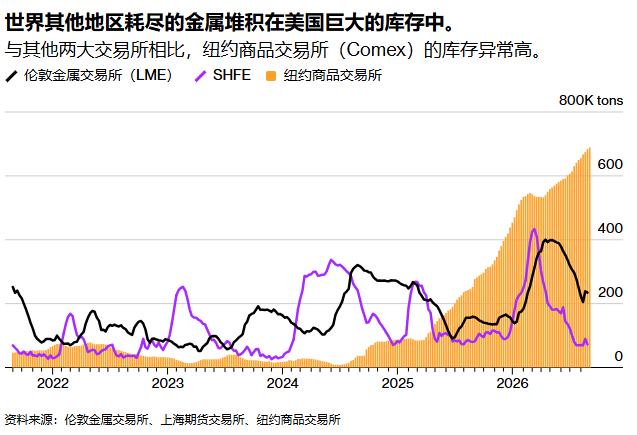
US copper imports hit a record high, mainly due to the continued price premium of copper futures on the New York Mercantile Exchange (Comex). Since President Trump first officially proposed tariffs on copper in February last year, this has created huge arbitrage opportunities for traders.
Tariff trade has had a severe impact on global inventories. LME copper inventories fell sharply last month, inventories supporting copper contract transactions fell to a very low level, and the tight inventory situation intensified. Although additional deliveries have relieved some of the pressure, the spot price is still far higher than the LME three-month futures price. This phenomenon known as the “spot premium” indicates that demand exceeds supply.
AI and the energy transition: Copper's “structural demand” is reshaping long-term logic
The long-term upward logic of copper prices has not changed. The development of artificial intelligence and the rapid construction of data centers are important driving forces for the current increase in copper demand. AI's demand for copper goes far beyond wires and cables within data centers — data centers consume large amounts of electricity, meaning the market also needs additional power generation facilities, transmission lines, substations, transformers, and broader grid upgrades.
According to industry estimates, the copper consumption of 1 gigawatt computing power data centers is 2.5 times that of traditional data centers. In 2026 alone, the construction of global computing power clusters will add nearly 400,000 tons of copper demand. Other agencies estimate that the related increase in copper demand due to the expansion of global computing power in 2026 is expected to be about 475,000 tons. The development of electric vehicles and renewable energy is also further increasing demand for copper — solar power facilities, wind farms, and battery energy storage projects also require large amounts of copper.
The point is that almost every aspect of the electrification process is inseparable from copper. Large mines around the world generally face declining ore grade, aging equipment, and rising operating costs, and new projects are limited by lengthy exploration, approval, and construction cycles.
Mining giants become the biggest winners
The rise in copper prices is certainly a big boon for some of the world's largest mining companies, which have long been eager to increase their holdings of this metal, which is about to enter a long-term boom in demand. Rio Tinto (RIO.US), BHP Billiton (BHP.US), Glencore, and Zijin Mining all reported significant profit increases in their latest financial reports, mainly due to the strong performance of their copper business.
Rio Tinto's copper business's basic EBITDA increased 84% year-on-year in the first half of 2026 to reach US$5.7 billion, and free cash flow increased 325%. As a comparison, the basic EBITDA of the iron ore business, the Group's largest source of profit, fell 1% year over year. The three major non-ferrous metal businesses of copper, aluminum, and lithium have contributed to more than half the profit before tax, depreciation and amortization.
Copper exports from Chile, the world's largest copper producer, still fell to their lowest point in a year
Despite this, many large mining companies are still facing operational challenges this year. Data released on Monday showed that despite a sharp rise in copper prices, Chile's copper export revenue in August fell to its lowest level in more than a year due to severe winter storms and mining accidents in Chile, the world's largest copper producer. Unless the copper industry recovers in the second half of the year, global copper supply will experience its first annual decline since 2017.
According to data released on Monday, Chile's copper exports last month were US$4.62 billion, down 14% from July and 3.2% from the same period last year. This is the lowest monthly data since July 2025. Despite the strengthening of copper prices, the average price in August rose by more than 40% compared to the same period last year, but exports declined.
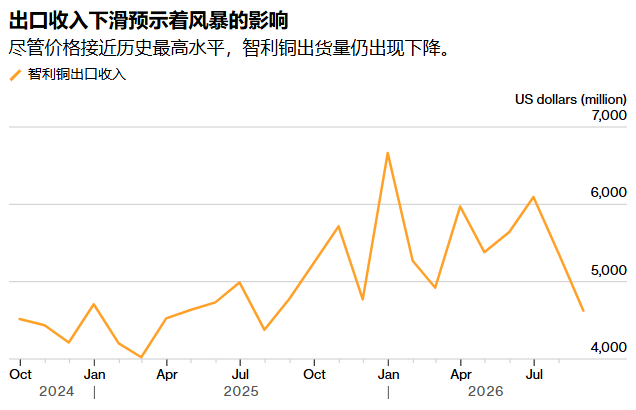
Chile's mining industry experienced operational setbacks this year. Heavy rains, blizzards, and high winds in July and August caused the mine to stop work, and poor sea conditions often restricted port activity. Production difficulties in countries that account for a quarter of global copper production are supporting copper prices, exacerbating an already tight global supply situation due to supply disruptions in other regions.
Extreme weather is further amplifying supply risks. Antofagasta and Lundin Mining have lowered the 2026 production guidelines to 625,000 to 655,000 tons and 300,000 to 325,000 tons, respectively. According to data from the International Copper Research Organization (ICSG), global copper production fell 1.1% year-on-year in the first half of 2026. Among them, industry giants Codelco and Freeport-McMoran both experienced double-digit declines in production.
Morgan Stanley has lowered its previous forecast for increased production to basically flat or even a slight decline — which means that the world's annual copper production is likely to drop for the first time since 2017.
Michael Cuoco, head of metals at StoneX Financial Inc., wrote that the combination of strong demand growth and supply challenges “should bring about a tighter balance between supply and demand in the future market, thereby supporting price increases.”