
- PRICING
- LIVE QUOTES
- LEARN
- HELP


EN
Our Pick Of The Best British Defensive Stocks In September 2026
UK gilt yields are reacting to stubborn inflation and shifting Bank of England rate expectations, which keeps volatility high for many stocks. That uncertainty pushes investors toward resilient British companies with stronger balance sheets and lower risk profiles. This article looks at 3 of the most resilient, low risk UK stocks in our model and explains how they might help anchor a portfolio when macro signals are unclear.
The three stocks highlighted below are just a sample of the low risk leaders in our model, and the full screen surfaced 2 more companies with equally compelling narratives that are not covered in this article. To go straight to the full list, identify your own low risk foundations and analyze their strength, head into the Low-Risk Leaders screener.
Tatton Asset Management (AIM:TAM)
Overview: Tatton Asset Management provides discretionary fund management and centrally managed, risk profiled model portfolios and multi manager funds for UK independent financial advisers, giving clients access to diversified, lower volatility investment solutions. Alongside this core activity, it also offers compliance consultancy, technical support, and mortgage and insurance product distribution services to adviser firms.
Operations: Tatton Asset Management generates about £47.6 million of revenue from its Tatton segment and £6.8 million from Paradigm, with all £54.3 million of reported revenue coming from the United Kingdom.
Market Cap: £422.4 million
Tatton Asset Management may suit investors who prefer a portfolio foundation built on risk managed, centrally run portfolios rather than stock picking. The company focuses on scalable, risk profiled model portfolios for advisers, supported by high profitability, strong return on equity, and a net debt free balance sheet that allows meaningful dividend payouts, including a proposed full year dividend of 27.0p for FY 2026. At the same time, it is important to weigh concentration in adviser relationships, regulatory scrutiny of model portfolio services, and a valuation that reflects quality expectations. For investors assessing how these strengths and trade offs could influence potential returns and resilience, the details behind Tatton’s margins, cash generation, and growth assumptions are key areas to review.
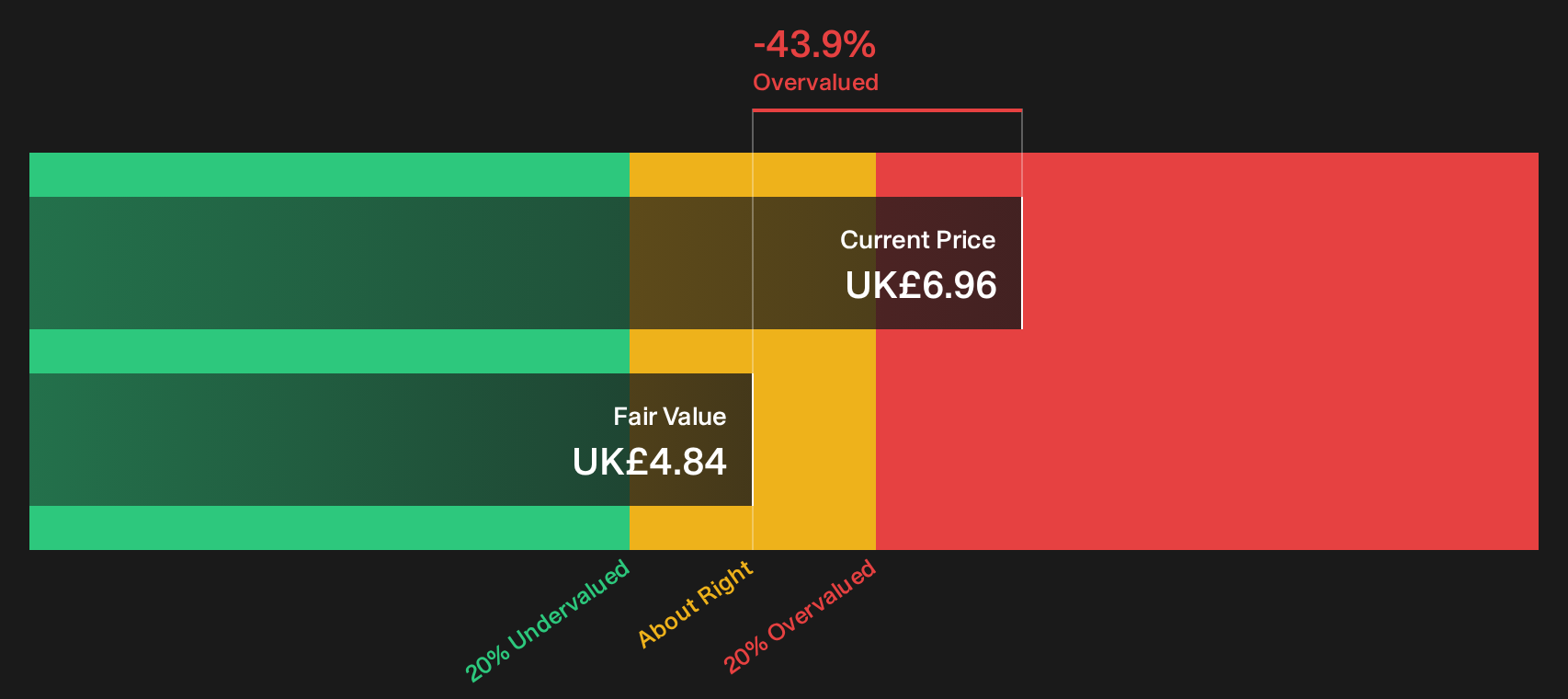
High margins, strong returns on equity and a net debt free balance sheet make Tatton Asset Management look like a quiet compounding engine. The bigger question is what the DCF valuation analysis for Tatton Asset Management says about how much of that quality is already priced in.
Griffin Mining (AIM:GFM)
Overview: Griffin Mining is a London headquartered miner focused on zinc, gold, silver and lead, anchored by its Caijiaying operation in Hebei, China, which is a producing mine rather than an early stage exploration project. That producing asset, and the underlying mineral reserves that support it, place Griffin Mining firmly in the Low Risk Leaders theme as an asset backed operator with more visible cash flow than many junior miners.
Operations: Griffin Mining generates all of its approximately $137.5 million in revenue from the Caijiaying Zinc Gold Mine in China.
Market Cap: £498.9 million
Griffin Mining gives you exposure to a producing zinc gold asset where cash flow is tied to a tangible mine, not just drill results. This can appeal if you are looking for lower risk building blocks rather than speculative bets. Earnings recently grew much faster than the wider UK mining sector and margins improved to 16%. However, limited analyst coverage and a premium P/E suggest sentiment can swing if that momentum stalls. Add in a single key mine, funding that leans on external borrowing and a board with relatively low independence and you have a stock where resilience and concentration sit side by side. This combination is exactly why a closer look can be worthwhile.
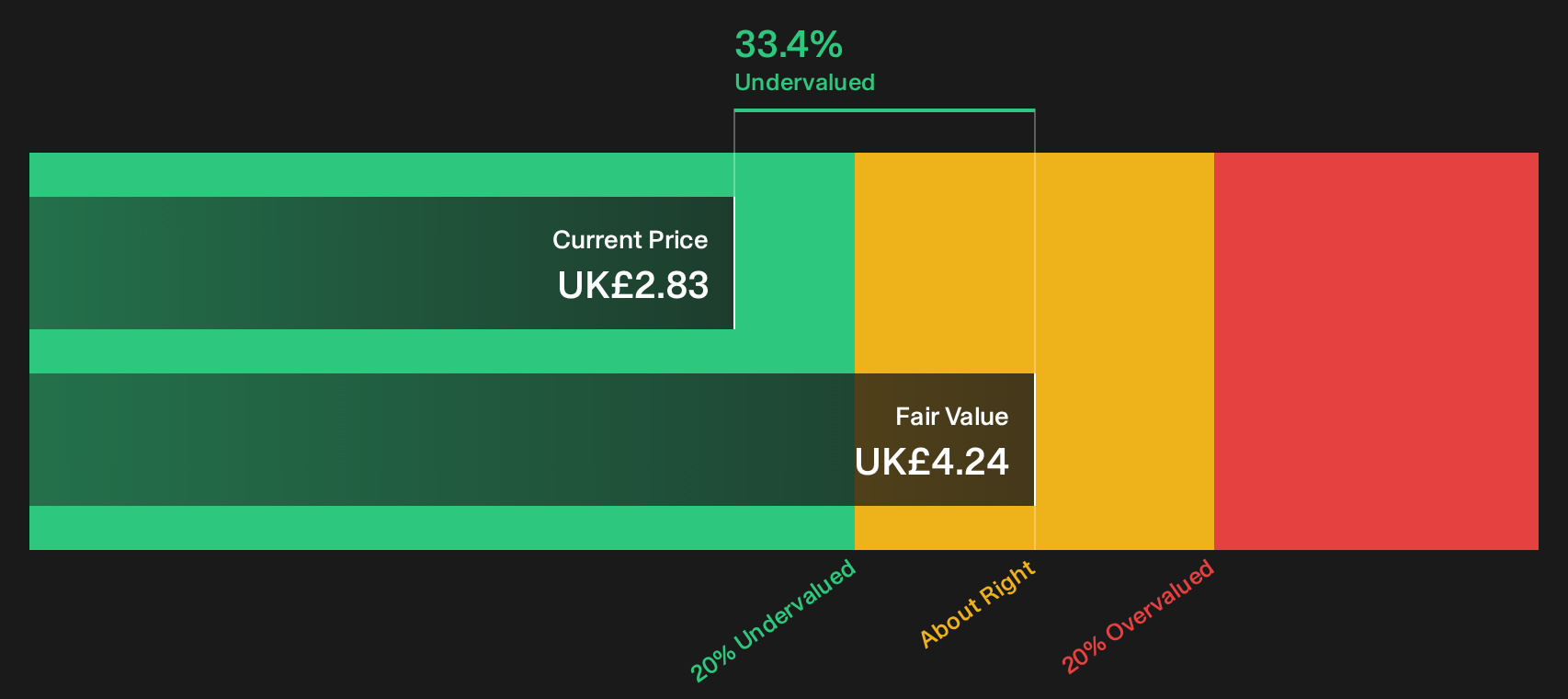
Griffin Mining’s accelerating earnings and improving 16% margins raise a clear question: Is the current P/E fully reflecting the story already, or missing something material in the DCF valuation analysis for Griffin Mining
BAE Systems (LSE:BA.)
Overview: BAE Systems is a global defense and aerospace company that supplies combat aircraft, warships, armored vehicles, munitions, electronic systems and security solutions to governments across the US, UK, Europe, the Middle East, Australia and other regions. Its Cyber & Intelligence segment provides cybersecurity and intelligence services to national security and central government clients, giving the group a stream of resilient, contract backed revenue that fits neatly with a low risk, foundation style role in a portfolio.
Operations: BAE Systems generates most of its revenue from its Electronic Systems, Air, Maritime and Platforms & Services segments, each contributing between about £5.3b and £7.8b, while Cyber & Intelligence adds around £2.4b as a meaningful but smaller contributor within the wider mix.
Market Cap: £55.4b
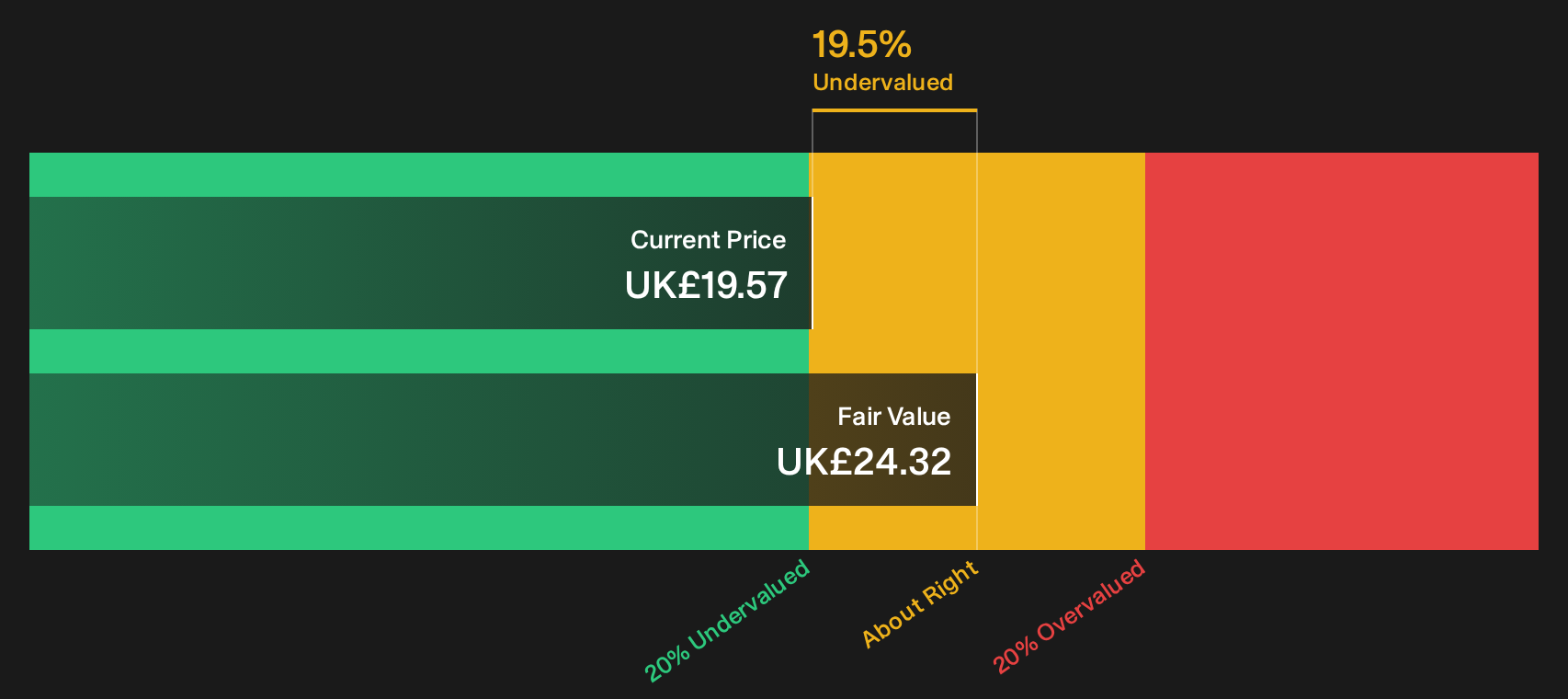
For investors looking to anchor a portfolio with contract backed cash flows, BAE Systems offers a mix of long term defense programs, a £75b order backlog and a Cyber & Intelligence arm that serves government and national security clients on multi year arrangements. Earnings growth has outpaced the wider Aerospace & Defense sector over the past year. The stock trades at a discount to some peers and fair value estimates. The trade off is exposure to ESG pushback, dependence on a handful of large government buyers and ongoing export control and governance scrutiny. That combination of resilience and policy risk may make BAE a stock worth a closer look for low risk leaders.
BAE Systems’ contract backed order book and government clients hint at earnings that the market may not be fully pricing. Before you assume the rerating story is straightforward, review the analyst forecasts for BAE Systems and see what could upset that script.
Seeking Fresh Alternatives Before They Fly
Some of the most interesting opportunities move from quiet to crowded quickly. Scan these fresh stock ideas before momentum builds, while the data still gives you an edge.
- Spot high quality companies early and review the curated 8 high quality undiscovered gems that could be moving from under the radar for now to the next breakout group.
- Target reliable income candidates and check the hand picked 6 dividend fortresses before yields get compressed and prices start rising as more investors catch on.
- Position for long term infrastructure shifts and assess the focused 39 power grid technology and infrastructure stocks while these potential candidates are still releasing fresh numbers before the crowd catches up.
This article by Simply Wall St is general in nature. We provide commentary based on historical data and analyst forecasts only using an unbiased methodology and our articles are not intended to be financial advice. It does not constitute a recommendation to buy or sell any stock, and does not take account of your objectives, or your financial situation. We aim to bring you long-term focused analysis driven by fundamental data. Note that our analysis may not factor in the latest price-sensitive company announcements or qualitative material. Simply Wall St has no position in any stocks mentioned.
Have feedback on this article? Concerned about the content? Get in touch with us directly. Alternatively, email editorial-team@simplywallst.com