
- PRICING
- LIVE QUOTES
- LEARN
- HELP


EN
Why It’s Time to Load Up on SoFi Stock
SoFi Technologies (SOFI) continues to post robust quarterly results, yet its share price remains down 43.5% from its 52-week peak, trailing the broader market.
SoFi’s underperformance stems largely from the market’s anxiety over the company's evolving revenue mix. In recent quarters, the company has become more reliant on its lending business, which requires substantial capital and exposes the company to greater credit risk. That concern intensified in the second quarter as lending once again expanded faster than SoFi’s non-lending businesses, putting additional pressure on the stock.
The company's second-quarter earnings reflect this shift. SoFi generated $1.2 billion in adjusted net revenue, a 40% year-over-year increase, with the Financial Services and Technology Platform arms contributing $551 million, or 46% of the total. That represents a notable decline in the contribution from non-lending operations. For comparison, these businesses accounted for 57% of SoFi’s total revenue at the end of 2025.
Although SoFi’s non-lending segments continue to expand, lending has evolved as the primary driver of revenue growth. The fintech has also been retaining a greater proportion of loans on its balance sheet to capture higher returns. This strategy can boost net interest income and overall profitability, but it also ties up substantial capital and increases SoFi’s exposure to losses if borrowers default.
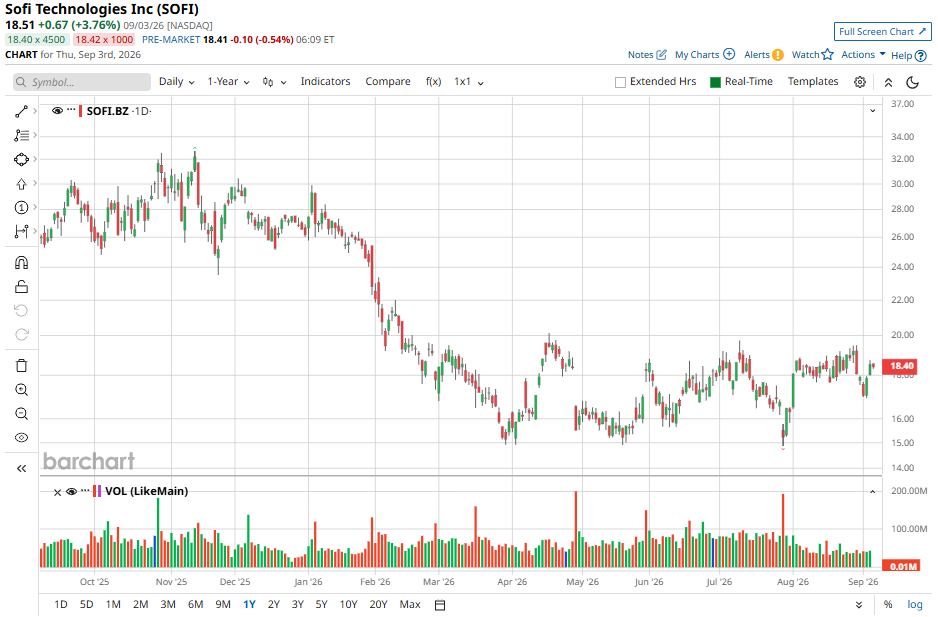
Diversifying Revenue Streams Boosts SoFi’s Growth Potential
Despite lagging behind the broader market in 2026, SoFi has strong catalysts that could spur a sharp recovery in its share price. The fintech continues to grow its member base and is benefiting from higher customer lifetime value.
SoFi expanded its user network by roughly 1.1 million during Q2, bringing its total base to 15.8 million, a 35% surge year-over-year. Product uptake jumped simultaneously, with a record 2.2 million new products opened (up 42% YoY to 24.4 million total). This growth reflects SoFi driving engagement across its existing customers. Multiplying product adoption per user boosts individual customer value while lowering average acquisition expenses. That drives higher operational efficiency for the company.
Cross-selling momentum is also accelerating rapidly for SoFi. Notably, over 51% of new product openings in Q2 came from existing members, up from 43% in Q1. This rising multi-product adoption reflects deepening user retention and solidifies SoFi's competitive edge.
While lending operations remained a primary revenue driver, management is actively broadening non-lending income streams. Fee-generated revenue scaled to $472 million in Q2, representing 39% of total net revenue, driven by higher origination activity, expansion in its loan platform services, increased interchange fees, higher trading volume, and technology platform gains.
Furthermore, integrating new loan products into its platform segment allows SoFi to unlock high-margin, capital-light income while expanding cross-selling opportunities across a broader audience. Over time, SoFi’s management expects the capital-efficient, fee-based operations to generate more than 50% of top-line revenue. Transitioning away from pure lending dependence will enhance capital efficiency, stabilize earnings quality, and build greater insulation against macroeconomic fluctuations.
Why Buy SoFi Stock Now?
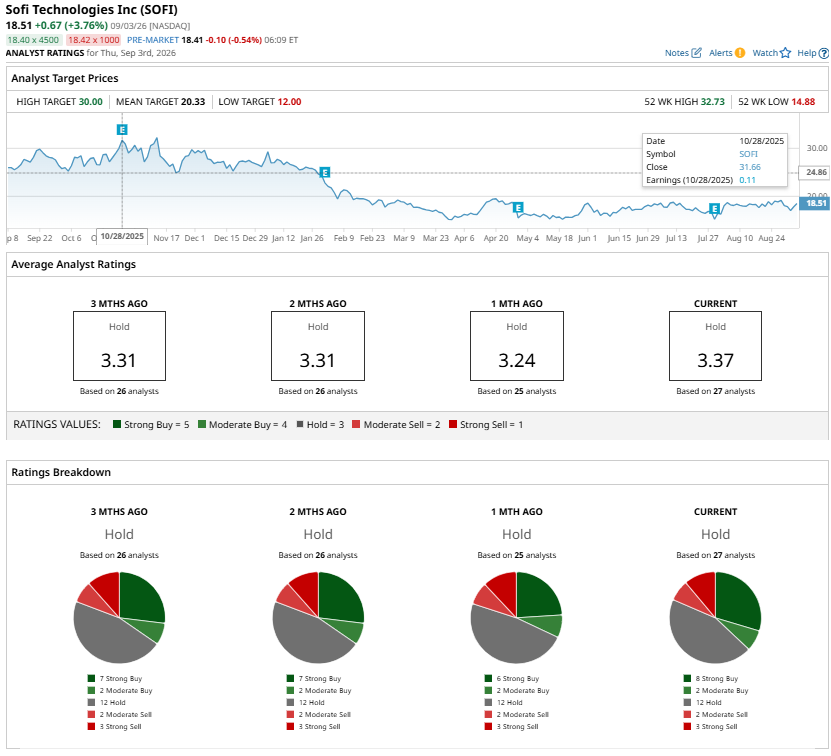
SoFi’s increasing reliance on lending is a concern investors should monitor, especially as the company retains more loans on its balance sheet. At the same time, Wall Street analysts remain cautious, with the stock carrying a consensus “Hold” rating.
Nevertheless, fintech’s expanding membership base, stronger product adoption, and rapid growth in fee-generating revenue provide a favorable foundation for future expansion. The company is strengthening its engagement with existing members while scaling its more capital-efficient, non-lending businesses. As fee-based activities are projected to contribute more than half of total revenue, SoFi could gradually reduce its reliance on lending and achieve a more consistent and capital-efficient growth profile.
Given the continued increase in customer lifetime value, the expected expansion of its non-lending segments, and the stock still trading well below its 52-week high, SoFi shares appear attractive to buy and hold.
On the date of publication, Amit Singh did not have (either directly or indirectly) positions in any of the securities mentioned in this article. All information and data in this article is solely for informational purposes. For more information please view the Barchart Disclosure Policy here.