
- PRICING
- LIVE QUOTES
- LEARN
- HELP


EN
With plans to lay off another 50,000 people and cut models in half, Volkswagen launches an epic “industrial weight reduction”! Facing the crisis of Chinese car companies and energy costs
The Zhitong Finance App learned that the supervisory board of German automobile manufacturing giant Volkswagen AG (Volkswagen AG) supports a comprehensive restructuring plan, which includes another drastic reduction of 50,000 jobs, a drastic reduction in the number of models, and a reduction in the industrial manufacturing landscape, thus giving CEO Oliver Blum the clearest authorization so far to completely reform Europe's largest automobile manufacturer.
This new round of restructuring of Volkswagen was not solely triggered by the impact of high oil prices caused by the geopolitical situation. Instead, sales in China are falling, German manufacturing costs are high, European production capacity is idle about 500,000 vehicles a year, and structural “industrial weight loss” forced by China's NEV leaders to accelerate their entry into Europe.
If the downsizing plan already planned since the end of 2024 is added, the large group's overall planned staff reduction is close to 100,000 people; at the same time, Volkswagen plans to cut the number of models by up to half, reduce product complexity by about 75%, and concentrate capital on high-sales, high-return on investment brands and manufacturing platforms by 2035.
Financial data also shows the urgency of this round of restructuring: revenue for the first quarter of 2026 was 75.7 billion euros, down 2% year on year; operating profit of 2.5 billion euros, down 14.3% year on year, operating profit margin fell from 3.7% to 3.3%; and net cash flow from the automotive sector improved from negative 800 million euros in the same period last year to positive 2 billion euros. Revenue for the second quarter was 82,444 billion euros, up 2% year on year, but operating profit fell 9.5% to 3.469 billion euros, profit margin fell from 4.7% to 4.2%, and profit after tax fell by 32.9% to 1,538 billion euros. Revenue for the first half of the year was approximately 158.1 billion euros, and operating profit fell 11.6% to 5.931 billion euros, automobile sales fell 8.4% to about 4 million units, and the operating profit margin was only 3.8%.
Volkswagen management has lowered the 2026 revenue growth guideline from 0% to 3% to minus 3% to 0%, but maintained the annual profit margin guide of 4.0% to 5.5% and the long-term guideline of increasing the operating profit margin to 9% in 2030; it is worth noting that the forecast did not take into account the potential impact of further escalation of the geopolitical situation in the Middle East.
Energy and shipping shocks are becoming additional variables that reduce the profit margins of European cars. Brent crude oil is close to 96 US dollars per barrel, up more than 7% this week, with a cumulative increase of nearly 60% since this year; on September 1, only 4 commodity carriers passed through the Strait of Hormuz, lower than the 10-day average of about 13 ships, and only 18 ships in the Mander Strait, which is lower than the average of about 24 ships. At the beginning of the war, the daily rent for the Middle East-China super-large tanker rose to a record 423,736 US dollars; certain Red Sea cargo deviations could also increase about 10,000 nautical miles, 34 days of voyage, and more than 5 million US dollars in freight, without fuel or insurance.
For the public, the continued deterioration of the geopolitical situation in the Middle East will be transmitted along the four channels of high logistics and transportation costs for factory electricity and gas, parts and battery materials, supplier operating capital, and actual consumer purchasing power. However, the main reasons that are currently putting pressure on its performance are still China's competitive pressure, US tariffs, Germany's high costs and excess production capacity. The geopolitical situation in the Middle East is more like an “accelerator of business crisis” rather than a fundamental starting point for a new round of layoffs.
Volkswagen plans to lay off another 50,000 employees, and the 9% profit margin target is forcing the industrial landscape to shrink
The latest measures, such as Volkswagen's approval of a comprehensive restructuring plan and a plan to lay off 50,000 more employees, were approved at a conference held in Wolfsburg on Thursday, doubling the scale of staff cuts for Volkswagen Group brands since the end of 2024, while also paving the way for the company to reduce its model lineup by up to half by 2035. The number of new layoffs was about 8% of Volkswagen's total global workforce as of the end of last year.
Management is promoting these cuts in response to declining sales in the Chinese market, high costs in Germany, and underutilization of factories. Volkswagen is also stepping up investment, and plans to invest 135 billion euros (157 billion US dollars) in capital expenditure and R&D between 2027 and 2031, a reduction of about 16% from the investment plan agreed last year.
While spending is being cut, Chinese rivals focusing on the production capacity of cheaper pure electric vehicles are expanding at an accelerated pace in the European market, further increasing the pressure on the public to cut costs and direct investment to the strongest businesses.
“This is a brave plan and a realistic decision for all parties involved,” Citigroup analysts wrote in a research note. They called the agreement a “life and death” arrangement for the car manufacturer.
They added that this “should further enable Volkswagen to continue to invest capital in the brands and models with the highest return without maintaining excess production capacity.”
Volkswagen's American Depositary Receipts (i.e. US stock ADR — VWAGY) surged about 9% in New York on Thursday, the biggest increase since March 2023, after the restructuring, which exceeded expectations and showed the determination of the executive team, was revealed by the media.
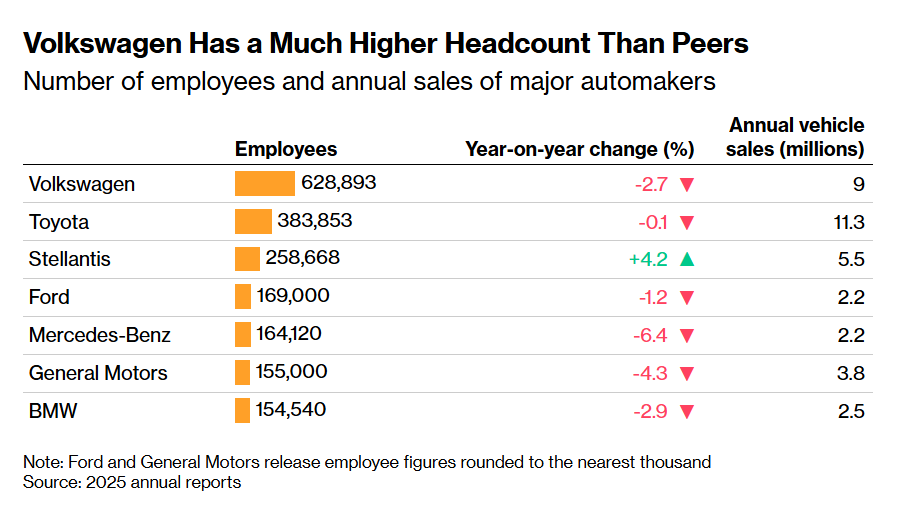
As shown in the chart above, Volkswagen has far more employees than its peers — a chart of the number of employees and annual sales of major car manufacturers. Note: The number of employees announced by Ford and GM is rounded to the nearest thousand. Source: 2025 Annual Report.
On behalf of the company's employees, the Volkswagen Workers' Committee is trying to downplay the scale of potential layoffs, saying that the figure of 50,000 is a planning assumption derived from Volkswagen's goal of achieving a 9% profit margin by 2030, rather than a fixed target for reducing the number of employees. A spokesperson for the labor organization also said that according to existing agreements, large-scale mandatory layoffs will not be implemented until the end of 2030.
Factories will not close for the time being, labor compromises in exchange for Volkswagen's “Future Plan 2030”
This latest difference reflects a broader compromise behind Thursday's unanimous vote by the Supervisory Board. After weeks of increasingly intense rhetoric, the agreement was reached a day earlier than expected. Labor representatives have accepted Volkswagen's need to cut costs even further, but they strongly oppose closing factories, weakening the common decision-making system — that is, the employee representation system in German corporate decision-making, and plans to separate parts of Volkswagen's core business.
It was unanimously approved by the Supervisory Board on Thursday, precisely because the two sides reached an exchange compromise: management was authorized in principle to promote cost cuts, efficiency improvements, and potential staff reductions; the Workers' Committee exchanged guarantees that no forced layoffs, no immediate closure of factories, no weakening of common decision-making powers, and no division of core business until the end of 2030.
In the plan, which was eventually named “Future Plan 2030” by VW executives, Bloom won support for additional layoffs and extensive efficiency improvement measures. The goal of this restructuring is to achieve an operating profit margin of 9% by 2030, based on annual sales of approximately 9 million vehicles.
The employees were assured that they would not immediately abandon any factory, and the disputed decision to stay at the factory will continue to be negotiated over the next few months.
The agreement did not mention the immediate closure of any of Volkswagen's major automobile manufacturing plants. Volkswagen admits that its European plants currently have excess production capacity equivalent to about 500,000 cars every year. The company said that as existing models were discontinued between 2031 and 2034, its plants in Emden, Hanover, Neckarsulm and Zwickau currently lacked competitive follow-up production plans. The company will next look into alternative uses for these plants.
This allows labor-leaning supervisory board members to support the restructuring without abandoning their core red line. Christian Benner, president of the German Metals Industry Union, and Daniela Cavallo, chairman of the VW Workers' Committee, said that the multi-party compromise “avoided a dangerous escalation,” while stressing that they had not agreed to close any factories and that plans to split the Volkswagen passenger car and parts business had also been cancelled.
Referring to the restructuring plan, the two labor leaders said, “The work has just begun.” “However, what we will never accept in the future is for employees to bear the burden of restructuring unilaterally.”
The Porsche-Piech family holds the majority voting power for Volkswagen through Porsche Holdings. With return on investment and dividend income under pressure, the family has been driving the company to accelerate restructuring and transformation actions. Blum believes that while funding the electric vehicle and battery manufacturing industry ambitions and large-scale software platform investments, Volkswagen can no longer afford the same huge cost base and industrial layout of traditional automobiles.
A spokesperson for Volkswagen's luxury car brand Porsche said in a recent statement that Porsche also “welcomes this decision and intends to continue to support the Volkswagen Group Management Committee, which is its core investment target, in advancing the transformation work.”
The capital market's focus is on whether Volkswagen can increase its profit margin of only 3.8% in the first half of the year to 9% in 2030 by reducing fixed costs and complexity, without sacrificing the competitiveness of electric vehicles, batteries, and software. The company reduced its 2027-2031 capital expenditure and R&D budget to 135 billion euros, a decrease of about 16% from the previous round of planning; as a result, American Depositary Receipts rose by about 9% in a single day, reflecting investors' first reward for capital discipline.
However, factories will not close for the time being, and forced layoffs will still be ruled out before the end of 2030, which means that some cost improvements must be completed through natural attrition, product withdrawal, and efficiency improvements — this is a bullish option with high operating leverage, but it is far from a profit that has already been realized.