
- PRICING
- LIVE QUOTES
- LEARN
- HELP


EN
Rumor has it that the Bank of Japan is inclined to raise interest rates by 25 basis points in September, and it is not ruled out that the pace will accelerate in the future
The Zhitong Finance App learned that according to people familiar with the matter, the Bank of Japan tends to raise the benchmark interest rate by 25 basis points this month to deal with the risk of price increases, while not ruling out the possibility of increasing interest rates thereafter. Bank of Japan officials will consider raising the policy interest rate from 1% at a two-day meeting that ends on September 18, according to people familiar with the matter. People familiar with the matter said they still believe that the risk of inflation is biased upward, and that rising service prices and the continued weakness of the yen reinforce the reasons for action.
People familiar with the matter revealed that the current views of officials on economic development are basically in line with expectations. One of the people familiar with the matter said that there have been no major changes in the current situation, so there is no need to take more drastic measures to raise interest rates, such as raising interest rates by 50 basis points, thus reducing the possibility of a drastic rate hike.
After the news was announced, the yen weakened slightly in active trading. Previously, some traders apparently expected the yen to fluctuate more sharply based on hawkish remarks made by a committee member earlier this week. The USD/JPY exchange rate fluctuated around 157 late Thursday afternoon.
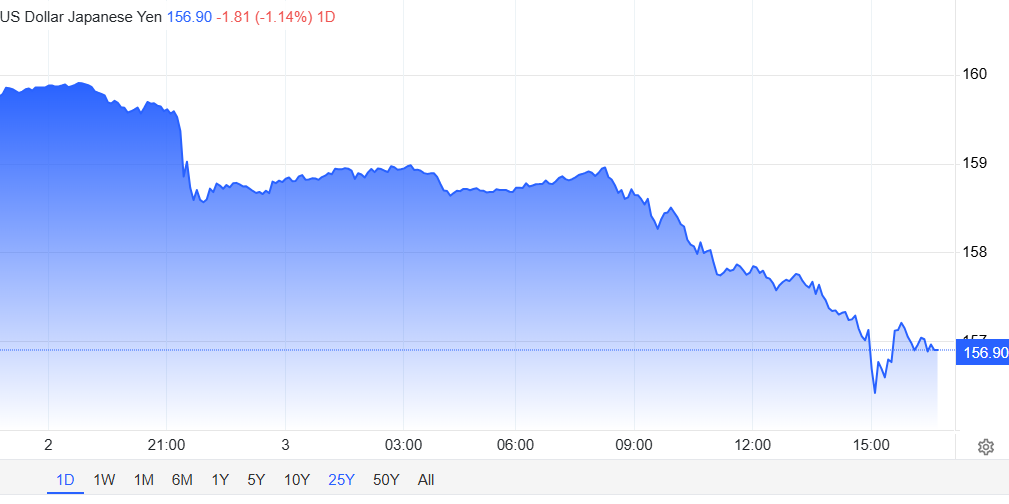
People familiar with the matter revealed that the Bank of Japan is also aware that further interest rate hikes may be needed after September, and said it will adjust the pace of interest rate hikes flexibly according to economic development and the risk of rising inflation. This means that the Bank of Japan will not rule out the possibility of speeding up the pace of interest rate hikes if the situation requires it.
The Bank of Japan's decision will receive unusually close attention from Washington. US Treasury Secretary Vincent repeatedly made it clear through a series of interviews and statements during the G20 finance ministers meeting held earlier this week that he wanted Japan to raise interest rates.
According to the US Treasury Department, during a bilateral meeting with Bank of Japan Governor Kazuo Ueda, Beisent discussed “the importance of formulating sound policies to stabilize inflation expectations and avoid excessive currency fluctuations.”
The pricing of overnight index swaps indicates that investors are prepared for interest rate changes after two weeks. With such high expectations, the decision to wait could itself trigger a shock in global financial markets. If interest rates were raised again in September, it would be only three months since the last rate hike in June, which would be the shortest interval between the two rate hikes since Kazuo Ueda became the governor.
On July 31, the US and Japan joined forces to buy yen. This is the first time since 1998 that the two countries have taken such coordinated intervention measures. As a result, Bezent's comments are even more weighty. The move helped the yen to recover from its lowest level in nearly 40 years.
US support for the yen may make it more difficult for the government led by Prime Minister Takaichi Sanae to put pressure on the Bank of Japan to slow down the pace of interest rate hikes. However, Takaichi Sanae's preference for a loose monetary policy remains a key uncertain factor in whether the Bank of Japan can maintain a faster pace of austerity.
After the G20 summit on Tuesday, when interviewed by reporters, Kazuo Ueda did not try to calm speculations about the September rate hike. He said that the central bank needs to take into account the risk of rising inflation when formulating policies.
Japan's key inflation indicator is expected to move towards the 3% target after government subsidies and other measures helped curb inflation in recent months, according to economists surveyed by the agency. The weak yen and rising oil prices have increased inflationary pressure, as Japan is heavily dependent on imports.
Kazuo Ueda also said that the data is basically in line with the bank's expectations, adding that there have been no major changes in the way monetary policy is implemented in the future.
This indicates that this month's rate hike could be the usual 25 basis points. Monetary Policy Committee member Takada Hajime once voted against and supported interest rate hikes in July when the committee kept interest rates unchanged, and he proposed on Wednesday that a larger rate hike is also possible. However, unless the situation changes significantly, the 50 basis point rate hike will present a major communication challenge for the Bank of Japan.