
- PRICING
- LIVE QUOTES
- LEARN
- HELP


EN
Encompass Health (EHC) Stock Still Looks Like A Bargain Despite Its 100% Run
Encompass Health stock has delivered a 5 year total return that slightly more than doubled an investment, yet current valuation checks suggest the shares may still trade below an indicated intrinsic value based on a Discounted Cash Flow (DCF) estimate and earnings multiples.
- Over the past 5 years, Encompass Health has returned about 100.4%, which puts recent pricing in the context of a stock that has already rewarded patient holders.
- The main support for the current valuation is the potential for consistent cash flow generation from its rehabilitation hospital network. A key risk is that higher capital spending needs or weaker reimbursement economics could pressure those cash flows.
- The broader valuation checks present a mixed picture rather than a clear bargain or clear premium, with the company scoring 4 out of 6 on value metrics.
The stock's next move may depend on whether Encompass Health can convert that DCF implied discount and the mixed valuation signals into a margin of safety that still looks attractive after the recent multi year gains.
Compare Encompass Health's mixed value score and implied DCF discount with other potential opportunities by scanning 54 high quality undervalued stocks, which also pair solid financial quality with pricing that still looks reasonable.
Does Encompass Health Look Undervalued on Cash Flow?
The Discounted Cash Flow (DCF) model here uses projected free cash flows to estimate what Encompass Health might be worth today. In this view, the company is treated as a steady cash generator rather than a high risk turnaround story.
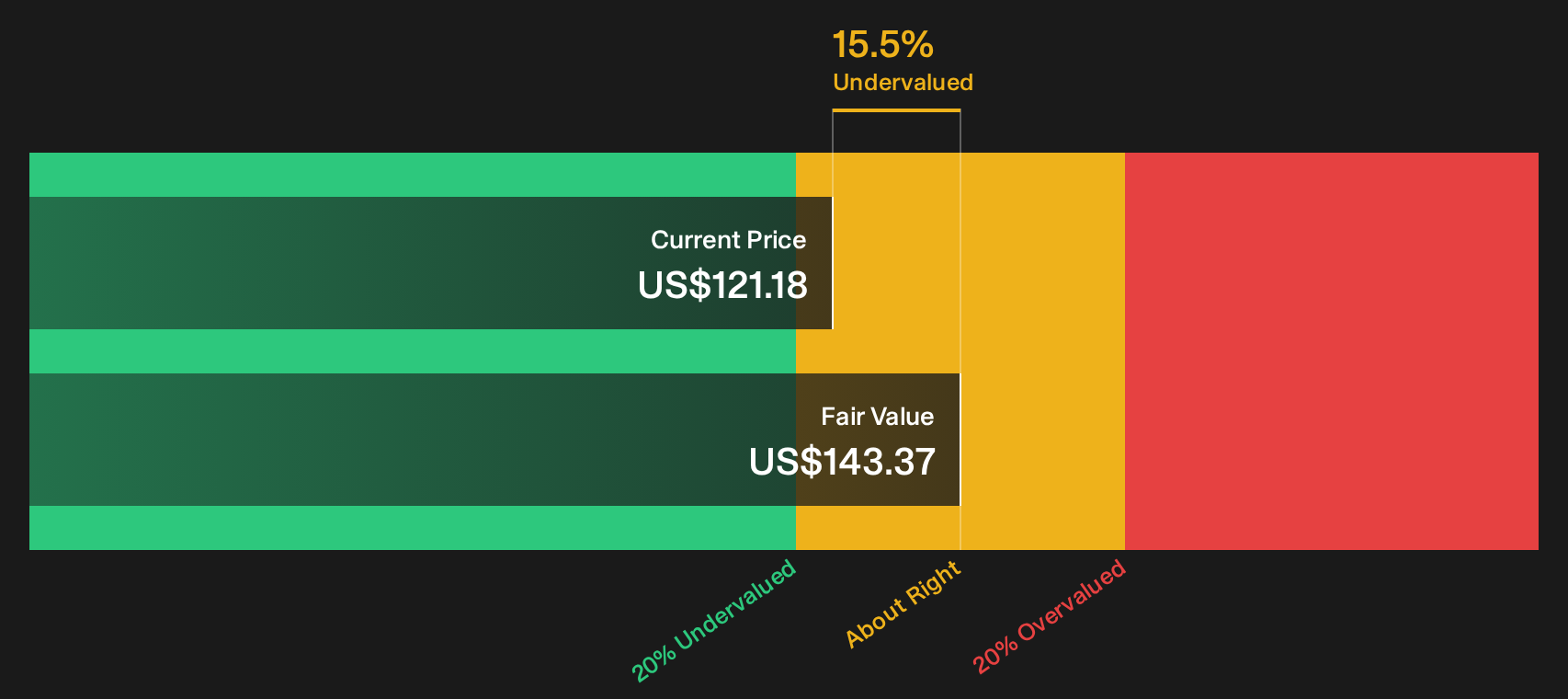
Encompass Health produced latest twelve month free cash flow of about $435 million, and the model assumes these cash flows keep growing rather than shrinking. On those inputs, the 2 Stage Free Cash Flow to Equity approach points to an estimated intrinsic value of about $143 per share. Compared with the current share price used in this model, that implies roughly a 15.5% discount.
On this DCF view, Encompass Health stock currently screens as undervalued relative to its modelled cash flows.
Our Discounted Cash Flow (DCF) analysis suggests Encompass Health is undervalued by 15.5%. Track this in your watchlist or portfolio, or discover 54 more high quality undervalued stocks.
Is Encompass Health Still Cheap on Earnings?
The P/E ratio is a simple way to see what investors are paying today for each dollar of Encompass Health earnings. For a company built around recurring rehabilitation services, it is a useful checkpoint.
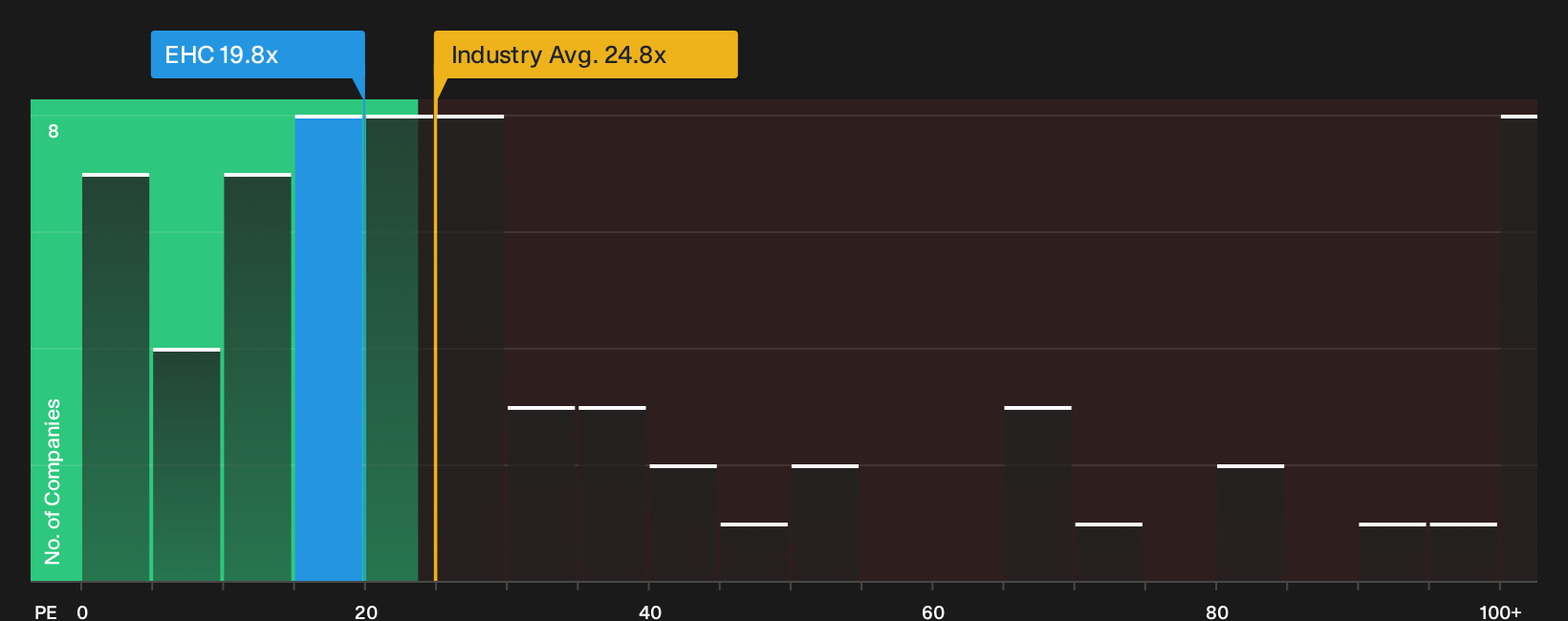
Encompass Health trades on a P/E of about 19.8x. That is above the peer group average of 16.9x, yet below the broader Healthcare industry average of roughly 24.8x. The fair P/E ratio from this model is 25.5x, which is higher than both the current multiple and the peer benchmark. This indicates that the current valuation is below the level implied by those inputs.
On this P/E view, Encompass Health stock appears inexpensive relative to the earnings multiple indicated by this model.
See what the numbers say about this price — find out in our valuation breakdown.
The Encompass Health Narrative: What Would Justify Today's Price?
Simply Wall St Narratives pick up where Encompass Health's valuation puzzle leaves off. They spell out the growth, margin and earnings paths that would need to hold for the stock to be worth meaningfully more or less than today’s price. Each one anchors its number to a specific view of how Encompass Health's growth, profitability and risks could evolve, which you can revisit as new information comes through on the Community page.
Community views on Encompass Health sit far apart, with one camp focused on capacity led upside and the other on execution and competitive risk.
Bull case: 18% undervalued
"Sustained execution of the company's high-return de novo hospital and bed addition strategy, combined with a robust pipeline in underserved/new markets, is set to drive outsized same-store and total discharge growth..."
Read the full Bull Case to see why Encompass Health could be undervalued
Bear case: 22% overvalued
"The accelerating industry shift toward value-based care and outpatient/home-based rehabilitation models threatens the long-term relevance of inpatient rehabilitation facilities, exposing Encompass Health to risks of declining patient volumes and reduced market share..."
Read the full Bear Case to see why Encompass Health could be overvalued
Do you think there's more to the story for Encompass Health? Head over to our Community to see what others are saying!
The Bottom Line
For Encompass Health, both the Discounted Cash Flow (DCF) intrinsic value estimate and the earnings multiple view point to the stock as undervalued rather than stretched. The broader checks are mixed rather than emphatically cheap, which keeps the focus on whether the company can keep turning its rehabilitation network into reliable cash flows without a step up in capital strain or weaker reimbursement terms. The crux for investors is whether that current discount reflects an opportunity in a solid cash generator or is simply the market pricing execution and industry shift risks more cautiously.
This article by Simply Wall St is general in nature. We provide commentary based on historical data and analyst forecasts only using an unbiased methodology and our articles are not intended to be financial advice. It does not constitute a recommendation to buy or sell any stock, and does not take account of your objectives, or your financial situation. We aim to bring you long-term focused analysis driven by fundamental data. Note that our analysis may not factor in the latest price-sensitive company announcements or qualitative material. Simply Wall St has no position in any stocks mentioned.
Have feedback on this article? Concerned about the content? Get in touch with us directly. Alternatively, email editorial-team@simplywallst.com