
- PRICING
- LIVE QUOTES
- LEARN
- HELP


EN
Dear GameStop Stock Fans, Mark Your Calendars for September 8
GameStop (GME) has more than a meme-stock reputation riding on its upcoming earnings report. The video game and collectibles retailer has been battling a shrinking core business, with sales declining in each of the past four fiscal years. At the same time, concerns about share dilution and the company’s ability to drive sustainable retail growth have continued to weigh on investor sentiment. Still, GameStop’s preliminary fiscal 2026 second-quarter results, released on Aug. 31, may have given investors something to watch.
The company expects quarterly net income of $290 million to $310 million, almost double the $168.6 million reported a year earlier. But there’s a catch. The stronger bottom line isn’t being driven by a rebound in game sales. Instead, investment gains, particularly from GameStop’s stake in eBay (EBAY), are doing much of the heavy lifting, while quarterly sales are expected to decline to $780 million-$800 million from $972.2 million a year ago.
As of Aug. 1, 2026, the company held approximately 43.4 million shares of eBay common stock, with a fair value of approximately $4.947 billion. GameStop said its quarterly net income includes approximately $238 million in net gains related to its eBay derivative asset and equity investment. These gains were partially offset by a loss of approximately $75 million on digital assets and related receivables.
Meanwhile, the topline decline primarily reflects the prior-year launch of the Nintendo Switch 2, planned store closures, and the divestiture of the company’s France operations. GameStop’s expanding investment portfolio, led in part by its sizable eBay stake, has added a new financial dimension to the company beyond its traditional retail business. However, for a company whose long-term prospects still depend heavily on revitalizing its core operations, investment gains alone may not be enough to win over Wall Street.
Given this backdrop, the company is expected to release its full fiscal 2026 second-quarter earnings report on Sept. 8. With the report just days away, GME stock could be worth keeping on the radar.
About GameStop Stock
Founded in 1984, Texas-based GameStop is a specialty retailer best known for video games, gaming consoles, accessories, collectibles, and other entertainment products. The company operates through a network of physical stores and an online platform, while its buy-sell-trade model allows customers to exchange games, consoles, and accessories for cash or store credit.
Over the years, GameStop expanded its footprint through acquisitions, eventually becoming one of the world’s largest video-game retailers. By the late 2010s, the company operated thousands of stores across multiple countries, offering both new and pre-owned games and hardware. But GameStop’s biggest transformation came in 2021, when it shot to global fame during the meme-stock frenzy as retail investors piled into GME, turning the struggling retailer into a Wall Street phenomenon.
In January 2021, retail investors drove GameStop shares up more than 1,600%, fueled by calls on Reddit’s (RDDT) WallStreetBets message board to pile into the beleaguered stock and the growing use of nascent digital investment platforms to place trades. Yet, as is often the case with meme-stock rallies, the frenzy proved difficult to sustain. After reaching a record $120.75 in January 2021, GameStop has since given back 85% of those gains.
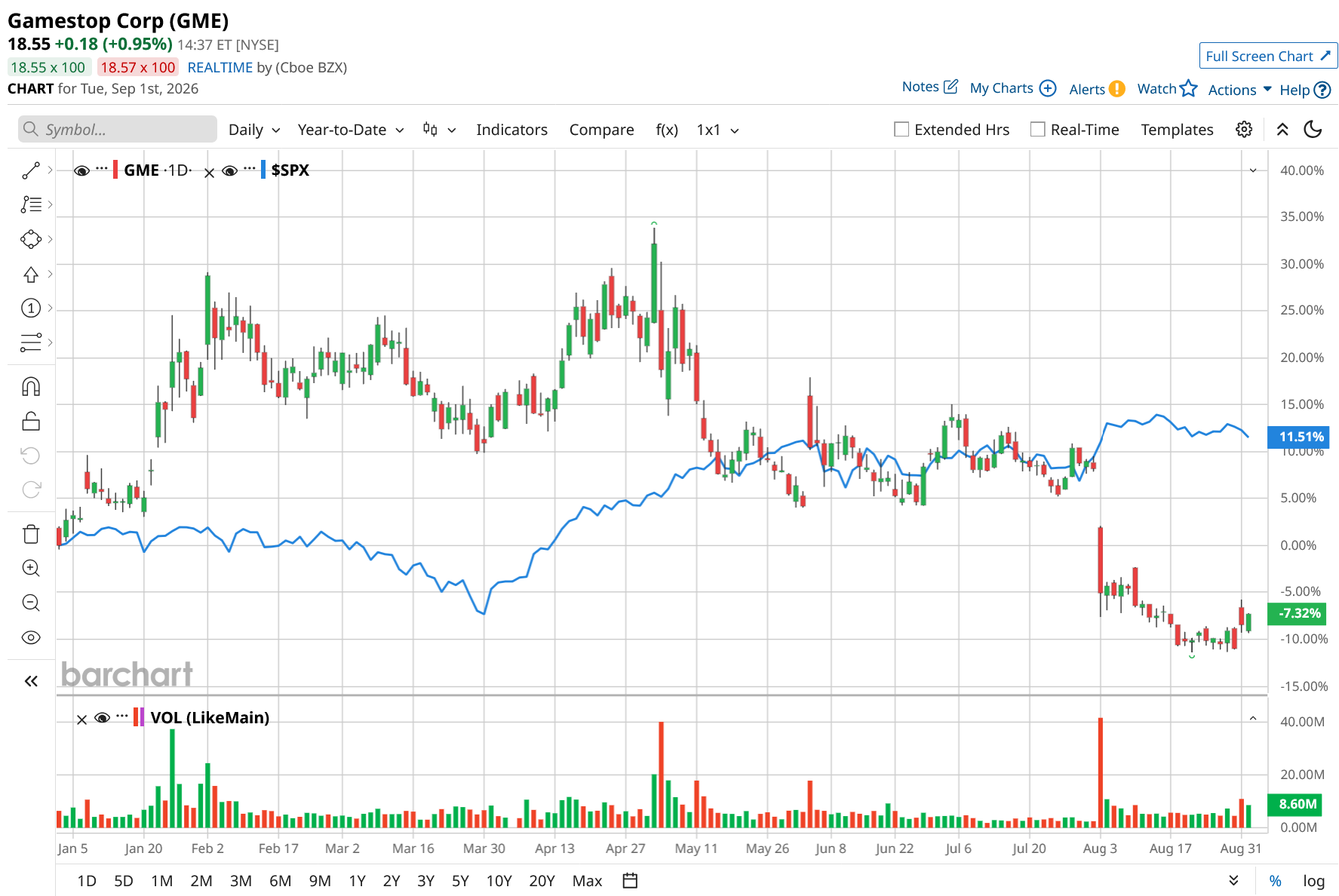
More recently, GME stock received a modest lift after the company released its preliminary second-quarter earnings on Aug. 31, with shares jumping 2.9% that day as its eBay investment provided an additional boost. Even so, the stock remains down roughly 8% so far in 2026, significantly trailing the broader S&P 500 Index ($SPX), which has climbed about 12% over the same period. GameStop currently has a market capitalization of approximately $8.25 billion.
GameStop’s Q1 Earnings Snapshot
GameStop delivered a notable financial turnaround in its first-quarter earnings report, posting stronger results across several key metrics. Net sales reached $835.3 million, up 14% year-over-year (YoY) from $732.4 million in the prior year’s first quarter, pointing to signs of stabilization in the company’s retail business after numerous quarters of persistent contraction.
The company also posted the highest quarterly net income in GameStop’s history, at $389.6 million, compared with $44.8 million in the prior year’s first quarter. Excluding impairments, gains on digital assets and related receivables, unrealized gains on the derivative asset, and other items, adjusted net income came in at $179.3 million, versus $73.1 million a year earlier.
GameStop’s operating performance also showed a sharp improvement. Operating income reached $143.3 million, marking the highest first-quarter operating income in the company’s history, compared with an operating loss of $10.8 million in the prior year’s first quarter.
Meanwhile, GameStop continued to build a sizable financial cushion. Total cash, cash equivalents, marketable securities, digital assets and related receivables, and collateral pledged for the derivative asset stood at $9.7 billion at the end of the first quarter. Of this amount, $8.4 billion consisted of cash, cash equivalents, and marketable securities, up from $6.4 billion at the close of the prior year’s first quarter.
Adding another potential catalyst for shareholders, GameStop’s Board of Directors unanimously approved a discretionary $2 billion share repurchase authorization on June 2, 2026, valid through June 2, 2029. The new authorization replaces the company’s previous buyback authorization from March 2019.
Key Takeaways
With Sept. 8 fast approaching, GameStop’s earnings will put its turnaround story to the test. With no Wall Street analyst coverage, GME often trades more on retail-investor enthusiasm and meme-stock momentum than traditional fundamentals. A stronger core business could finally give the stock a fundamental foundation, while continued retail weakness would leave its investment gains and meme-stock appeal doing much of the heavy lifting.
On the date of publication, Anushka Mukherji did not have (either directly or indirectly) positions in any of the securities mentioned in this article. All information and data in this article is solely for informational purposes. For more information please view the Barchart Disclosure Policy here.