
- PRICING
- LIVE QUOTES
- LEARN
- HELP


EN
Walmart Has Been in and Out of the $1 Trillion Club. Is Its Latest Removal Permanent?
Key Points
Walmart fell below $1 trillion because investors were disappointed by guidance, not because the underlying business suddenly weakened.
E-commerce, advertising, memberships, and automation are growing quickly and helping Walmart become more profitable beyond traditional retail.
With earnings still rising and the stock below its February peak, Walmart has a credible path back to a $1 trillion valuation over time.
Walmart (NASDAQ: WMT) shares recently traded with a total market capitalization of around $820 billion, roughly $180 billion below the $1 trillion mark it crossed in February, and I do not think this exit is permanent, given how the underlying business is performing.
On Feb. 3, 2026, Walmart became the first traditional retailer to close a trading day with a market value of $1 trillion, with shares up 2.9% at $127.71. It was the 11th U.S. company to finish a session with a 13-digit valuation, joining a group made up almost entirely of technology names.
Missed Nvidia in 2009? This Rare Signal Is Flashing Again. In 2009, a "Double Down" signal flashed for a little-known chipmaker called Nvidia. For the first time in years, that same "Total Conviction" signal is flashing for a company 1/100th the size of Nvidia. Continue »
The milestone landed just days into John Furner's tenure as chief executive after he succeeded Doug McMillon. The stock had climbed more than 28% over the prior year and over 14% in the first weeks of 2026.
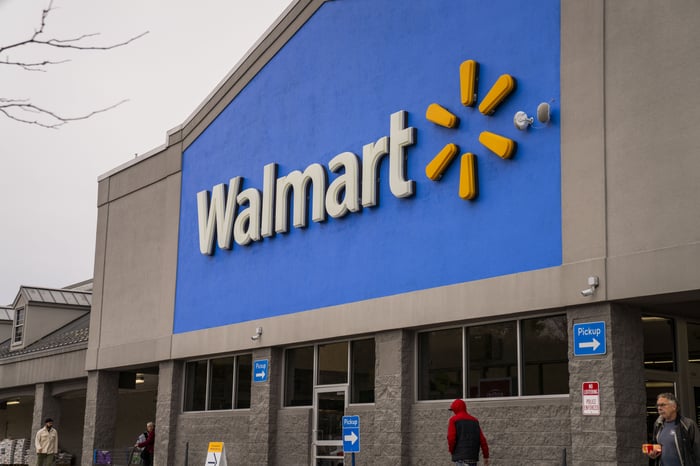
Image source: Getty Images.
Why it fell back out
The drop came fast. Walmart shares tumbled 9% after its August earnings report, not because results were weak, but because the outlook disappointed investors who had priced in perfection. Over the past 12 months, the market cap has fallen about 8%, and the company now ranks 18th globally by value. Part of the issue is that forward price-to-earnings had expanded to nearly 45 times, leaving almost no cushion for a guidance number that came in short of expectations.
What the business actually did this year
Here is what makes me think Walmart's removal from the trillion-dollar club is temporary. In the quarter ended July 31, Walmart posted revenue of $187.9 billion, up 5.9%, beating estimates. Global e-commerce sales grew 23%, marking the 10th consecutive quarter of 20% or better growth for Walmart United States. Operating income jumped 28.8% to $9.38 billion, and on an adjusted constant-currency basis, it rose 17.4%. Adjusted earnings per share came in at $0.81, up 19.1%.
The higher-margin pieces are doing the heavy lifting. Global advertising revenue rose 38%, and membership fee revenue climbed 17%, with Walmart+ net additions hitting a second-quarter record. International membership income grew 28%. Store-fulfilled delivery increased 40% in the quarter. These businesses carry far better economics than moving boxes through a supercenter, and they are compounding.
The tech and logistics build-out
Walmart is no longer really just a big-box retailer in how it operates. By early 2026, roughly 65% of stores were serviced by automated distribution centers. The company has leaned into artificial intelligence, same-day delivery, and expanded pharmacy, which helped drive a 12% increase in memberships. Management also raised full-year fiscal 2027 adjusted EPS guidance to $2.80 to $2.87 from the prior $2.75 to $2.85. That is a company raising expectations, not lowering them.
Why $1 trillion will come back
Do the math on what it takes. Walmart needed about $125.47 per share to cross the threshold in February. The stock now trades meaningfully below that, so the gap is roughly 20% to 22%. With earnings growing near 19% and the e-commerce, advertising, and membership engines all expanding at double-digit rates or better, closing that gap does not require much of a heroic rerating.
The near-term drag is real. Third-quarter guidance calls for net sales growth of only 3% to 3.75% in constant currency, with a 125-basis-point headwind that Walmart expects to persist through fiscal 2027. Tariff refunds of $2.9 billion also boosted recent gross margins and will not repeat.
I also think Walmart is a reliable place where people to shop. There's a certain familiarity and trust that shoppers have with the brand, which gives it a strong position in people's minds. When a company is growing revenue by nearly 6% on a $750 billion annual run rate, while its highest-margin segments are growing between 17% and 38%, the $1 trillion mark starts to look less like a ceiling and more like a level the company could revisit over time.
Micah Zimmerman has no position in any of the stocks mentioned. The Motley Fool has positions in and recommends Walmart. The Motley Fool has a disclosure policy.