
- PRICING
- LIVE QUOTES
- LEARN
- HELP


EN
Hard Egg Innovation (00400) reported net profit surged 96.3%, AI Token factory launched to begin valuation reshaping
The Zhitong Finance App learned that currently, AI computing power is moving from cloud training to edge inference and large-scale deployment. Memory chips benefit from an exponential increase in the number of large model parameters and the continued boom, while embedded intelligence is driving the acceleration of end-side computing power. Thanks to the resonance of the three tracks, Hard Egg Innovation (00400.HK) handed over an interim report card of “increasing profit” on August 31.
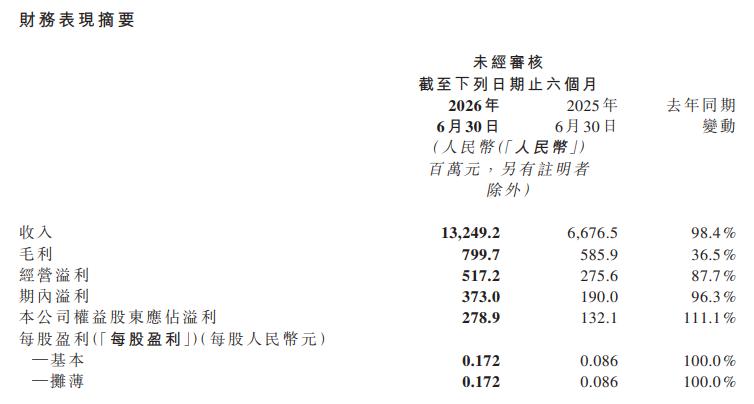
According to financial data, in the first half of the year, the company achieved revenue of RMB 13.249 billion, an increase of 98.4%; against the backdrop of continued demand for AI computing power and memory chips, operating profit of 517 million yuan, a sharp increase of 87.7% year on year; net profit of 373 million yuan, a sharp increase of 96.3% year on year. The three major indicators increased overall, profit flexibility accelerated, and AI strategic transformation momentum continued to be realized.
Meanwhile, the AI Token factory entered the eve of fulfillment. The previously disclosed service orders of more than 1 billion US dollars were officially converted into service contracts. The next five years will contribute a total of more than 1 billion US dollars in service fee revenue, and delivery will begin in the fourth quarter of 2026. The market innovates the pricing logic for hard eggs and is switching to a “token computing power operator”.
Second growth curve formed
Hard Egg Innovation has been deeply involved in the chip industry for 30 years, serving tens of thousands of customers at home and abroad, covering AI computing power centers and hundreds of AI smart terminal industry scenarios, and deeply cooperating with leading global chip manufacturers such as NVIDIA, Intel, AMD, and SanDisk. This basic market is not only the ballast stone for current results, but also provides a ready-made customer pool and supply chain capabilities for new businesses.
Using this accumulation as a foundation, the company is transforming chip resources into deliverable computing power services. Focusing on the demand for intelligent computing center construction, the company has built a comprehensive product matrix covering the core chip and software ecosystem, and transformed upstream chip resources into full-stack computing power services from chip selection to cluster deployment and operation and maintenance. Revenue content is shifting from shipment volume to depth of service.
In terms of physical intelligence, the company anchors edge computing platforms such as NVIDIA Jetson, and has completed the layout from development kits to mass production solutions in the field of intelligent terminals such as robots and drones; SoM-level products developed by Kepler Lab have been shipped in batches to customers such as customs, banks, etc., to provide a complete solution from large cloud models to end-side real-time reasoning for robot “big brain” architectures, and has accumulated benchmark customers such as Meituan, Baidu, and Wenyuan Zhixing in autonomous driving and robotics scenarios. As the pace of mass production for downstream customers accelerates, this sector is expected to become a new driving force for medium- to long-term growth.
Full-stack service capabilities around AI computing power requirements are in place, and storage and intelligent card slots are in place. But what really points to the future is the AI Token Factory.
The core of the Token factory is consumption-based billing — every time a customer's AI application invokes computing power, the company gets a share. The revenue is deeply tied to the customer's business activity, and the revenue pattern changes from one-time delivery to continuous sharing. This model is based on the pace of increasing computing power demand in the vertical industry: terminals such as humanoid robots and drones require continuous operation and reasoning, and are inseparable from the supply of computing power on the end side, yet most vertical enterprises do not have the ability or will to build their own computing power clusters, so third-party computing power services are just what they need.
Hard Egg Innovation built a vertical industry token power scheduling platform, using a dual-track deployment of “own computing power clusters+third-party computing power centers at home and abroad” to avoid the financial pressure of heavy asset expansion; lightweight token computing power output for vertical industries such as humanoid robots and drones reused the company's existing downstream customer ecosystem, and the marginal customer acquisition cost was far lower than that of peers.
On August 24, the five-year contract secured more than 1 billion US dollars in service fee revenue. Delivery began in the fourth quarter of 2026. The computing power network plan covers many Asian countries, with a total computing power of over 100 megawatts. Customers cover the vertical market of first-tier cloud service providers and robots. From the disclosure of intentions in mid-July to the official execution of the contract, it was just over a month. For the computing power service circuit, being able to complete the leap from intention to contract within this time window is the customer's substantial recognition of the business model and delivery capacity. More importantly, the revenue recognition cycle for this contract was five years long, and qualitative changes in the revenue structure began as a result.
Switching of valuation anchors
After the Token factory was launched, the revenue model for Hard Egg Innovation is changing. Naturally, the old framework of pricing based on hardware distribution logic is no longer applicable. There are three reasons.
First, the efficiency of the old model has peaked. Take Ketong Technology as an example: by the end of 2025, the inventory was about 772 million yuan, the number of turnover days was about 21 days, and it could be rotated about 17 times a year. This is an industry-leading level of efficiency, and there is limited room for optimization within the old framework. When the market still prices the company according to the distributor logic, the room for imagination for growth is trapped in the ceiling of this model, and the value of the new business cannot be measured. This is the reason why the valuation logic must be changed.
Second, the pattern of demand is being restructured. Computing power is becoming a standardized service that can be measured, subscribed, and renewed. The consumption method is moving from “centralized procurement” to “pay-as-you-go consumption,” and computing power expenses are changing from predictable fixed asset investments to daily operating costs that change with business fluctuations. For companies, the visibility and sustainability of revenue streams changed, and so did the yardsticks for evaluating the company's value.
Third, the contract model has changed. A five-year contract for the AI Token factory has been completed, and service fee revenue of more than 1 billion US dollars will be shared over the next five years. The significance of this single contract is not limited to the amount; it also provides a replicable model for a complete computing power operation model. Contracts continue to be implemented, the customer pool continues to expand, and the revenue flywheel continues to accelerate. Referring to overseas computing power operators, CoreWeave's contract reserves as of the end of 2025 reached 66.8 billion US dollars, which is equivalent to about 13 times its revenue for that year. Once the model works, the contract size is not linear accumulation, but compound interest accumulation.
The company's revenue model is being reshaped, and financial data have simultaneously confirmed that during the reporting period, operating profit was 517 million yuan and net profit was 373 million yuan, up 87.7% and 96.3%, respectively.
Contract execution starts value reshaping
A five-year service contract was implemented, and more than 1 billion US dollars of service fee revenue was shared over the next five years, with an average annual average of about 200 million US dollars. Delivery of services began in the fourth quarter of 2026. The scale of confirmation was limited during the year, and revenue was gradually released starting in 2027. For computing power operators, this is a yearly payout schedule, and the market prices it because it records a predictable revenue pace in the report.
It is also a business related to computing power, distribution and operation, and the valuation difference is an order of magnitude. Traditional hardware distributors do distribution and supporting services in the industrial chain. Chip distribution is highly dependent on distribution networks, and distribution wins with scale and efficiency. The market sales ratio of leading overseas sellers is generally low. The distribution revenue scale of electronic components is large and profit margins are meager. A low multiple is a reasonable price for low profit margin revenue.
However, AI computing power operators (such as CoreWeave) are completely different. Revenue is contract-locked, predictable, and sustainable. The revenue pattern has changed from “point” to “linear,” and the gross margin structure is far higher than that of the distribution business. As a typical reference, CoreWeave's contract reserves as of the end of 2025 reached 66.8 billion US dollars, equivalent to about 13 times that year's revenue; by June 2026, it had further climbed to about 104 billion US dollars. Currently, CoreWeave's market sales ratio is more than 6 times that of traditional distributors, and the market is willing to pay a premium for this “foreseeable future.”
This logic also applies to hard eggs. Hard Egg and CoreWeave have a common business foundation. The upstream has the same original factory resources, and the downstream has tens of thousands of existing customers. Many of these customers themselves are computing power consumers — turning hardware buyers into continuous computing power customers is a direct path for the Token factory to reuse the downstream customer ecosystem.
Hard Egg's starting point for transformation is higher than most of its peers. Thirty years of accumulated supply chain and tens of thousands of existing customers make it unnecessary to build a computing power ecosystem from scratch. The upstream has obtained authorization from the original factory, and the downstream can find buyers of computing power. The central scheduling platform and the asset-light track keep the financial pressure of heavy asset expansion out of the door.
The pace of transformation also exceeded expectations. From the disclosure of intentions in mid-July to the execution of the contract on August 24, in just over a month, the $1 billion five-year contract completed the leap from intention to signing. Differentiated card slots for vertical industries such as humanoid robots and drones allow it to avoid head-on competition with GM cloud giants.
The five-year contract has already locked in the first revenue stream. The next key is to see if the depth of contract reserves can continue to be accumulated. Once the market began measuring this company on the scale of computing power operators, the migration of the pricing reference frame was completed. The revenue structure of hard eggs is already shifting to service, and the order structure is also moving closer to contractualization. Once the pricing reference frame is switched, the revaluation is no longer an expectation, but a quarterly process of cashing out.
Looking ahead to the second half of the year, the company's customer demand is strong and there are plenty of orders in hand, and management expects the business to continue to grow rapidly. The AI token factory will begin delivery in the fourth quarter, and computing power nodes will gradually be implemented, and the revenue structure will extend from one-time hardware delivery to continuous computing power services. From delivery to sharing, the business model of this path has been verified, and the competitive barriers to hard egg innovation no longer come from a single contract, but from the entire customer network and computing power scheduling system. This is the layout that Hard Egg Innovation is actually doing.