
- PRICING
- LIVE QUOTES
- LEARN
- HELP


EN
China Steel Association: In July, China's exports of 10.121 million tons of steel fell 1.9% month-on-month
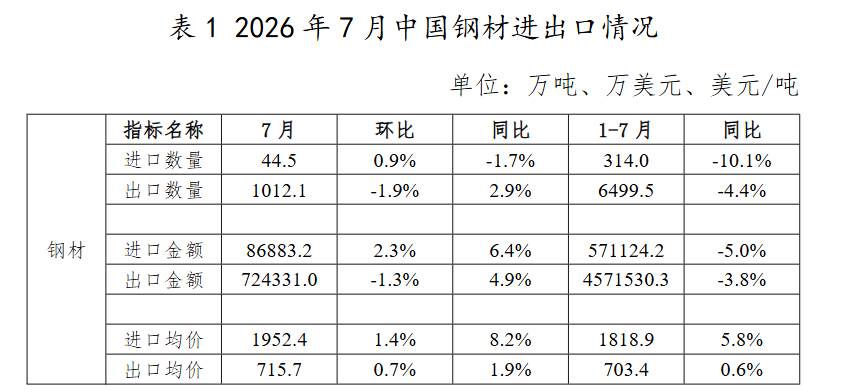
The Zhitong Finance App learned that on September 1, the China Steel Association released a monthly report on the import and export of steel products. In July 2026, China exported 10.121 million tons of steel, down 1.9% month-on-month and 2.9% year-on-year; the average export price was 715.7 US dollars/ton, up 0.7% month-on-month and 1.9% year-on-year. In January-July, China exported a total of 649.95 million tons of steel, a year-on-year decrease of 4.4%; the average export price was 703.4 US dollars/ton, up 0.6% year-on-year.
In July, China imported 445,000 tons of steel, up 0.9% month-on-month, down 1.7%; the average import price was 195.2.4 US dollars/ton, up 1.4% month-on-month and 8.2% year-on-year. From January to July, China imported a total of 3.140 million tons of steel, down 10.1% year on year; the average import price was 1818.9 US dollars/ton, up 5.8% year on year. In July, China's steel and billet exports remained at a high level. Among them, steel exports exceeded 10 million tons for 3 consecutive months, and the average export price rebounded month-on-month; steel billet exports exceeded 2 million tons for 2 consecutive months.
I. Overall import and export situation of primary steel products
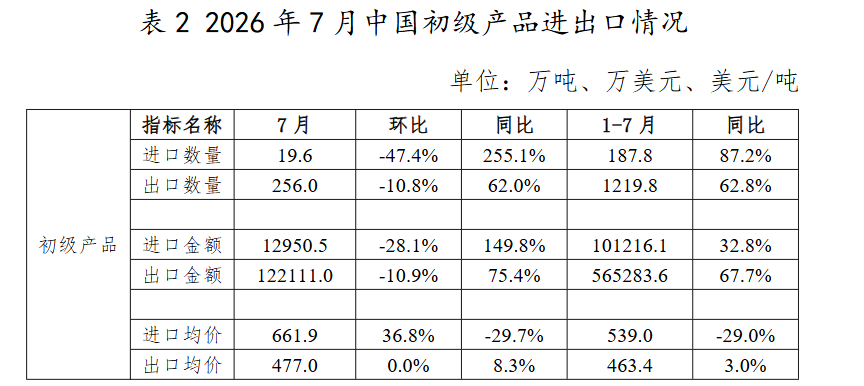
In July 2026, China exported 2.56 million tons of primary products (steel billets, pig iron, direct reduced iron and recycled steel raw materials), down 10.8% from the previous month; the average export price was 477.0 US dollars/ton, which remained flat from month to month. From January to July, China exported a total of 12.198,000 tons of primary products, up 62.8% year on year; the average export price was 463.4 US dollars/ton, up 3.0% year on year.
In July, China imported 196,000 tons of primary products, down 47.4% from the previous month; the average import price was 661.9 US dollars/ton, up 36.8% from the previous month. From January to July, China imported a total of 1.888 million tons of primary products, up 87.2% year on year; the average import price was 539.0 US dollars/ton, down 29.0% year on year.
II. Export situation of steel products
In July 2026, China's steel exports exceeded 10 million tons for three consecutive months, falling month-on-month and increasing year-on-year. By type, exports of long timber have strong toughness, plates are differentiated under pressure, and billet exports remain high. Looking at the subregions, ASEAN's internal trend is divided, GCC exports continue to weaken, and exports to Turkey have more than doubled month-on-month.
Situation by species
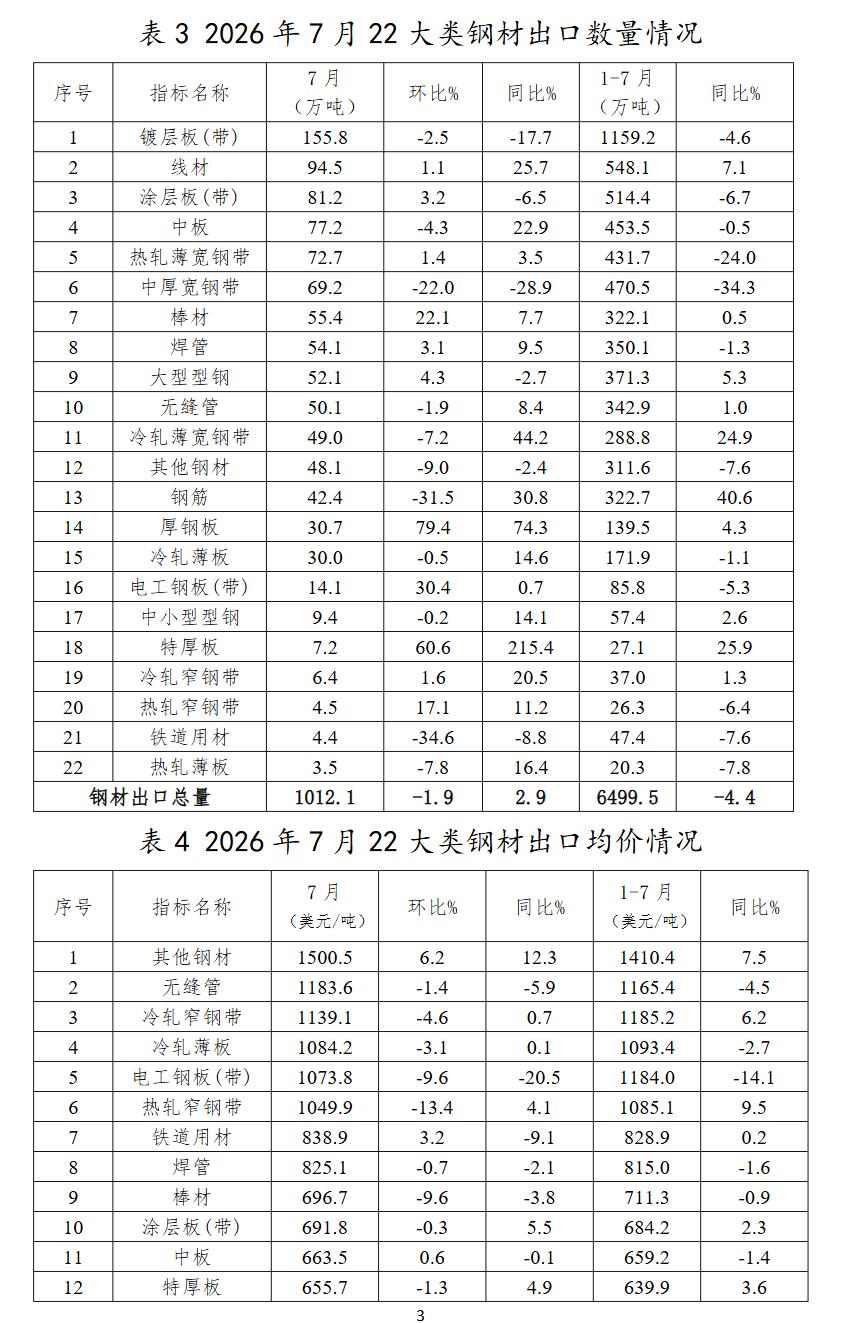
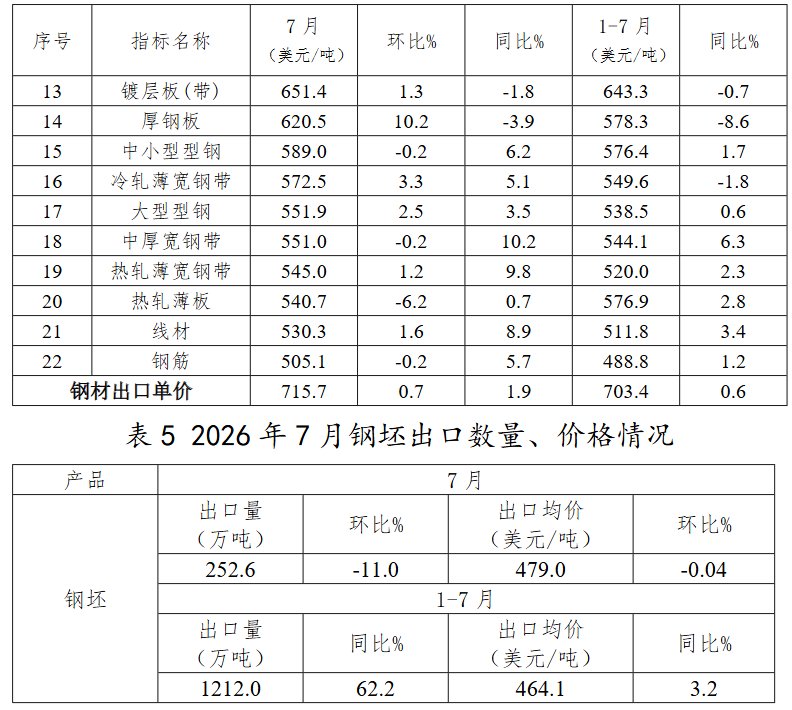
In July, the export volume of 11 of the 22 major steel varieties increased month-on-month, with a total of 10 varieties with a monthly export volume exceeding 500,000 tons. Among the types of export growth, exports of thick steel plates and extra thick plates all increased by more than 60% month-on-month, and electrical steel plates (strips) and bars all increased by more than 20% month-on-month; among the types where exports declined, railway materials, steel bars, and medium thick and wide steel belts all fell by more than 20% month-on-month. In January-July, coated sheets (strips) were still the variety with the largest cumulative export volume, accounting for 17.8% of total steel exports; a total of 10 types achieved year-on-year export growth. Among them, the cumulative export growth rate of bars, seamless pipes, and thick steel plates changed from negative to positive from January to June, and the cumulative export volume of medium thick and wide steel strips still fell by more than 30% year on year. In July, export unit prices for 13 types of products fell month-on-month, with electrical steel sheets (strips) falling the highest, falling 9.6% and 20.5% month-on-month, respectively; thick steel sheets rose 10.2% month-on-month, the highest increase for the month. In January-July, export unit prices for nine varieties fell year-on-year.
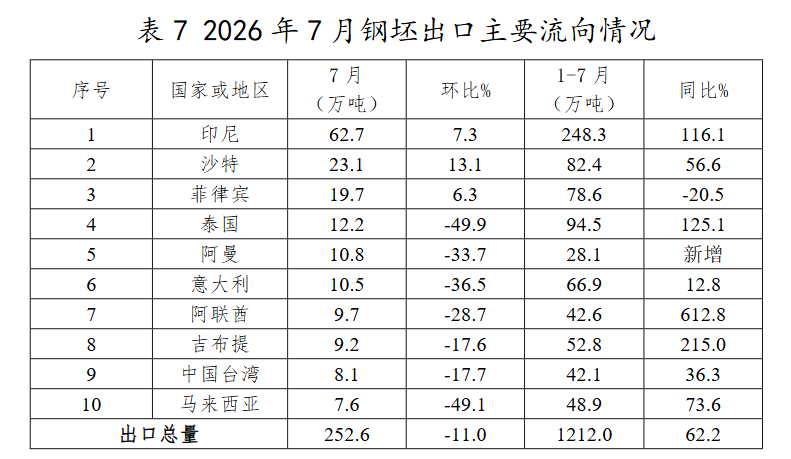
In July, the export volume of steel billets declined somewhat, and prices remained flat. Exports of 2,526,000 tons were exported in the same month, down 11.0% from month to month, exceeding 2 million tons for two consecutive months, at a high level; the export unit price fell slightly by 0.04% month-on-month. From January to July, exports totaled 12.120 million tons, a sharp increase of 62.2% year on year, and the export unit price rose 3.2% year on year.
Subregional situation
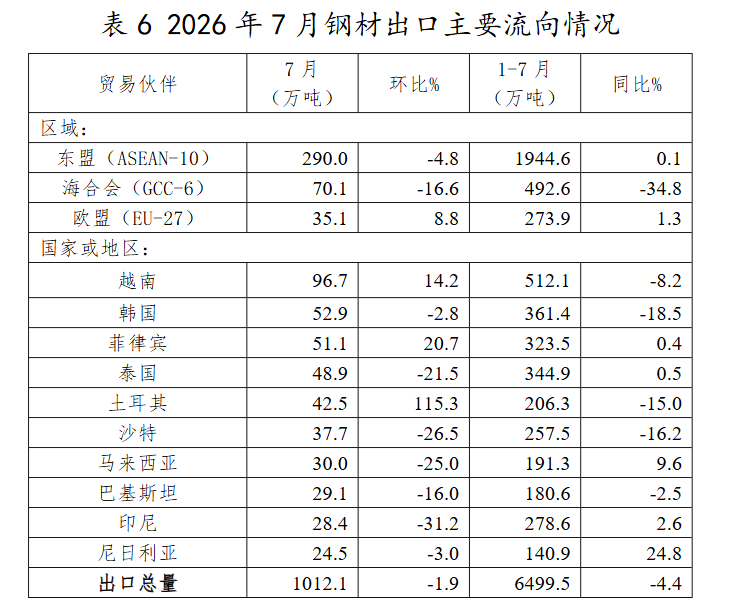
In July, the performance of steel exporting countries was divided. Exports to Turkey increased sharply by 115.3% month-on-month, while exports to the Philippines and Vietnam increased by 20.7% and 14.2%, respectively. Meanwhile, exports to Indonesia, Saudi Arabia, Malaysia, and Thailand declined month-on-month, falling 31.2%, 26.5%, 25.0% and 21.5%, respectively. In January-July, China's exports to ASEAN changed from negative to positive, with a slight increase of 0.1%; exports to the EU increased by 1.3% year on year, but the increase was 9.5 percentage points narrower than in January-June; exports to the GCC fell 34.8% year on year. By country, exports to countries such as Vietnam, South Korea, Saudi Arabia, and Turkey declined significantly year on year. Exports to Nigeria increased 24.8% year on year, making it the country with the most outstanding growth in the African market.
In July, China's steel billet exports declined somewhat month-on-month, with export trends diverging to major destinations. Among them, exports to Indonesia, Saudi Arabia, and the Philippines continued to grow, exports to Thailand and Malaysia fell sharply by nearly 50% month-on-month, and destinations such as Italy, Oman, the United Arab Emirates, Djibouti, and Taiwan Province of China all showed double-digit month-on-month declines. In January-July, among the top ten destinations for China's billet exports, only the Philippines declined year on year. The rest of the markets grew significantly. Oman was classified as a “new increase” year on year due to zero base for the same period last year.