
- PRICING
- LIVE QUOTES
- LEARN
- HELP


EN
AI bonuses continue to be released! South Korea's exports continued to grow strongly in August, and chip exports tripled
The Zhitong Finance App learned that against the backdrop that demand for artificial intelligence (AI) continues to drive chip exports and inject strong momentum into the overall economy, South Korea's exports continued to grow strongly in August. This also gave the Bank of Korea almost no reason to retreat from its newly shifting hawkish stance after two consecutive interest rate hikes.
According to data released by the Korea Customs Service on Tuesday, exports surged 72.5% year on year after adjustment for differences in working days; imports increased 22.5% year on year, achieving a trade surplus of 34.7 billion US dollars in the same month. Unadjusted exports rose 68.7%, higher than the revised 63% increase in July.
Semiconductors remained the primary engine of South Korea's export growth in August. Chip exports soared 209 percent year over year to 46.7 billion US dollars; exports of computer products surged 419%.
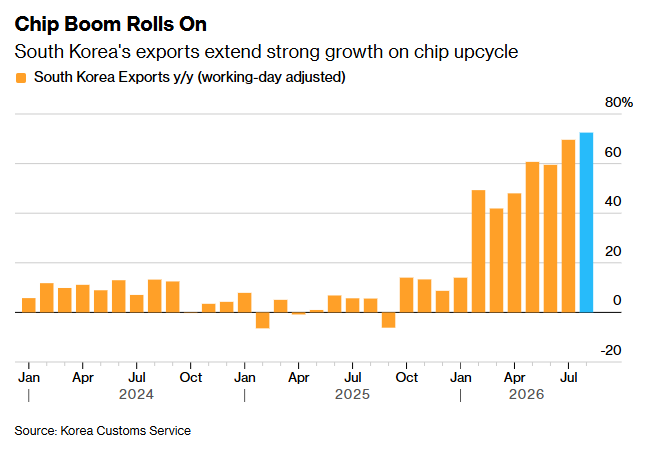
The data shows that external demand remains resilient despite rising energy prices and geopolitical tension putting pressure on other industries. This further consolidates the Bank of Korea's decision to raise the benchmark interest rate by 25 basis points for the second time in a row last week. Meanwhile, the central bank raised the 2026 economic growth forecast from 2.6% to 3.3%, providing more room for policymakers to focus on inflation.
South Korea's overall inflation rate slowed to 2.8% in July, lower than market expectations, but the core inflation rate accelerated to 2.6% after excluding volatile food and energy prices, indicating that potential price pressure is still strong. Meanwhile, the economy grew 0.6% month-on-month in the second quarter, exceeding economists' expectations.
The Bank of Korea remains unchanged in its forecast for price increases, and still expects consumer inflation to be 2.7% this year and 2.3% in 2027. Excluding energy and food price fluctuations, the core inflation rate is 2.5% this year and next, which is a slight increase from previous expectations.
Bank of Korea Governor Shin Hyun-song said that continuous interest rate hikes will help stabilize the foreign exchange market and further strengthen the Korean won. He also pointed out that there is still room for the Korean won to continue to appreciate.
In recent months, the Korean won exchange rate has risen sharply. The exchange rate has broken through the 1,400 won to 1 US dollar mark. Last month, it was the best performer among major Asian currencies. This rebound is expected to help curb imported inflation.
In terms of export destinations, exports to China increased by about 119% in August, and exports to the US increased by 89.3%; exports to India and the European Union increased by 47.3% and 14.6%, respectively.