
- PRICING
- LIVE QUOTES
- LEARN
- HELP


EN
American Express (AXP) Stock Looks Undervalued On Fair Value Yet Priced Right On Earnings
American Express stock has delivered strong long term gains over the past five years, yet current checks suggest a mixed picture where the Excess Returns intrinsic value estimate points to meaningful upside while market based multiples look closer to fair. After recent share price softness this leaves investors weighing whether the current level offers a reasonable entry or already reflects much of the good news.
- Over 5 years American Express has returned about 120%, which puts recent short term weakness into context as a pullback within a much larger move.
- The company’s closed network model and use of artificial intelligence to keep fraud rates low can support confidence in its franchise, while any shift in loss experience or spending trends on its cards remains a key risk for the valuation.
- On Simply Wall St’s broader checks American Express scores a 4 out of 6 value score, which points to a mixed picture rather than a clear bargain or clear overvaluation.
The issue now is whether American Express stock at around US$330 already reflects the intrinsic value suggested by the Excess Returns model or if there is still a reasonable margin of safety.
Spot opportunities beyond American Express by scanning 45 high quality undervalued stocks that pair solid fundamentals with the kind of durable advantages investors look for in payment and financial stocks.Does American Express Look Undervalued on Excess Returns?
The Excess Returns model looks at how much profit American Express can generate over and above the return that shareholders require. For American Express the inputs signal a profitable franchise on a relatively modest capital base, with book value at about $50.79 per share and a stable EPS estimate of $21.47 per share supported by analyst return on equity assumptions.
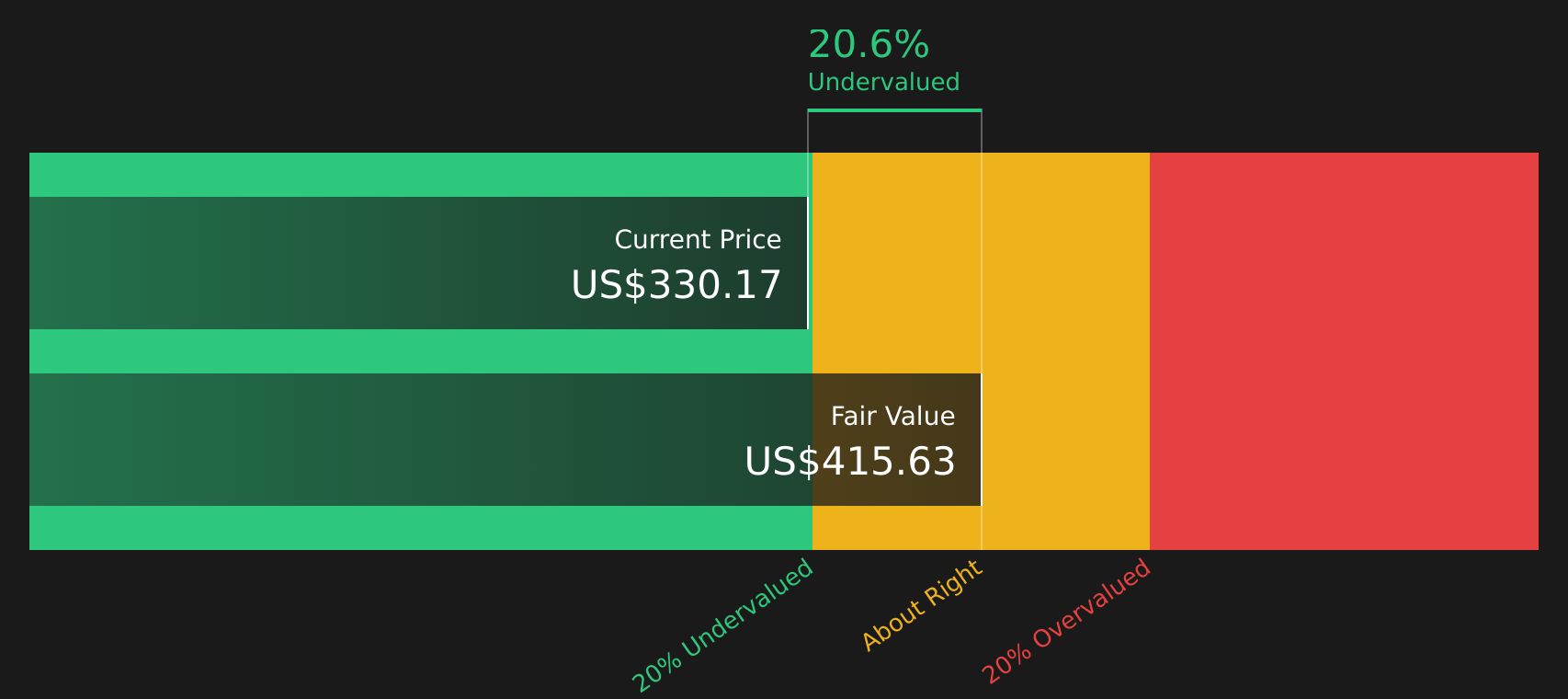
The model assumes an average return on equity of 36.46% and a cost of equity of $4.91 per share, which implies excess return of $16.56 per share and a stable book value moving toward $58.89 per share. On these economics the Excess Returns valuation points to an intrinsic value of about $415.63 per share, which compares to the recent share price around $330 and implies the stock is 20.6% undervalued. Because American Express is reported to maintain the lowest fraud rate among major U.S. card networks thanks to its closed system and use of AI, the market may be assigning a premium for quality that still leaves the stock below this intrinsic estimate.
On the Excess Returns framework, American Express stock currently screens as undervalued relative to the intrinsic value implied by its projected profitability on equity.
Our Excess Returns analysis suggests American Express is undervalued by 20.6%. Track this in your watchlist or portfolio, or discover 45 more high quality undervalued stocks.
Does American Express Look Fairly Valued on Earnings?
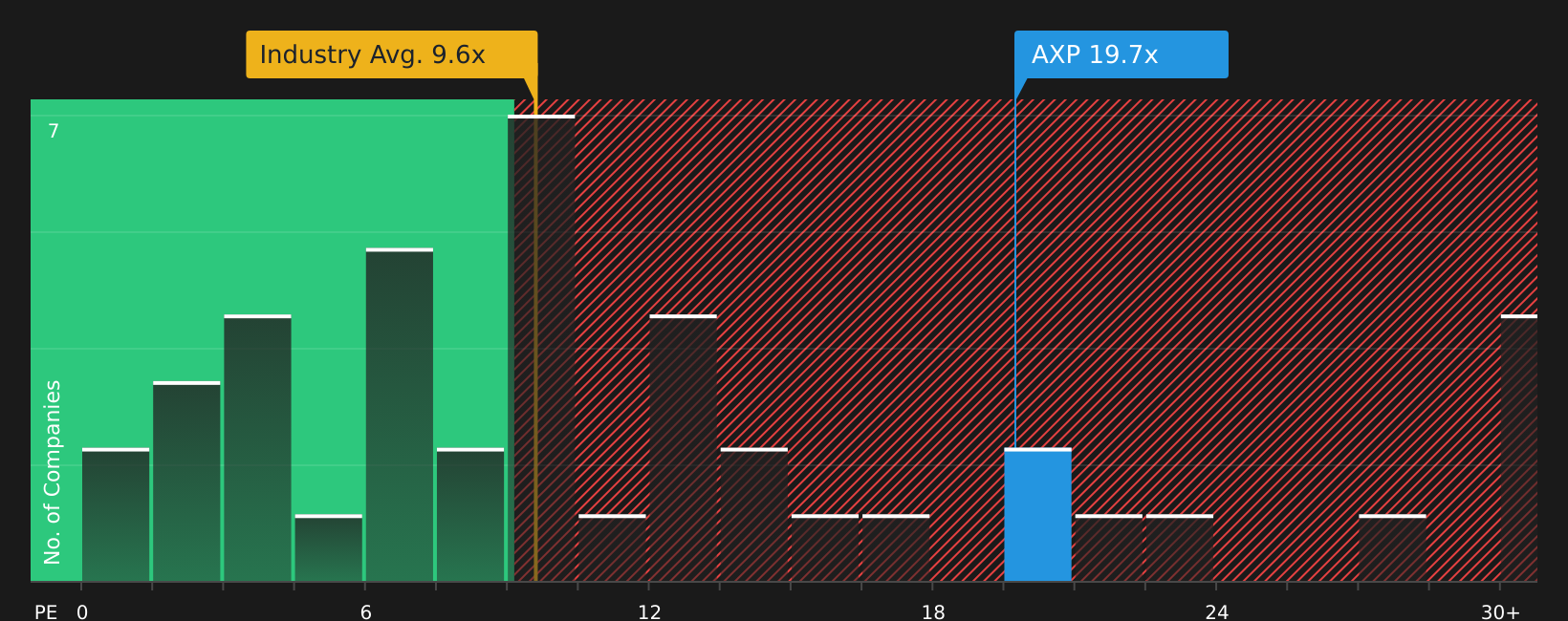
The P/E ratio is a useful way to compare what investors are paying for each dollar of American Express earnings against similar financial companies. Right now American Express trades on a P/E of about 19.7x, which is close to its modelled fair P/E of 19.9x and slightly below the peer average of 20.8x in Consumer Finance. It is also much higher than the broader industry average P/E of 9.6x, which reflects that investors treat American Express differently to more commodity style lenders in the sector.
The fair P/E of 19.9x already builds in what the model sees as appropriate for American Express considering its margins, growth profile, size and risk. With the current P/E only a touch below that level, the multiple does not flag a big discount or premium. Instead it suggests the stock is broadly aligned with what investors might expect to pay for these earnings today.
On the P/E multiple, American Express stock currently looks roughly fairly valued compared with its tailored fair ratio and close peers.
See what the numbers say about this price — find out in our valuation breakdown.
The American Express Narrative: What Would Justify Today's Price?
Simply Wall St Narratives pick up where the valuation contrast for American Express' intrinsic value versus its market multiple leaves off. Narratives spell out which paths for growth, margins and earnings would need to play out for the stock to be worth meaningfully more or less than today, and each ties its outcome to a clear view on how American Express' financial strength, profitability and risks might evolve. This gives you a reference point as fresh information comes through.
Community views on American Express sit quite far apart, with one camp seeing a quality compounder and another focused on valuation risk.
Bull case: 12% undervalued
"Sustained momentum in acquiring younger (Millennial and Gen Z) cardholders, with these groups showing strong spend growth and lower delinquency rates compared to industry averages, suggests a successful strategy in capturing the next generation of affluent consumers..."
Read the full Bull Case to see why American Express could be undervalued
Bear case: 10% overvalued
"However, overall, American Express seems to be overvalued (at least a little) at the moment..."
Read the full Bear Case to see why American Express could be overvalued
Do you think there's more to the story for American Express? Head over to our Community to see what others are saying!
The Bottom Line
For American Express, the Excess Returns intrinsic value estimate points to meaningful undervaluation, while the current P/E suggests the market is already paying a full price for today’s earnings. That gap largely reflects different weight on long term profitability on equity versus nearer term sentiment and peer comparisons. With broader checks sitting in the mixed tier, the key question is whether American Express can keep earning returns on equity that justify the intrinsic value estimate without a material setback in credit losses or customer spending. How that plays out will likely determine whether the current discount is an opportunity or a warning.
This article by Simply Wall St is general in nature. We provide commentary based on historical data and analyst forecasts only using an unbiased methodology and our articles are not intended to be financial advice. It does not constitute a recommendation to buy or sell any stock, and does not take account of your objectives, or your financial situation. We aim to bring you long-term focused analysis driven by fundamental data. Note that our analysis may not factor in the latest price-sensitive company announcements or qualitative material. Simply Wall St has no position in any stocks mentioned.
Have feedback on this article? Concerned about the content? Get in touch with us directly. Alternatively, email editorial-team@simplywallst.com